
Stability balls help posture, fine motor skills
TOM PINNEY/DAILY FORUM
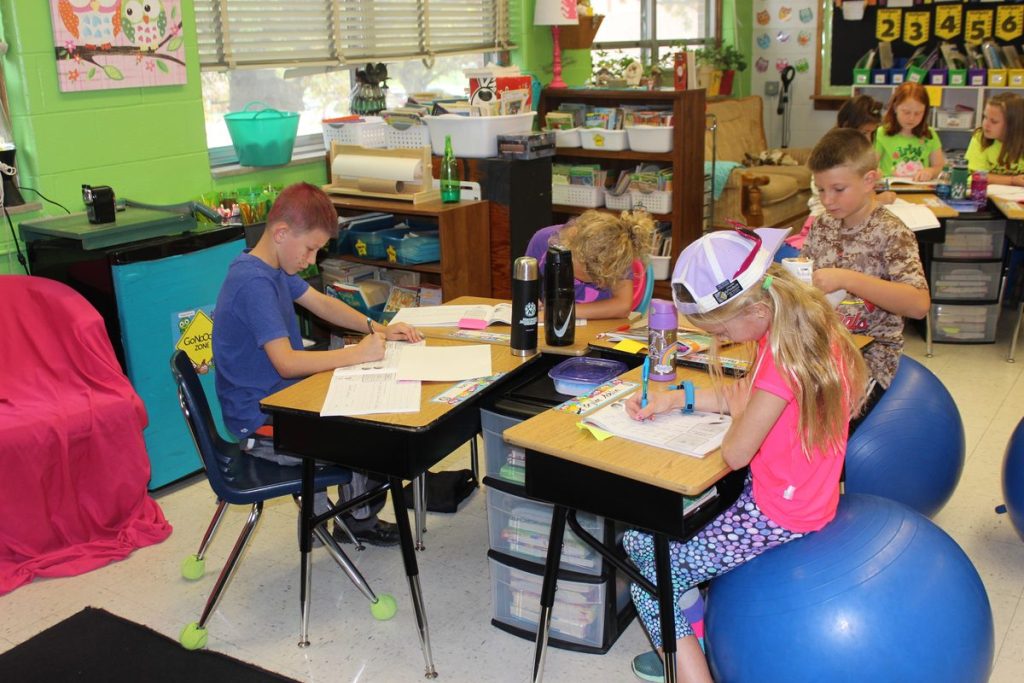
Keeping balance Students in Jamie Casteel’s third grade class sit on “stability balls” instead of desk chairs while they do their work. This is the fifth year Casteel has used the stability balls in her classroom.
In 2000, after successfully incorporating exercise into her curriculum, Fort Collins, Colorado-based elementary teacher Lisa Witt began to develop the first “WittFitt” teacher’s manual and experimented with using stability balls as seats within her classroom. After the move proved successful with her students in not only keeping them active but improving posture and concentration, she left teaching to further develop WittFitt.
Sixteen years later, WittFitt markets a stability ball chair and an adaptive “active sitting” curriculum to schools in all 50 U.S. states, Puerto Rico, and several Canadian provinces.
St. Gregory’s School third-grade teacher Jamie Casteel bought into the curriculum and began replacing chairs in her classroom with stability balls in 2011. She said it teaches the students responsibility very quickly.
“The stability balls come with a curriculum and a contract for the students to sign before the students actually start using the stability balls,” Casteel said. “Then I start implementing the chairs into the classroom.
“Early on, we start out by going a half-hour on the balls, then a half-hour back in normal seats. Before too long, we’ve completely phased the chairs out.”
Of course, the stability balls are not the end-all, be-all in her classroom, as circumstances tend to change.
“Sometimes, if they get injured, they can’t sit on the stability ball because I don’t want to injure them further,” Casteel said. “I’ve never had a student get hurt on the ball, it’s always been during a sport or doing something at home.
“We’re also looking at replacing a few stability balls because they’ve broken. Even then, they are made to just leak air out slowly so that they don’t pop and drop kids to the ground immediately.”
Casteel said the stability balls quickly become the popular choice for the students.
“Often, the students will bring their stability balls to the horseshoe table to work with me instead of sitting in the normal chairs I have around it,” Casteel said. “When they leave my classroom and come back for a visit, the first thing they tell me is how much they miss the chair.”
The difference is immediately noticeable, according to Casteel.
“With the hard desk chairs, students often have to fidget around a bit in order to find ‘the spot’ in the chair which is most comfortable to them,” Casteel said. “With the stability ball, they find it almost immediately, which means less time they spend fidgeting around and more time focusing.”
Improving focus and concentration is one of the obvious benefits of the stability ball, as well as improving posture. However, there was one benefit to the stability ball which is rather intriguing.
“The stability balls are actually shown to improve handwriting,” Casteel said. “It has to do with giving the brain the need to focus on gross motor skills.
“One of the ways to develop the fine motor skills is forcing the brain to focus on the gross motor skills, such as pushing and pulling, then transitioning to fine motor skills. The brain has spent so much time working on the gross motor skills, so a fine motor skill like handwriting becomes easier.”
Casteel said she sees a huge improvement in posture when she pulls out the Chromebooks.
“The students spend time in the technology lab working at computers and working on posture while in those chairs, but then they come into the classroom and work on their Chromebooks while sitting on their stability balls,” Casteel said. “Their posture is so much better.”
However, “active sitting” goes further than stability balls, and St. Gregory’s is implementing different forms of active sitting throughout the building. Some classrooms have added couches, milk carton seats, and standing desks as part of the active sitting curriculum.
Casteel said having multiple forms of seating in the classroom is proving beneficial for the students.
“Non-traditional seating is becoming more popular because of how it aids education,” Casteel said. “We’re learning that some kids learn better in different types of seats.”