Campus pantry organized to ease student hunger
TONY BROWN/DAILY FORUM
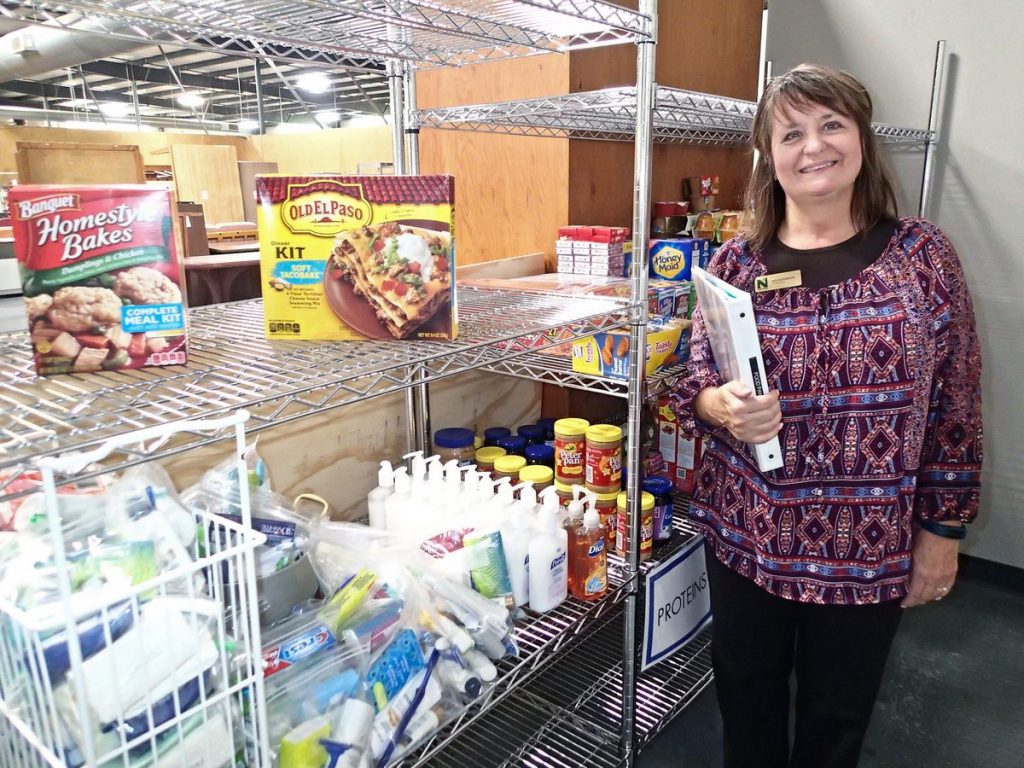
Sue Nickerson, a member of the Pay It Forward Committee at Northwest Missouri State University, stands beside shelves containing non-perishable food items and personal care products available to university students and staff in need through the Pay It Forward Food Pantry. “While working with our Pay It Forward students, we noticed an increase in the need for food and personal hygiene items,” Nickerson said. “We felt that barriers such as food insecurity should not prohibit our students from achieving a college degree.”
Over the decades, the phrase “starving student” has become a sort of half-humorous, half-romantic cliché used to describe the travails of ambitious young strivers navigating the challenging road leading to a college degree and a prosperous career.
But like most clichés, this one springs from the hard truth that higher education in the United States is a very expensive proposition these days — one that for many is shadowed by debt, privation, and genuine sacrifice.
In a town like Maryville and on a campus like Northwest Missouri State University, most people probably seldom, if ever, consider the possibility that some college students go dangerously hungry.
In fact, because of the university’s numerous programs encouraging community service, Bearcats are more generally thought of as the kind of folks who collect donations for various humanitarian efforts rather than standing in need of charity themselves.
But, whether it fits the popular image of college life or not, some students really can’t afford to adequately feed themselves, a situation that a group of Northwest staff members have decided to do something about.
Now up and running, Northwest’s Pay It Forward Food Pantry is spearheaded by the university’s Office of Student Affairs. The initiative grew from a proposal developed by the Pay It Forward Committee, a group founded in 2008 to oversee a loan program and other resources that provide assistance to students who are struggling financially.
“While working with our Pay It Forward students, we noticed an increase in the need for food and personal hygiene items,” said Sue Nickerson, who works as the Student Affairs executive secretary. “We felt that barriers such as food insecurity should not prohibit our students from achieving a college degree.”
The new pantry, located in the Materials Distribution Center adjacent to the University Police Department on College Park Drive, is open 9 a.m. to 9 p.m. daily and staffed by University Police personnel.
Space was provided by Ann Martin, Northwest’s director of purchasing, and committee members have taken responsibility for stocking the shelves with non-perishable foodstuffs and other items.
Nickerson said donations are already arriving at the pantry, which offers a selection of canned fruits and vegetables, boxed pasta, instant meals, soap, shampoo, toilet tissue, feminine products, and toothpaste.
Unlike the Nodaway County Ministry Center pantry on South Main Street, the campus operation does not receive U.S. Department of Agriculture commodities, which means patrons don’t have to provide proof of sufficiently low income. All that is required is a Bearcat ID card and an expressed need for assistance.
As a general rule, Nickerson said, pantry clients, which can include both students and university employees, are limited to two plastic shopping bags of food and toiletries per visit.
Students and staff in need of assistance simply ask for access to the pantry at the University Police service window and display their card.
Rather than setting up eligibility guidelines and asking people to fill out paperwork, Nickerson said the committee decided it would be better to rely on the honor system so that people can stop in at the pantry quickly and easily and keep their dignity intact.
“If they are here, we assume there is a need,” she said.
Now that the Pay It Forward operation is up and running, Maryville has two food pantries, and the Rev. Jonathan Mitchell, pastor of the First Presbyterian Church and a member of the Ministry Center board of directors, says that’s just fine.
Mitchell said the Pay It Forward group discussed its plans with the Ministry Center board before moving ahead, and that he has no worries that the two organizations will be competing for resources, food donations, or monetary gifts.
The main thing, he said, is that the people who can’t afford to buy food get enough to eat.
Mitchell said a fair number of Northwest students use the Ministry Center pantry each year, especially toward the end of the fall and spring semesters, and that having a pantry on campus will make it easier for campus residents who don’t have access to a vehicle.
“This is very much a cooperative effort,” Mitchell said. “The Ministry Center supports it. It’s one more way to support the community.”
As for Nickerson, she said helping get the pantry off the ground has served to increase her own awareness about food insecurity, which, on a campus filled with young, active, people glowing with health and optimism, tends to remain a hidden problem.
“It’s opened my eyes,” she said. “I grew up in Maryville, and you don’t always realize that there are people without enough food.”
Anyone wishing to donate non-perishable food items and personal care products to the Pay it Forward Food Pantry can do so at the Student Engagement Center in the J.W. Jones Student Union or at the University Police Department.
Monetary donations should be directed to the Northwest Foundation and are tax deductible. University employees can support the effort by completing a Faculty and Staff Annual Giving Campaign form and designating a gift to the Pay it Forward Food Pantry.
Northwest’s Pay It Forward Committee consists of Nickerson; Edward Gibson IV, coordinator of diversity and inclusion; Becca Lawrence, director of equity and accessibility; and Amee Wilmes, senior assistant director of federal and state programs in the Office of Financial Assistance.
The Food Pantry Committee consists of Gibson, Nickerson, Lawrence, and Wilmes as well as University Police Chief Clarence Green; Anne Long, senior human resources generalist; Spencer Martin, senior food service director; Lori Steiner, executive director of advancement services in the Office of University Advancement; and Alex Taylor, Greek Life graduate assistant.