Meter replacement to raise water bills for some users
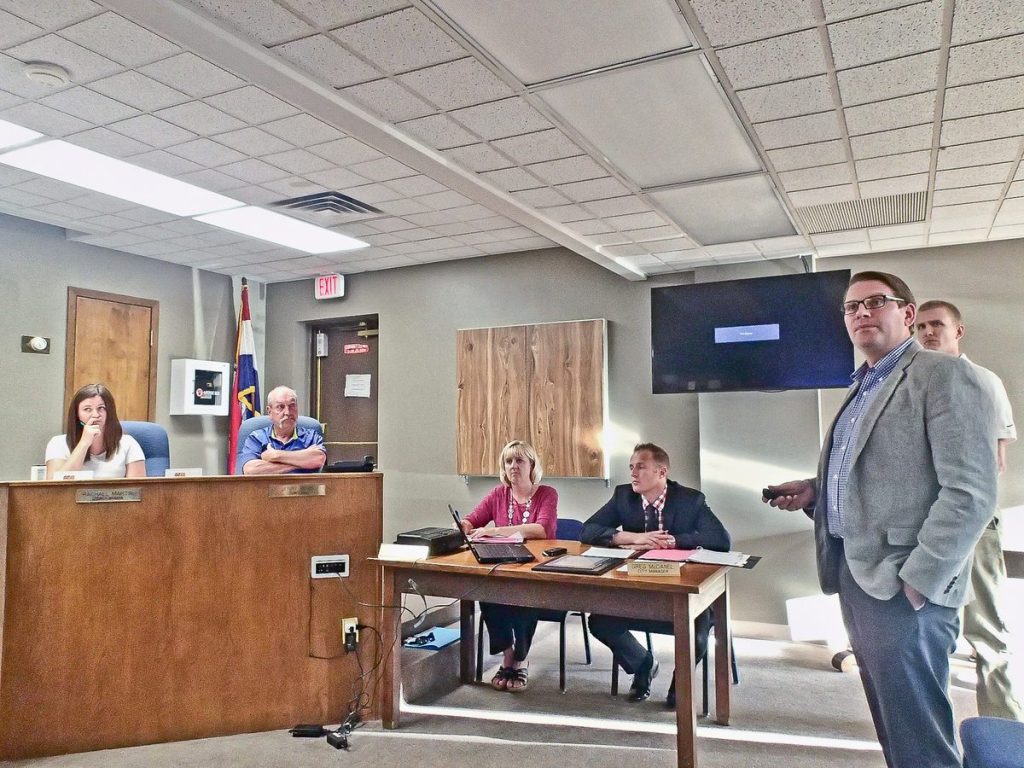
FILE PHOTO
Schneider Electric’s Peter Hinkle, shown standing in sports coat at right, addresses the Maryville City Council back in July with regard to his company’s proposal for replacing all of the city’s 4,200 water meters with machines offering greater accuracy and remote-reading capability. Hinkle said an audit of 144 sample meters shows Maryville’s system to be 90 percent accurate with most of the faulty meters located at commercial and industrial sites.
The vote by the Maryville City Council this week was unanimous, and so were the misgivings.
But despite worries about public perception, the five-member council approved replacement of Maryville’s approximately 4,200 aging water meters with new generation devices designed to provide near-perfect accuracy and instant remote-reading capability.
Council members Renee Riedel and Jerry Riggs both said the meter upgrade, to be performed by Schneider Electric, a multi-national corporation specializing in energy efficiency and automation, makes sense from a “business” perspective. However, each voiced concerns about negative citizen reaction to the project.
That’s because the upgrade is to be paid for in large part with additional revenue from water customers currently under-billed because their existing meters are inaccurate.
Peter Hinkle, Schneider’s Midwest sales team leader, told the council following a test of 144 sample meters this summer that the city’s meter network is currently 90 percent accurate with most of the faulty machines located at commercial and industrial sites.
So, while water rates won’t increase, at least not to pay for meter replacement, water bills for a significant number of businesses and homeowners will.
Customers whose current meters accurately measure water usage won’t see any change.
The council’s fear is that meter replacement will be perceived as a rate hike, even though, in reality, the city will simply start billing customers for water they are currently using for free.
In Maryville, the water and sewer budget is classed as an “enterprise fund,” meaning that costs associated with those services are supposed to be paid by user fees rather than taxes. In that sense, improving meter accuracy simply means the city will be able to collect what it is owed.
But citizens might not see it quite that way, said Riggs, who noted that voters have just approved a pair of sales taxes earmarked for general operations and new development at Mozingo Lake Recreation Park and next spring will likely be asked to renew an existing half-cent municipal sales tax for capital improvements.
“I’m having trouble getting my arms around this,” Riggs said, noting that the meter project, as outlined by Schneider, will not only pay for itself but provide the water and sewer fund with quite a bit of new money.
The company’s projections show that replacement will produce efficiency-related savings and increased revenues totaling about $7.8 million over 15 years. Of that amount, $3.6 million will be paid to Schneider for installation of the new system, leaving a net improvement in the city’s bottom line of nearly $4.2 million.
While the city could spend that money in any number of ways, City Manger Greg McDanel and Public Works Director C.E. Goodall said significant costs are on the horizon for Maryville’s drinking water system, and that uncollected money from water usage is not only owed but needed.
For example the microfiltration membranes purchased several years ago for the water treatment plant could reach the end of their useful life in as little as two years, Goodall said, and require up to $3 million to replace.
McDanel said he recognized the meter project poses something of a public relations problem since — as opposed to new streets and conference centers, like the one soon to be constructed at Mozingo Lake Recreation Park — underground water and sewer installations are “out of sight and out of mind.”
“But it is a major part of our infrastructure,” he said, “and the water and sewer fund is an enterprise fund.”
Riedel said she was skeptical following Schneider’s original presentation back in July and thought the proposal sounded a little too much like a business pitch.
However, subsequent discussions with McDanel and Goodall, she said, changed her mind.
“You are our paid professionals,” Riedel said. “I’m going to support you when you say we need something.”
In other business during its regular Monday session, the council approved an ordinance containing ballot language proposing a transient guest tax proposal to be placed before voters living inside the city limits during the Nov. 8 general election.
Commonly referred to as a bed tax, the levy, if approved by a simple majority, would add a 5-percent surcharge to local hotel bills.
Most of the resulting revenue — $3.45 million over 23 years — would be used to help pay for a new $20 million indoor athletics facility and special events center at Northwest Missouri State University. The remaining income, projected at about $65,000 a year, is to go for projects associated with tourism and economic development.
While the university, and especially athletics, would have priority in terms of facility use, McDanel said a committee made up of Northwest and civic leaders will be charged with ensuring the center is also available for community events and activities, including trade shows, large gatherings, concerts, Maryville Parks & Recreation programs, and personal fitness.
Additional measures approved by the council this week include:
• A lot split at 1315 E. Jenkins St. related to construction of a new Habitat for Humanity house.
• Approval of land leases for hangars at Northwest Missouri Regional Airport.
• Ordinances providing for the sale or lease of heavy equipment formerly used by the city to operate the solid waste transfer station north of town. The equipment is to be turned over to Maryville Transfer LLC, a consortium of private waste haulers that recently leased the facility and is running it as a private business.
• Repair of a failing pump at the Mozingo Lake water intake facility by Allied Systems Inc. at a cost of $21,050.
• Annual adjustment of property tax levies providing revenue for the city’s General Fund, Maryville Public Library, Parks & Recreation, and municipal debt retirement.
The General Fund levy will increase from $0.3415 per $100 of assessed valuation to $0.3555, and the library and parks taxes were both raised a fraction of a cent. Maryville’s debt service tax was lowered from $0.1352 to $0.1290.
All four levies combined add up to $1.0536 per $100 of assessed valuation, which compares to $1.0347 in 2016, a difference of $0.0189.