Lettuce Dream complex nears completion
TONY BROWN/DAILY FORUM
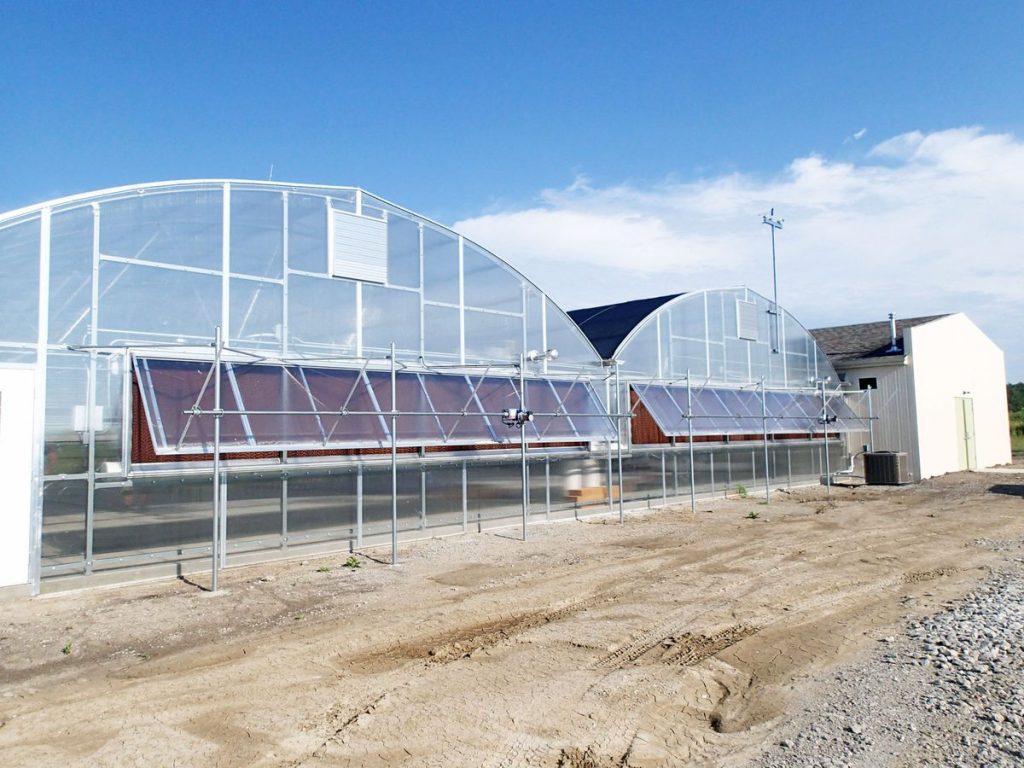
The greenhouse complex built by Lettuce Dream, a local non-profit seeking to provide job training for young adults with developmental and cognitive disabilities, is nearing completion at the newly constructed intersection of East Second Street and Che Drive on the east end of town. The first crop of hydroponically grown lettuce is to be planted in September with training modules for clients set to begin shortly after the first of the year.
While the plumbers and electricians still have some work to do, the Lettuce Dream greenhouse complex sprouting up in a new retail complex just west of the East First Street/Highway 71 intersection is nearing completion.
When fully operational early next year, the operation will produce hydroponically grown lettuce for area grocers and restaurants while providing progressive levels of job training for people with developmental and cognitive disabilities.
Since groundbreaking ceremonies were held in late April, crews led by construction manager Jeff Smith have erected two interconnected 35-by-96-foot greenhouses and a 32-foot-by-62-foot operations building.
All three structures have concrete pad foundations, and the operations building was erected using pre-fabricated, interlocking poly-acrylic beams filled with insulating foam and concrete. The greenhouses consist of metal framework covered with translucent acrylic panels.
An automated weather station sits atop one of the greenhouses and will transmit information about outdoor conditions to a computerized device controlling four suspended natural gas heaters that, in the winter, will ensure a minimum growing temperature of 45 degrees.
While the exterior of the alternative agriculture facility is essentially complete, Lettuce Dream board President Diane Francis said a fair bit of work remains before a trial lettuce crop is planted in September,
Installation of propagation and cultivation tables should happen toward the end of this month, Francis said. The structures will support “gullies” — long gutter-like structures — designed to hold lettuce plants grown in nutrient-enriched water rather than soil.
The non-profit organization’s first goal is to establish a crop rotation for moving plants from the propagation area through two sets of cultivation tables designed for young and mature lettuce prior to harvest.
Francis said Lettuce Dream staff and volunteers will be joined this fall by horticulture students from Northwest Missouri State University in working to make the facility operational.
“We need to learn ourselves,” Francis said, before providing services to “trainees,” the term used to designate area residents with various disabilities who will be Lettuce Dream’s clients. “We’ll need to spend a couple of months experiencing it and getting the bugs worked out.”
Francis said that soon after the first of the year she hopes to have two groups of trainees, consisting of eight to 10 people each, helping grow subsequent lettuce crops while working through several planned skill modules.
Just what objectives those modules will contain is still being worked out, and Francis said Lettuce Dream’s Education and Training Committee is to meet next week with consultant Wendie Blanchard, who founded a similar greenhouse operation — Arthur & Friends — in New Jersey.
Once the lettuce is under cultivation, Francis said Lettuce Dream hopes to host a series of open houses, probably in November, so that members of the public can tour the complex.
Also in November, Francis said, the organization will likely hire an employment facilitator, whose job will be to work with trainees, as well as volunteers, job coaches, interns, and others, in getting the initiative’s education and job placement programs on track.
The facilitator, who may be part-time at first, will report to Lettuce Dream Director Jackie Allenbrand, who was hired this year.
Allenbrand earlier established the P.H.A.R.M. Dog USA program in conjunction with the University of Missouri’s AgrAbility initiative. That effort provided specially trained dogs to farmers coping with physical disabilities.
Once they are operational, Francis said, one greenhouse will function largely as a training facility while the other will be dedicated to production. Though job training, rather than on-site employment, is the primary goal, Francis said some clients, as their skills improve, could be placed in minimum-wage production jobs while helping train others.
Asked how Lettuce Dream might be affected by new federal rules requiring sheltered workshop clients to be paid minimum wage and mainstreamed into the private sector, where they would work alongside non-disabled employees, Francis said the guidelines appear to support her organization’s goals.
The rules specifically target disabled workers between the ages of 18-24, which is roughly the target demographic Lettuce Dream seeks to serve with post-secondary training designed to prepare people for employment in a non-sheltered environment.
Francis said few opportunities for job training exist for young adults with developmental disabilities after they leave high school, and that Lettuce Dream is intended to accomplish just that.
“We’re not giving people an opportunity to grow after they get out of high school,” she said. “Most people at that age still need several years of growth and maturity. This is a place where some of that can occur.”
Applications for potential Lettuce Dream trainees are not yet available, but should be later this fall, according to Francis, who said the organization plans to work with area school districts.
On other fronts, the group is organizing a couple of fundraisers, including a Lettuce Dream table night at the Pizza Ranch restaurant and No-Shave November, during which men and women will be asked to seek donations in exchange for not shaving their faces or legs.
Francis said Lettuce Dream is also working out details about where to sell its first lettuce crop. Possible buyers include the Maryville Hy-Vee supermarket and the Wabash Junction restaurant in Stanberry. Additional buyers have expressed interest, but Francis said the organization is waiting until it has a handle on production before making any commitments.