
Senator Pearce, others explore omnibus bill
TOM PINNEY/DAILY FORUM
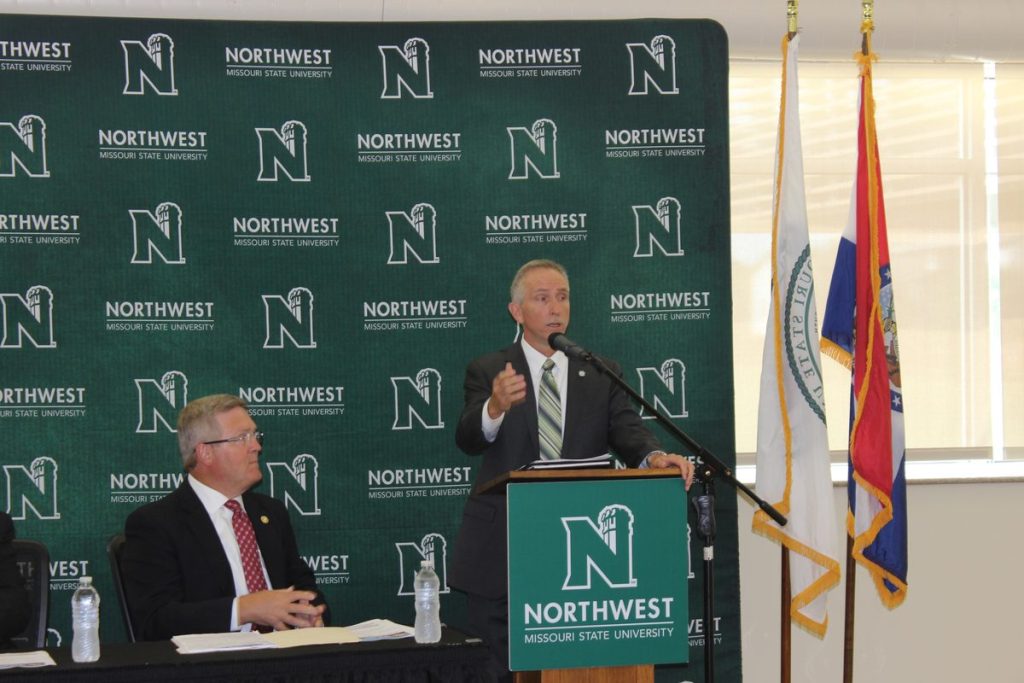
Dr. Jasinski addresses the audience at a forum for Senate Bill 997 Monday. Senator and bill sponsor David Pearce (left), Representative Allen Andrews, and former Representative Mike Thompson were also on hand to answer any questions.
On June 16, Governor Nixon signed Senate Bill 997 into law in Missouri. An omnibus bill for education, Senate Bill 997 had many provisions and ordinances for higher education institutions in the state.
Perhaps the most important impact from the bill is the ordinance to make general education credits uniform across the state so that those credits can transfer between institutions without issue.
The bill also reinstates and extends the Wartime Veterans Survivor Grant, establishes a Coordinating Board for dual credit courses, and implements a “15 to Finish” act which requires universities to educate students on the importance of graduating on time.
On Monday, the bill’s Sponsor, Senator David Pearce (R-Warrensburg), came to Maryville to discuss the bill and it’s functions. Also on hand to talk about the bill were State Representative Allen Andrews (R-Grant City), former State Representative Mike Thompson, who now serves on the State Coordinating Board for Higher Education, North Central Missouri College President Dr. Lenny Klaver, Missouri Western State University External Relations Director Brandt Shields, and Northwest Missouri State University Dr. John Jasinski.
In his speech, Thompson explained that the process to get to the bill took lots of legwork on the part of the Coordinating Board and the sponsoring legislators.
“We went to colleges and universities around the state, and we talked to students, faculty, and stakeholders alike,” Thompson said. “With the information we gathered, we put together a plan to bring Missouri education forward.”
Representative Andrews explained the bill was necessary because Missouri is falling behind, and most of that regression is due to the fact that people can’t have their credits transfer.
“We’re 47th in the nation in economic growth,” Andrews said. “I’m not satisfied with that. But this bill brings our education system closer to being as efficient as possible.”
Dr. Jasinski said the bill was really a joint effort between the state legislature and the schools throughout the state.
“How many of us are affected by the performance of our higher education institutions?” Dr. Jasinski asked. “This bill applies to all of us, from students and faculty at the university to members of the Maryville community and the communities surrounding all universities.
“If our universities function well, we all function well.”
For Northwest Missouri State University, this bill doesn’t change much in the way of general operations for now. According to Provost Dr. Timothy Mottet, Northwest has already implemented meta-majors, which are designed to benefit students with multiple degree paths and allow them to graduate with requisite proficiencies within four years.
In addition, Dr. Jasinski announced his intention to have Northwest Missouri State University act as a pilot school for the concurrent enrollment program created by the bill.
“It simply means students are dual enrolled at Northwest and North Central Missouri College, or Northwest and Metropolitan Community College,” Jasinski said. “It will allow for ease of transfer and will obviously be more efficient relative to getting students through the pipeline to graduation.”
Dr. Klaver used his speaking time to thank Thompson, Pearce, and Andrews for their work in Jefferson City to make college more accessible. Mr. Shields similarly thanked the Board for their involvement in the matter after noting his first applause in Maryville.
“Higher education is huge to economic development,” Shields said. “This bill allows us to get amazing results from our students.”
While Senate Bill 997 focuses on accessibility and affordability of college, Pearce acknowledged the bill was, in some ways, incomplete.
“Some degree programs require more than 120 or 124 credit hours for completion, and we recognize that as a blind spot for this bill,” Pearce said. “There are some degree programs that will not and should not be brought down to 120 credit hours, but if there are some degree programs that we can bring down to that limit, everyone still wins.”
Pearce also mentioned the ability to offer incentives to graduates.
“They have a program in Texas where, if you graduate on time, part of your debt is forgiven,” Pearce said. “This bill gives us the ability to start that here.”
The incentives to graduating on time, however, would not be extended to those longer programs.
Despite the issues, Dr. Jasinski explained that such a bill was incredibly important for the state’s educational system.
“The specifics of this bill are imperative to future educational success,” Jasinski said. “We’re proud of our performance, but we can’t rest on our laurels.”




