
Districts see value in crisis plans
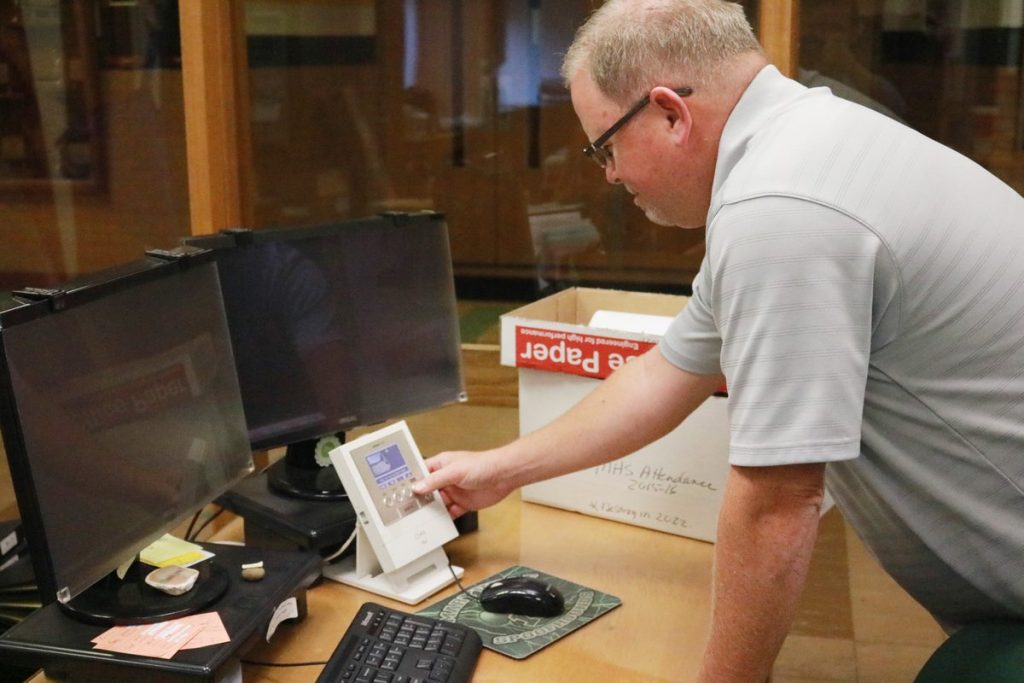
Maryville Assistant Superintendent Steve Klotz demonstrates the district’s recently installed secured entrance system. The device allows the office to see who is requesting entrance at the main door, which remains locked during school hours, before allowing entry. Every school in the Maryville school district is now equipped with the secured entrance, as is St. Gregory school, West Nodaway, North Nodaway, and South Nodaway.
As the first day of school nears, school supplies are being purchased in preparation for registration days and open houses. Something that isn’t normally thought of in conjunction with the start of school, but equally necessary, is the practice by administrations and their staff toward crisis prevention.
Known as Emergency Operations Planning, districts continuously work to make sure students are as safe as possible in the case of all types of potential emergencies.
What once included tornado and fire drills, emergency plans now include material regarding school shootings, bomb threats, and intruders.
Districts in Nodaway County have reached out to both local and statewide resources in regards to their EOP including law enforcement, Missouri School Board Association, and the Missouri Center for Education Safety.
Schools with multiple district buildings, like Nodaway-Holt, and Maryville, must have building-specific plans regarding situations like natural disasters and emergencies.
Maryville Superintendent Becky Albrecht said it’s important for details of those plans to be clear, concise, and public.
“We post simplified emergency procedures and evacuation routes in all classrooms,” she said. “We conduct multiple trainings for staff, including round table discussions, drills, and simulations. We also conduct multiple drills with students and staff during the school year.”
Nodaway-Holt Superintendent Karma Coleman said the district has had a crisis plan for some time, but situations at the national level moved her to look into possible updates.
“A year ago we decided to review our crisis plan due to all the situations that seemed to be occurring,” she said. “We started the review process by having MCES come in and do a risk assessment. We have a committee in place that began breaking down and analyzing our crisis plan and making changes based on the risk assessment.”
Coleman agreed with Albrecht that it’s important to make sure there is action added to the plan itself.
“There is value in having a plan in place before something happens, but a crisis plan as a written document isn’t helpful during the crisis. It’s running drills and training regularly that is most helpful,” Coleman said.
Coleman noted that crisis management doesn’t just include incidents in the school. Nodaway-Holt was forced to utilize its crisis plan last year when the death of a student required the district to provide grief counseling and other resources to the students and staff in the district.
One-building school districts, including Northeast Nodaway, may have it easier than multi-building school districts, but must still make sure plans are efficient.
A current building project to create a breezeway between Northeast Nodawy’s agriculture building and the school closes off an unlocked door to the main building that could be seen as a security risk.
Superintendent Jeff Mehlenbaher said it’s important for administrations to continue to seek out security flaws in their districts.
“Our safety procedures cover instances of drug use, sexual assault, abduction, intruders, suicide, earthquakes, tornadoes, weapons, and bomb threats,” Mehlenbacher said of the school’s EOP. “The steps taken include an annual review of the procedures to determine if changes are needed. Dates are scheduled throughout the year to review particular instances in more depth.”
Much like Northeast Nodaway’s plan to limit unsecured entrances into the building, school districts countywide have looked into enhanced security measures. If they haven’t already, every district has worked to monitor every entrance with a camera system that allows the office staff to see who is at the door and allow entry upon request.
North Nodaway, South Nodaway, and West Nodaway currently have those systems in place. Maryville will have the secured entrance systems in place in every building by the fall, and Nodaway-Holt has looked into the system for its school, but at a price tag of $30,000 to $50,000 per building, the procedure doesn’t come cheap.
Nodaway-Holt, Jefferson, and Northeast Nodaway have instead limited outside entrances to one door, which is located near the office to enhance security measures as much as possible.
Private schools too have taken precaution with security measures. St. Gregory’s elementary school now has the secured entrance system, as well.
Because of the college student traffic throughout the day, Horace Mann is limited on its security options.
The school has closed all entrances to the building except the middle doors with a secretary now placed at the entrance to check in all guests.
The secured entrances at Maryville were installed late this spring in an effort to continue EOP improvements.
“Last summer our district completed a risk assessment through MCES and an online evaluation through the US Department of Education’s Readiness and Emergency Management for Schools Technical Assistance Center. Results were used to help us update our plans and practices.”
As difficult as it is for administration and faculty to discuss what to do during emergency situations, superintendents acknowledge the fact that such happenings can happen. While every detail of those plan aspects aren’t made known to the public for security reasons, it is important to let the patrons know such plans are in place for the safety of the students. Those plans are shared with local law enforcement so everyone knows how to react if a situation does arise.
“Making the plan known to everyone involved is extremely important to help all staff and responders coordinate quickly and efficiently,” Albrecht said.