
Council weighs water meter replacement proposal
TONY BROWN/DAILY FORUM
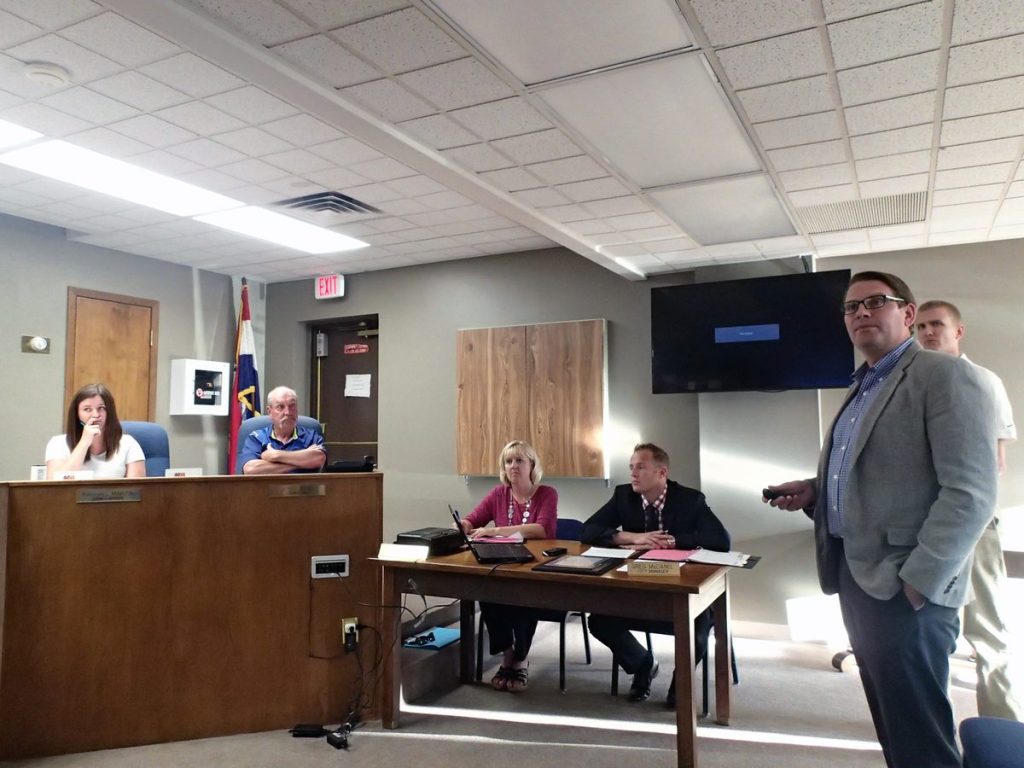
Schneider Electric’s Peter Hinkle, shown standing in sports coat at right, addresses the Maryville City Council on Monday with regard to his company’s proposal for replacing all of the city’s 4,200 water meters with machines offering greater accuracy and remote-reading capability. Hinkle said an audit of 144 sample meters shows Maryville’s system to be 90 percent accurate with most of the faulty meters located at commercial and industrial sites.
The Maryville City Council on Monday listened to a “mid-term project review” by representatives from Schneider Electric, a multi-national company specializing in energy efficiency and automation commissioned back in April to conduct an “investment grade” audit of the city’s water meters.
Maryville’s drinking water delivery system contains just over 4,000 meters of various makes and models, many of which are at least 20 years old. About 2,400 of those meters, all of which must be manually read, are hooked up to homes and apartments.
Public Works Director C.E. Goodall and his staff have been discussing the possibility of a large-scale meter upgrade for some time, but thus far the city has lacked the funding to move forward.
But should the council accept the proposal currently being put together by Schneider, Maryville would replace all of its existing water meters using projected savings derived from more accurate, automated readings plus reduced costs related to materials, labor, and maintenance.
In other words, Schneider believes a significant number of existing meters are inaccurate, and that replacing them will increase monthly charges for customers who are currently under-billed.
The firm’s findings are based on recently completed testing of 144 sample meters used to measure consumption by both commercial and residential customers.
Peter Hinkle, Schneider’s Midwest sales team leader, told the council that that the audit shows Maryville’s water meter system to be 90 percent accurate with most of the faulty meters located at commercial and industrial sites.
Hinkle said that by replacing meters the city would realize increased revenue and savings totaling $7.8 million over about 15 years, $3.6 million of which would be paid to Schneider for installation of the new system.
That leaves a net improvement in the city’s bottom line of nearly $4.2 million, which City Manager Greg McDanel would be used for future water system infrastructure upgrades.
While that may sound like a good deal, a couple of council members pointed out that much of the bigger bottom line would come from higher water bills.
Hinkle said testing indicates existing meters are operating within an accuracy range of 72 percent to 100 percent. So, once replacement is complete, municipal water customers whose machines are less than spot on will see an increase in their monthly bills.
While those customers are essentially receiving free water, Councilwoman Rachael Martin said she fears some residents will feel the city is being unnecessarily aggressive in trying to collect payment on every drop moving through the tap.
“This is so accurate,” Martin said. “In my mind it’s kind of like overkill.”
Martin’s fellow council member, Renee Riedel, said she is also concerned about the perception that the city wants to replace meters to boost revenues rather than simply recover costs.
“I know it’s a good business decision,” said Riedel, adding that giving Schneider the go-ahead might still be seen as “a shot at the taxpayers.”
As meter wastage goes, Maryville — with an estimated 10 percent loss rate — is in pretty good shape.
Schneider has undertaken similar projects in other Missouri cities, including Kirksville, where the initial wastage rate exceeded 17 percent, and Richmond, which was losing an estimated 43 percent of its treated water to leaks and other inefficiencies.
Aside from more accurate billing, Hinkle said replacing virtually all of the city’s water meters will result in other advantages as well, including the addition of “automated metering infrastructure,” technology that would allow municipal staff to read every meter in the city from a single location at the touch of a button.
This is a bigger plus for the city than one might think, since it takes three weeks worth of eight-hour days for a worker to manually read each of the city’s 4,200 meters at a cost of more than $17,000 a year.
If meters were read remotely, that employee could be reassigned to maintenance tasks that have a direct impact on system performance.
Automated metering technology would also collect data that homeowners and businesses could use to detect “pinhole” leaks, running toilets, and other problems related to higher-than-expected water bills.
Currently, Goodall said, it is often unclear if the responsibility for such issues should be assigned to the city or the property owner.
No decision about the re-metering proposal was made during Monday’s regular council session, and McDanel said discussion on the issue will continue during a series of budget study sessions scheduled to begin this week.
Schneider has yet to submit a final proposal to the city’s five-member governing board, but will likely do so sometime next month, Hinkle said.




