Regents approve NW budget, master plan spending
TONY BROWN/DAILY FORUM
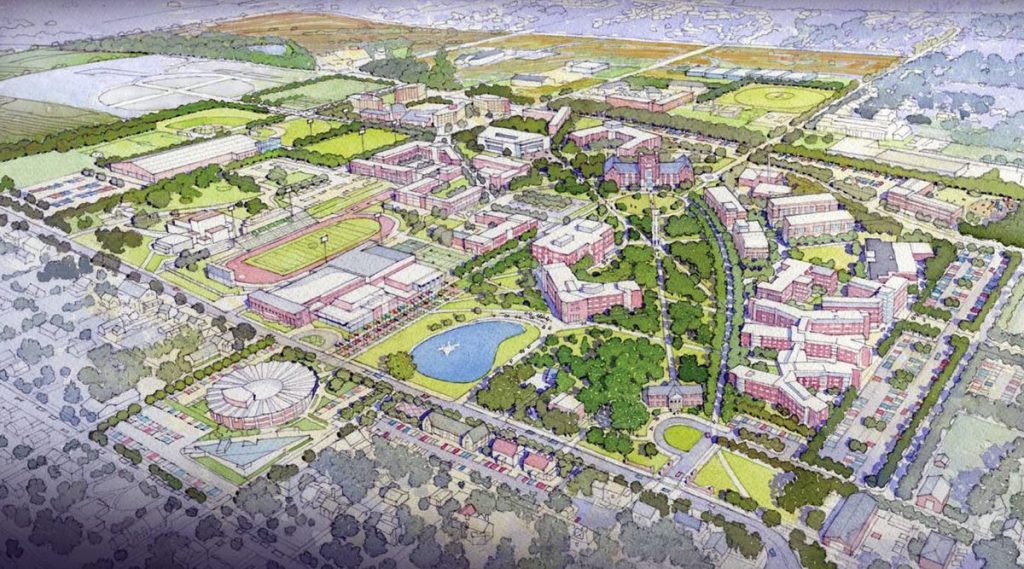
Pictured is a conceptual drawing of what a new main entrance to the Northwest Missouri State University campus would look like following construction of a proposed new welcome center. Improvements associated with the center include a u-shaped drive connecting with Fourth Street and the transformation of University Drive into a landscaped pedestrian corridor extending north to the Administration Building.
The Northwest Missouri State Board of Regents approved the largest budget in the university’s history Friday, green-lighting a $98.6 million package that for the first time in years includes significant spending from reserves for facilities expansion and new academic programs.
Stacy Carrick, Northwest’s vice president of finance, said the investment in new initiatives was possible thanks to $13 million in reserve funds built up over the past six years in the aftermath of a historic recession and state revenue crisis, which forced the institution to make deep cuts that included staff reductions.
Excluding one-time spending embracing proposed capital projects as well as new academic programs in Kansas City and St. Joseph, Northwest’s 2016-2017 budget totals about $95 million, as opposed to around $80 million in education and general operations spending in 2010.
Last year’s “education and general” budget totaled just under $91 million.
The spending blueprint carries a $3.7 million deficit — spending from reserves — which Carrick characterized as an “investment” in Northwest’s future.
That investment includes $2.5 million set aside for projects recommended in a campus master plan calling for construction of a “front door” visitors’ center at the intersection of University Drive and West Fourth Street.
The facility, which university President John Jasinski said should be completed within the next five years, would replace the Mable Cook Recruitment and Visitors Center, which Jasinski said lacks sufficient gathering space, restrooms, and other facilities to handle larger groups of prospective students and their families.
Improvements associated with the proposed center include a u-shaped drive connecting with Fourth Street and the transformation of University Drive into a landscaped pedestrian corridor extending north to the Administration Building.
As now conceived, the north-south street would be replaced by a new vehicle thoroughfare to the east of a row of parking lots located behind two residence halls and an academic building known as Wells Hall.
Other key features of the master plan, which is heavily dependent on the success of the ongoing “Forever Green” capital campaign, include the Bearcat Activity Center, which amounts to an indoor field large enough for football and baseball practice as well as other athletic activities; an “Agricultural Learning Center” at the R.T. Wright University Farm north of Maryville; and a new alumni center.
Additional proposals call for major renovations to the “high-rise” residence halls on the northwest end of campus.
The new budget anticipates $57.8 million in tuition and fee revenue, up from $55 million during the current fiscal year. Tuition for undergraduate and graduate students will remain unchanged in 2016-’17, but enrollment is expected to climb.
In addition, Northwest will receive an additional $920,000 in its core appropriation from the State of Missouri, a 2.9 percent increase over the current year, which ends June 30.
The Missouri Legislature approved a 4 percent performance-based increase for state-assisted colleges and universities in 2016-’17, but Northwest failed to meet the retention standard — by a mere three students —resulting in a reduction of funds.
Total state funding for Northwest will be $32 million, roughly a third of total education and general operations spending.
The auxiliary services budget, mostly funded by student room and board fees, is just over $28 million, meaning that Northwest’s total projected spending for the coming fiscal year comes to around $127 million.
Additional spending includes a 1.5 percent cost of living raise for faculty and staff and targeted pay increases designed to bring salaries up to the national market standard.
In other business Friday, the regents approved appointments for 261 faculty members and renewed the university’s agreement with the Northwest Foundation, which acts as the school’s fundraising and development arm.
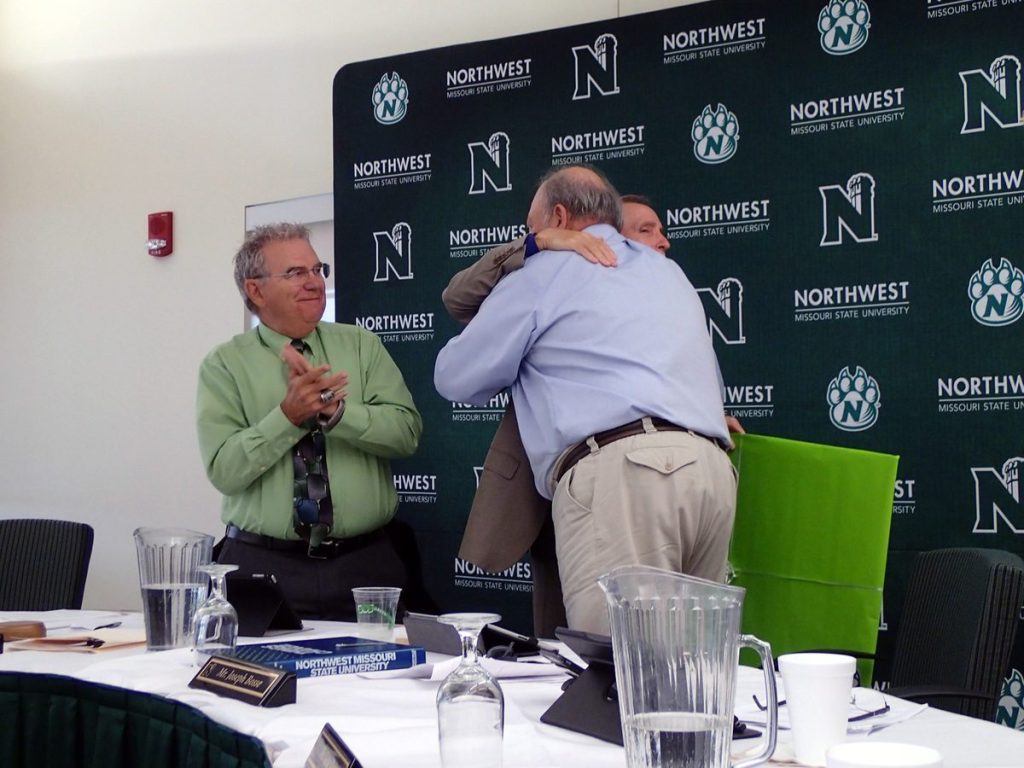
The board also reelected Dr. Pat Harr as chair and Gene Dorrel as vice chair and recognized departing regent Joe Bosse of St. Louis for his six years of service.
“I was a small, small part of it,” said Bosse, who played football for the Bearcats during his undergraduate days. “It’s been a great thrill to be a part of it and watch it work.”
Bosse’s departure leaves what is supposed to be an eight-person board appointed by the governor with a bare quorum of five members. The remaining regents include John Richmond, Marilou Joyner, Richard Smith, Harr, and Dorrel.
TONY BROWN/DAILY FORUM
Northwest Missouri State University President John Jasinski, center, embraces outgoing Regent Joe Bosse at the close of what was Bosse’s final meeting as a member of the school’s governing board on Friday. Looking on at left is Dr. Patrick Harr, who was reelected to a new term as board chair.