
Disaster seminar: Learning to ride out the storm
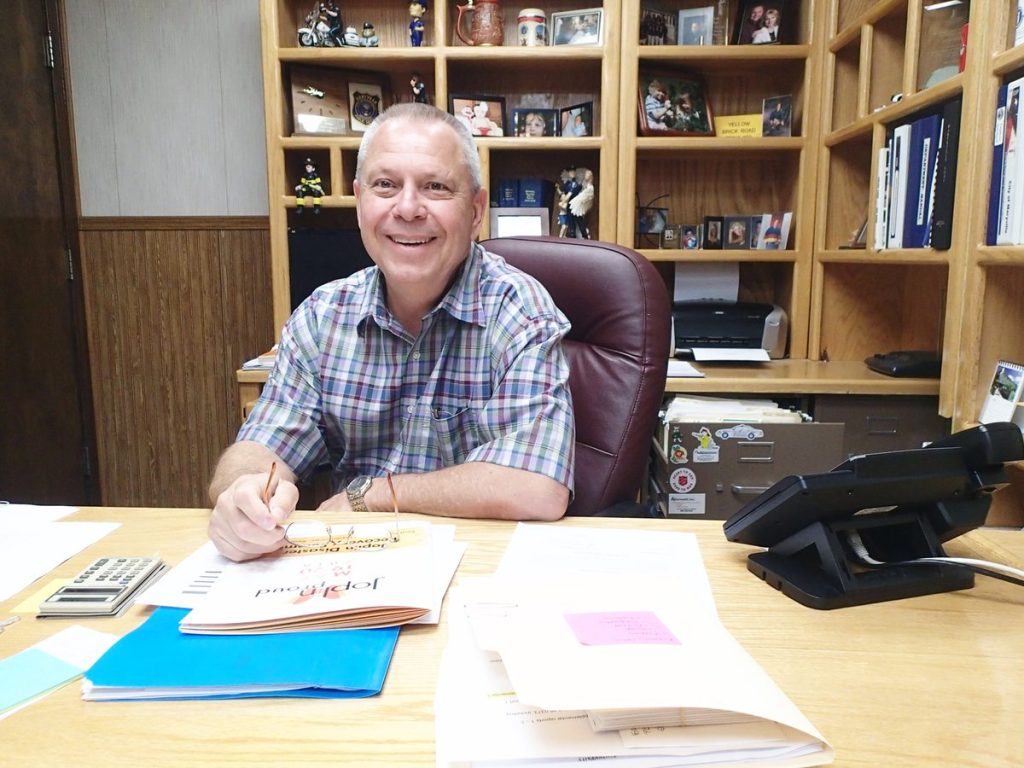
TONY BROWN/DAILY FORUM
Maryville Public Safety Director Keith Wood recently attended a “disaster recovery summit” in Joplin where he was able to hear first-hand from other crisis managers and first-responders who worked through the aftermath of that city’s devastating 2011 tornado.
Maryville Public Safety Director Keith Wood, along with Public Works Director C.E. Goodall, recently returned from Joplin, where they attended a “disaster recovery summit” organized as part of Joplin Proud.
The commemoration was held last month to mark the fifth anniversary of a devastating tornado that destroyed much of the southwest Missouri city, which has a population of slightly more than 50,000 people.
The EF5-rated twister, which struck on a Sunday afternoon — May 22, 2011 — reached a maximum width of nearly 1 mile during its rampage through the Ozark community’s heart.
One hundred and sixty-two people were killed, and 1,150 were injured. Damage was estimated at $2.8 billion.
It was the deadliest tornado to strike the United States since the 1947 and the seventh-deadliest overall. The storm also ranks as the costliest single tornado in the nation’s history.
Wood said about 300 community leaders, including police chiefs, city managers, crisis coordinators, and municipal department heads, attended the conference from all over the country, all of them likely thinking, “What if something like this happened in my town?”
And for a number of them, it had.
Wood said other officials attending the seminar came from such cities as Tuscaloosa, Alabama, which was struck by a deadly tornado, an EF4, just a month before the Joplin storm. Other cities sending representatives to the summit included Cedar Rapids, Iowa, the site of catastrophic flooding in 2008.
During Wood’s long tenure as police chief, Maryville has been largely spared from such devastation, the exceptions being a destructive hail storm a few years back and a vicious icefall in 2007 that downed trees and power lines across the region and left some local residents without power for as long as a week.
But just because it hasn’t happened here yet doesn’t mean it won’t, and Wood said his biggest takeaway from the Joplin conference was the need for training and preparation.
“You don’t wait for a disaster to happen, and then say, ‘We’re going to make this outcome productive,” he said. “The way you play is the way you practice.”
In studying the aftermath of the Joplin tornado, Wood said he came away impressed with the number of things the city did right, both in terms of people’s emotional response and the way in which local leaders were able to marshal and deploy people and resources.
“Their initial attitude was that the word ‘no’ was not in their vocabulary,” Wood said. “If they needed a resource they were going to push until they got it.”
Another lesson Wood said he learned at the summit, and one that applies especially to crisis managers, is the importance of making sure police, firefighters, and other first-responders “stay in their own swim lane.”
When people are missing, trapped, injured, and possibly dying, Wood said, it can be difficult to convince police officers intent on protecting and serving that their role is law enforcement and keeping the peace — not carrying people to safety. That’s where firefighters and specially trained search-and-rescue personnel come in.
In other words, when the chips are down simply doing the job you’re supposed to do is usually the best option. But sometimes that’s not an easy choice to make
“The key is knowing your job when a disaster happens, and then staying in your job,” Wood said, adding that some of the most touching remarks at the conference came from former Joplin police chief Lane Roberts, now director of Missouri’s Department of Public Safety.
Roberts, said Wood, lost his house in the storm but simply continued working to make sure the right people were in the right place doing the right things.
“He knew he had a bigger mission, a bigger purpose,” Wood said. “Once he knew his family was OK, he decided that the rest of it was just stuff.”
Wood said the conference made him reflect on the fact that one of his tasks as chief of Maryville’s police and fire operations is to “take care of the community, but also to take care of the people who are taking care of the community.”
Post traumatic stress disorder is still taking a toll on Joplin’s first-responders, he said, a situation that has placed a continuing burden on managers and supervisors to display sensitivity while providing emotional support and making sure professional help is available to those who need it.
“When they test the sirens in Joplin that’s a trigger for a lot of people,” he said. “There are some things that you have to do, but it’s still a trigger emotionally.”
As for Maryville, Wood said he tries to keep police and firefighters prepared by simply insisting that they know their jobs. Setting up street barricades for a parade, he points out, is just the same as setting them up after a tornado. You do what you’ve been trained to do regardless of the circumstances.
“It’s just another day,” he said, “albeit a very bad day. … That’s part of my management philosophy. You take care of the little things, and the big things take care of themselves.”
Wood said he also works to keep people aware that the worst can happen, and that they need to be prepared.
His administrative assistant, Christy Forney, for example, who also serves as the county’s emergency management director, meets regularly with members of the law enforcement, social services, and healthcare communities in order to make sure everyone knows their role should a crisis occur.
Readiness is all, Wood believes, and people rise to the level of their training and preparedness.
“You don’t have a response and recovery plan that just sits on a shelf,” he said.




