
Salesman proposes quick fix for county’s crackups
TONY BROWN/DAILY FORUM
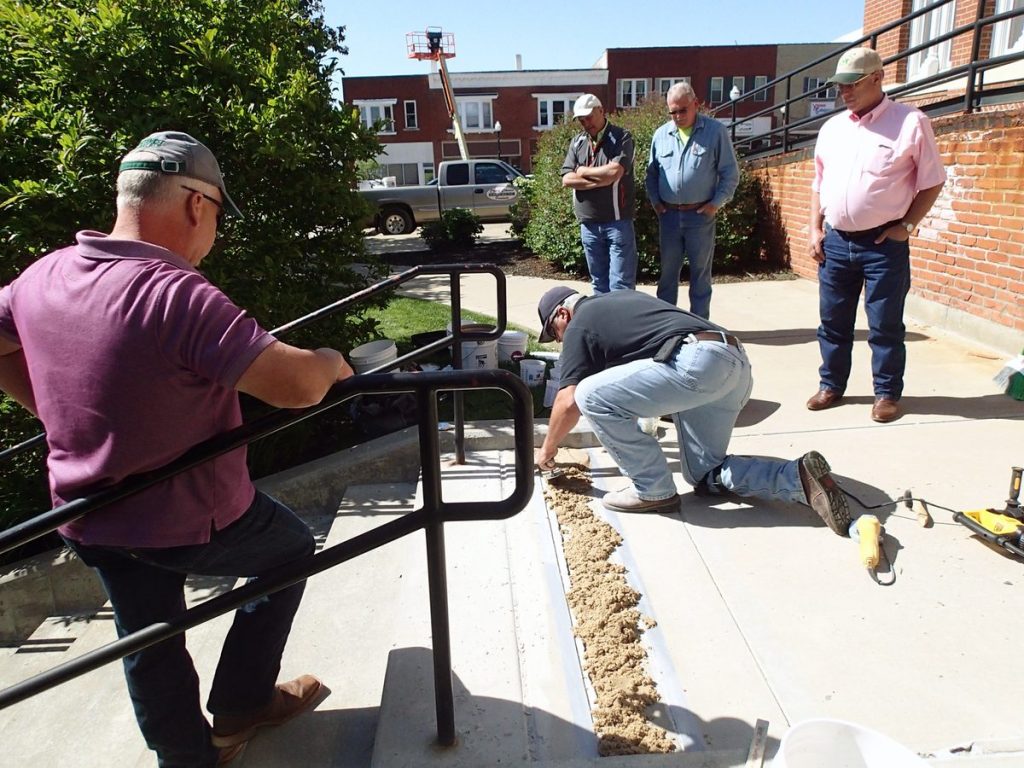
Members of the Nodaway County Commission, along with Road and Bridge Supervisor Ed Walker, standing fourth from left, watch Dan Edwards of Pro’s Choice Concrete Products of Platte City repair a large crack at the top of an outdoor staircase on the east lawn of the courthouse. Also pictured are Presiding Commissioner Bill Walker, left, North District Commissioner Robert Westfall, standing second from left, and South District Commissioner Robert Stiens, standing at far right.
As virtually every homeowner knows, especially those living in a freeze-and-thaw climate like northwest Missouri, concrete sidewalks and driveways like to crack and split.
With miles of sidewalks, parking lots, bridges, and roads to maintain, county and city governments know this as well, which is why the Nodaway County Commission has been talking lately with Dan Edwards of Pro’s Choice Concrete Products in Platte City.
Edwards is a Pro’s Choice sales representative and has been pitching a concrete repair material to the commission named FlexKrete.
As part of a presentation on Friday morning, Edwards demonstrated his product by fixing a deep split that had developed at the top of some stairs that rise from street level beneath the courthouse’s east entrance.
The stairs are fairly new, having been installed as part of a downtown streetscape project in 2007. But settling had caused the sidewalk to sink beneath the top stair by about an inch — just enough to grab somebody’s toe and send them tumbling down the hill.
Normally, repairing that sort of thing would require hammering out part of the sidewalk, setting up a form, and pouring fresh cement, which would then have to be roped off for a couple of days to cure before being reopened to pedestrians.
But Edwards claimed he could do the job in less than half a day with FlexKrete, which looks and pours a lot like cement, but isn’t.
Actually the stuff is a vinyl polymer resin designed to bond with concrete, asphalt, wood, or steel. Once poured, Edwards said it takes just an hour or two to cure into a rock-hard patch capable of withstanding loads of more than 10,000 pounds per square inch.
If the stuff works as advertised, county officials believe it could provide a fast, affordable way of keeping sidewalks and other masonry around the courthouse in good shape. Road and Bridge Superintendent Ed Walker said the material may also have bridge maintenance applications.
At first, the county considered using FlexKrete instead of grout to seal the gaps between modular strips of concrete used to construct new bridges. But at approximately $5,000 per bridge, Walker said the material’s price tag is likely cost prohibitive for jobs that size.
For one-off repair tasks, however, like smoothing over dangerous cracks on an outdoor staircase, FlexKrete could be just the ticket. The City of Maryville has been evaluating ways it might use the material as well.
Sold in 5-gallon buckets, FlexKrete looks like watery clay before it’s mixed with a small amount of liquid catalyst and three or four parts of sand aggregate. Edwards said different colors of aggregate are used to color the material so that it matches whatever is being repaired.
The resin isn’t cheap, and sells for almost $400 for a 5-gallon bucket, enough to produce 20 gallons or so of mixed material that is applied like cement and smoothed with a trowel.
Edwards said the product can save money due to its longevity, and because it requires less time and labor to apply and cure.
The commission has yet to decide if it will add FlexKrete to its hardscape maintenance arsenal. But whether or not the three-member panel buys into Edwards’ sales pitch, the east courthouse stairs got fixed at zero cost to the taxpayers.




