Occupational therapists provide holistic healing
SUBMITTED PHOTO
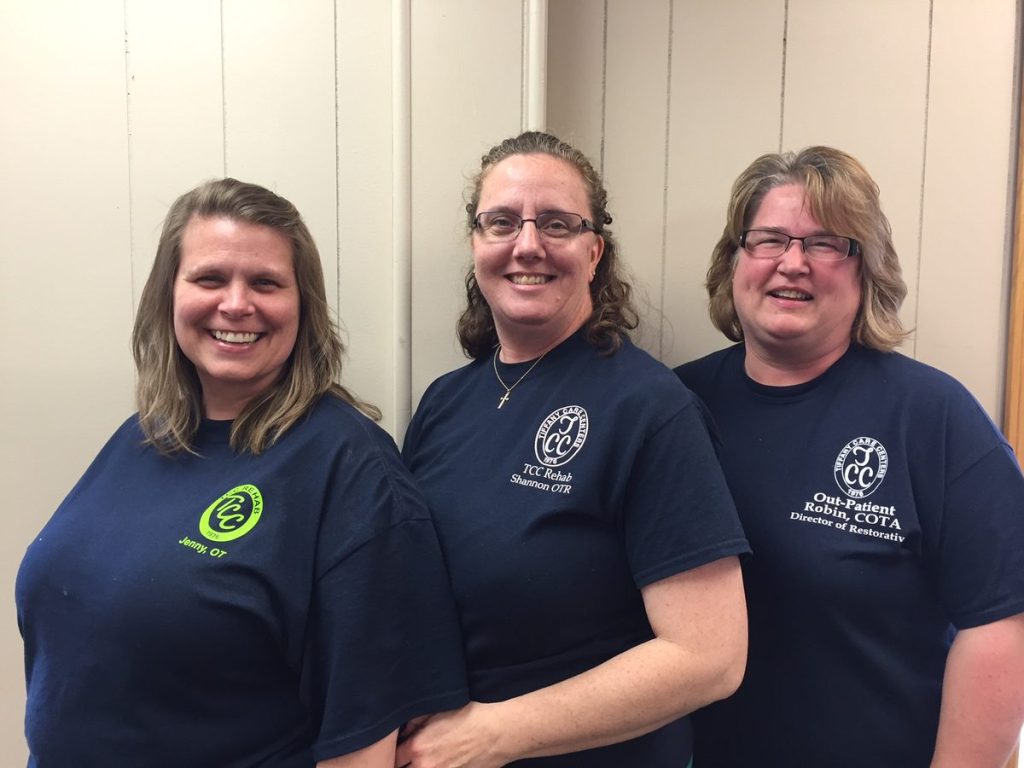
Pictured from left, Tiffany Care Center Rehab occupational therapists Jenny Herndon and Shannon Tharp and occupational therapy assistant Robin Davidson serve the communities of Maryville, Rock Port, Mound City, and Oregon. The goal of occupational therapy is to allow patients to participate in their life independently after an injury, surgery, or stroke.
Whether the patient is a teenager recovering from an athletic injury or a senior citizen recovering from a stroke, the goal of occupational therapy is to help patients live as independently as possible.
April is Occupational Therapy Month, as recognized by the American Occupational Therapy Association.
Occupational therapy focuses on using everyday activities to return a patient to regular daily living after an injury, surgery, or other significant health event.
Tiffany Care Center Rehab, based in Mound City, has two occupational therapists and one occupational therapy assistant on staff who serve the communities of Maryville, Rock Port, Mound City, and Oregon.
Jenny Herndon joined TCC Rehab as an occupational therapist in 2015 but has over 18 years of experience in the field.
She and her sister were first inspired to consider occupational therapy as a career after their mother suffered a head injury in a car accident when Herndon was 11 years old.
“I watched my mom go through occupational therapy my whole life,” Herndon said. “After the accident she had to learn everything again; it affected her speech, her vision, her walking.”
Her mother now says that while physical therapy taught her to walk again, occupational therapy taught her to live again.
Herndon spends her workdays either at Nodaway Nursing Home in Maryville or Oregon Care Center in Oregon.
While she works with a wide variety of patients, she particularly enjoys helping those who have suffered neurological difficulties such as strokes or head injuries, as well as those who are dealing with dementia.
“Part of my job is to see what they’re still able to do, and then I train caregivers to help them remain as independent as possible,” Herndon said.
At Nodaway Nursing Home, occupational therapy assistant Robin Davidson takes care of much of the daily treatments needed by residents, while Herndon does evaluations, creates care plans, and supervises discharges.
Another essential aspect of the job is education.
“A lot of occupational therapy is educating patients in new ways to do things and educating caregivers about how to change the environment or tasks to make them safer, especially with the elderly,” Herndon said.
Adaptation is often the key to successful rehabilitation. Some patients will not be able to fully return to their state of health before the accident or injury, but must make allowances for a new routine.
“One challenging but rewarding part of the job is helping people go through the grieving process after disability,” Herndon said. “People go through stages of adapting to their new normal, especially if it’s a permanent disability.”
Occupational therapy originated in the early 1900s when it became recognized as a useful treatment for veterans after World War I. The practice has as much to do with mental health as physical health.
“When working with veterans, they found that if you didn’t just focus on the physical aspects of disability but got patients engaged in life again, they recovered faster because it gave them purpose and meaning,” Herndon said.
Today, unfortunately, rural areas often suffer from a shortage of occupational therapists, something Herndon would like to see change.
She said that occupational therapy is a diverse trade that allows for creativity and flexibility.
Therapists may work with infants and young children, those with autism or cerebral palsy, athletes suffering from sports injuries, the elderly, or any number of other types of patients.
“Occupational therapy involves the emotional aspect of helping people, but you also get to do the biomechanical work,” Herndon said. “It’s kind of the best of both worlds in that you get to look at the whole person. It’s very holistic.”
“It’s kind of the best of both worlds in that you get to look at the whole person,” Herndon said. “It’s very holistic.”