Transition Skill Day held at Northwest
By JESSICA ALLEN Staff writer
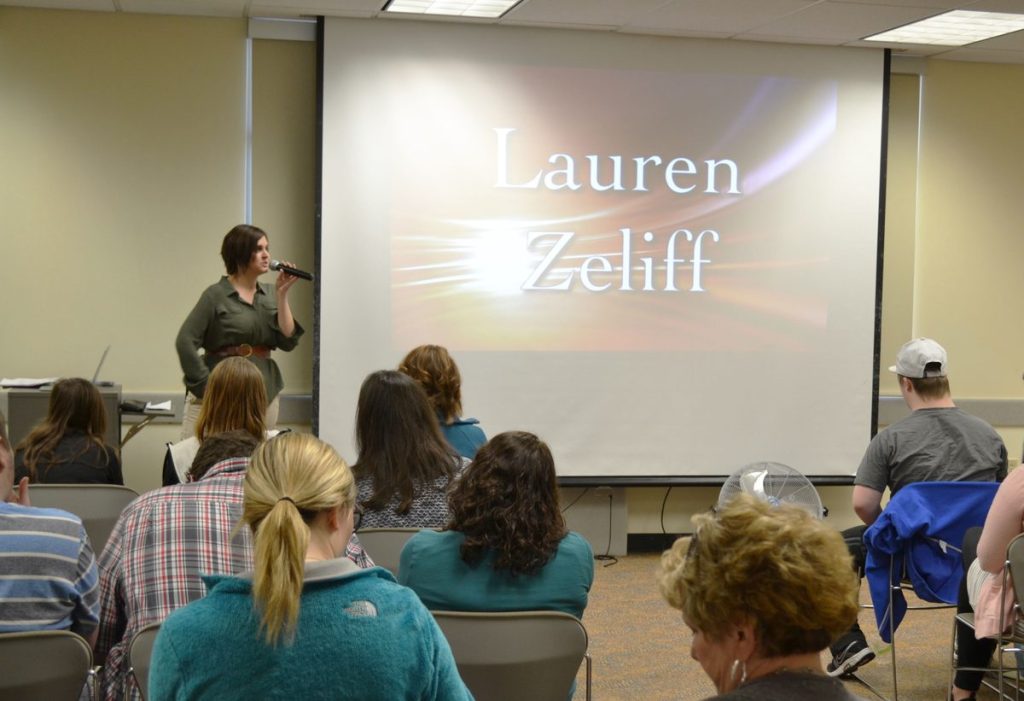
Lauren Zeliff, a community independent living specialist at Midland Empire Resources for Independent Living, speaks to special education students at the annual Transition Skill Day. Zeliff, who suffers from cerebral palsy, encouraged her audience to learn to advocate for their rights and persevere in pursuing higher education and employment.
For students with cognitive, learning, or physical disabilities, finding a job after high school may seem like a daunting task.
But a number of area organizations are committed to giving students the encouragement and resources they need to tackle the challenge head-on.
The Area Cooperative for Education Support, an organization that serves 21 school districts in northwest Missouri, began Transition Skill Day several years ago.
The event is aimed at educating junior high and high school students about what it will take for them to transition from high school to college and the workforce. More than 50 students participated this year.
“What we’re trying to do is bring skills and resources to students who have learning disabilities,” said Stacey Law, a community living coordinator with the Albany Satellite Regional Office of the Missouri Department of Mental Health.
“The goal is to open the students’ eyes to show them there is work out there,” she said.
Jodie Kurtz, educational diagnostician with ACES, said much of the Transition Skill Day is dedicated to “building career readiness skills” such as knowing how to dress professionally and experience successful interviews.
She said the ultimate goal is employment for all students with disabilities “at whatever level of ability they have.”
The keynote speaker for the event was Lauren Zeliff, a community independent living specialist at Midland Empire Resources for Independent Living, or MERIL.
Zeliff, has cerebral palsy, a neurological disorder that affects body movement and muscle coordination, and a learning disability.
After attending schools in Fairfax and Maryville for elementary and high school, she went on to graduate from Northwest Missouri State in 2010 with a bachelor’s degree in family and consumer science.
While in college, Zeliff worked three internships that she found through the Workforce Recruitment Program, which connects employers with college students and recent graduates with disabilities.
“I learned skills there that I use today,” Zeliff said.
She also attended the Partners in Policymaking leadership training program in Columbia, Missouri, where she learned about legislation that impacts people with disabilities, as well as how to be an advocate for herself and others.
“That is when I realized … I wanted to make a difference in the lives of individuals with disabilities,” Zeliff said.
She applied to work at MERIL three times before she was hired, and she encouraged her audience to never give up on themselves.
“If you really want something, you have to strive and have patience,” she said.
Zeliff stressed the importance of learning to advocate for oneself by applying for accommodations in college and at work and understanding one’s rights under the American Disabilities Act.
She also encouraged the students to read and understand their Individualized Education Program.
The IEP is required for every child receiving special education services under the Individuals with Disabilities Education Act.
According to the U.S. Department of Education, IEPs must include a statement of students’ levels of academic performance, goals for their education, and the accommodations and services a school will provide them.
Additionally, IEPs include “the transition services needed to assist the child” in reaching the goals of employment and, if possible, independent living skills.
Darla Wilkerson, volunteer with the Missouri Parents’ Act, said a big part of her job is helping parents and their children understand the IEP.
“I spend a lot of time with them to have them advocate for their rights under special education law,” Wilkerson said.
She conducted a session for the students at Transition Skill Day called “Why Should I Work?” in which she talked with them about the importance of summer jobs, internships, and workplace skills such as teamwork, professionalism, and networking.
Students also had the opportunity to talk with a panel of local employers about potential entry-level jobs.
Sponsors for the yearly event included MERIL, Vocational Rehabilitation, Albany Satellite Regional Office, Nodaway County Services, MPACT, Northwest Missouri State University, and the University of Missouri Pre-Employment Transition Services.
“If you really want something, you have to strive and have patience,” Zeliff said.