Author to address Civil War’s violent aftermath
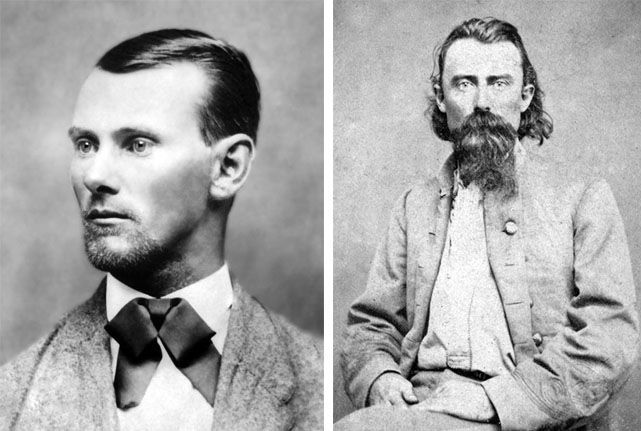
Jesse James, left, and “Jo” Shelby
Civil War buffs will get a treat this weekend when journalist and author Aaron Barnhart from the Missouri Humanities Council Speakers Bureau delivers a presentation on two of the epic conflict’s most colorful and controversial figures.
The free program, titled “Jesse James, ‘Jo’ Shelby, and the War after the War’ will begin at 2 p.m. Saturday, April 16, at the Nodaway County Historical Society Museum, located at 110 N. Walnut St. in Maryville.
Barnhart is a former television and media critic for the Kansas City Star and coauthor of “The Big Divide: A Travel Guide to Historic and Civil War Sites in the Missouri-Kansas Border Region.”
Raised in Kearney about 100 miles south of Maryville, Jesse Woodson James, who was shot by one of his own gang members in St. Joseph in 1882, was an American Civil War guerilla, outlaw, bank robber, train robber, and killer who became a national sensation for his exploits as a member of the James-Younger Gang.
James and his brother, Frank, were Confederate “bushwhackers” during the war and accused of participating in atrocities against Union soldiers in Missouri, including the infamous Centralia Massacre.
After the conflict ended, both Jameses rode with the notorious James-Younger band from about 1866 until 1876, when, during an attempted bank robbery in Northfield, Minnesota, several members of the gang were captured or killed.
According to Barnhart, Jesse James was long seen by many as a “romantic rebel without a cause.” Recent scholarship, however, has revealed a more human and tragic figure who fell prey to his own demons after refusing to accept the war’s outcome and targeting pro-Union Missourians for death.
Confederate Gen. Joseph O. Shelby, a native of Kentucky, played a brief post-war role in the James brothers’ story when he offered key testimony for the defense during a Missouri trial in 1883 in which Frank James was acquitted of all charges.
During a period of violence just before the Civil War began in 1861, now remembered as “Bleeding Kansas,” Shelby headed a group of pro-Southern “border ruffians.” Then, in 1863, he led a brigade of Missouri volunteers on what at the time was the longest cavalry raid of the war.
Between Sept. 22 and Nov. 3, 1863, the brigade traveled 1,500 miles through the state, inflicting more than 1,000 casualties on Union forces and capturing or destroying an estimated $2 million worth of Federal supplies and property.
After the war ended with a Union victory in 1865, Shelby and approximately 1,000 of his remaining troops rode south into Mexico.
For their determination not to surrender, the band was immortalized as “The Undefeated,” and the episode became the basis for a 1969 John Wayne-Rock Hudson film of the same name.
Shelby returned to Missouri in 1867 and resumed farming before being appointed U.S. marshal for the Western District of Missouri in 1893, a position he retained until his death in 1897 in Adrian, Missouri. He is buried at Forest Hill Cemetery in Kansas City.
For more information about Saturday’s presentation, call 660.582.8176.