Program promotes monarch habitat restoration
MIZZOU BOTANIC GARDEN
Disappearing habitat and changing weather patterns have drastically cut monarch butterfly populations in recent years, and landowners who want to help restore the iconic insect to its former numbers are being urged to apply for Monarch Butterfly Habitat Development Project funds through the Natural Resources Conservation Service’s Environmental Quality Incentives Program.
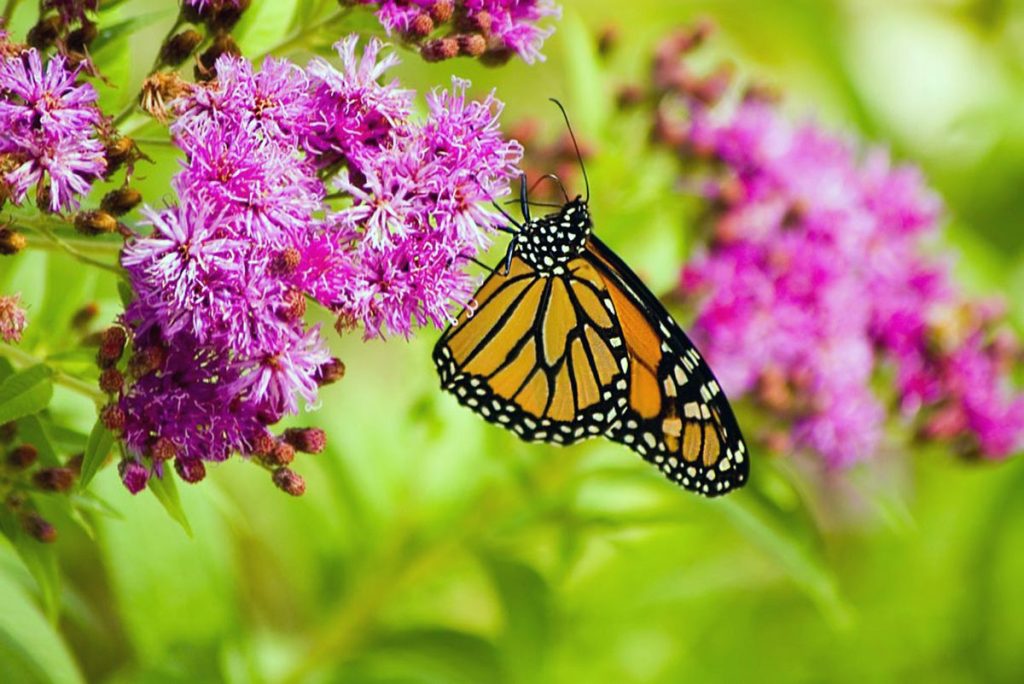
Nodaway County farmers and landowners interested in helping restore habitat for the endangered monarch butterfly — beloved for its striking orange/gold and black markings — are being urged to apply for funding through the Monarch Butterfly Habitat Development Project.
The U.S. Department of Agriculture’s Natural Resources Conservation Service is providing funds across 10 states, including Missouri, for financial and technical assistance related to creating more monarch-friendly fields.
NRCS District Conservationist Chris Rader said Monday that about $200,000 is available for qualifying farmers, ranchers, and other owners of ag land statewide. The application deadline is May 20.
Rader, who works out of the Maryville NRCS office at 502 West South Hills Drive, said proposed projects must comprise at least half an acre to be planted with a minimum of two varieties of milkweed, an essential feature of monarch habitat during spring and summer.
The use of herbicides and other production agriculture techniques have greatly diminished the numbers of milkweed plants in northwest Missouri, and Rader said land proposed for the program will score higher if it is located away from sprayed fields.
Milkweed is crucial to the butterfly’s development because adults lay eggs on the underside of the leaves of young plants, which then serve as the sole food source for developing larvae.
In addition to encouraging the propagation of milkweed, Rader said the Environmental Quality Incentives Program will also provide support for such practices as prescribed burning, development of field borders, fence construction, and the elimination of invasive plant species.
Besides a dearth of milkweed in the Midwest, Rader said, migrating monarch populations have also been stressed by the loss of winter habitat in Mexico and a growing number of extreme weather events across the western and central United States.
Conservationists attribute the disappearance of milkweed to agricultural practices in the Midwest, where genetically modified row crop seeds have been developed to resist herbicides that eliminate many species of the once-common herbaceous perennial.
Researchers have linked the increased use of these crops to a significant decline in monarch numbers between 1999 and 2010.
In 2013, Chip Taylor, director of Monarch Watch at the University of Kansas, told the New York Times that the Midwestern milkweed habitat “is virtually gone” with between 120 and 150 million acres lost.
In expanding the amount of monarch-friendly acreage, Rader said, Missouri landowners can also help improve habitat for honeybees and other flora and fauna native to this part of the state.
“We’re excited to be one of the 10 states nationally where funding is available to improve monarch butterfly habitat,” said NRCS State Conservationist J.R. Flores. “Monarch butterfly numbers have decreased significantly over the past few years. One of the reasons is a decline in milkweed, the primary plant used by monarchs to lay their eggs.
“It’s our hope that this targeted funding will increase habitat in the monarch migration path and increase the population of this beautiful butterfly.”
Area landowners interested in applying for monarch habitat funds can stop by the local NRCS office or call Rader at 660.582.7125.