CTRIP-plus: Incentives spur new development
PHIL COBB/DAILY FORUM
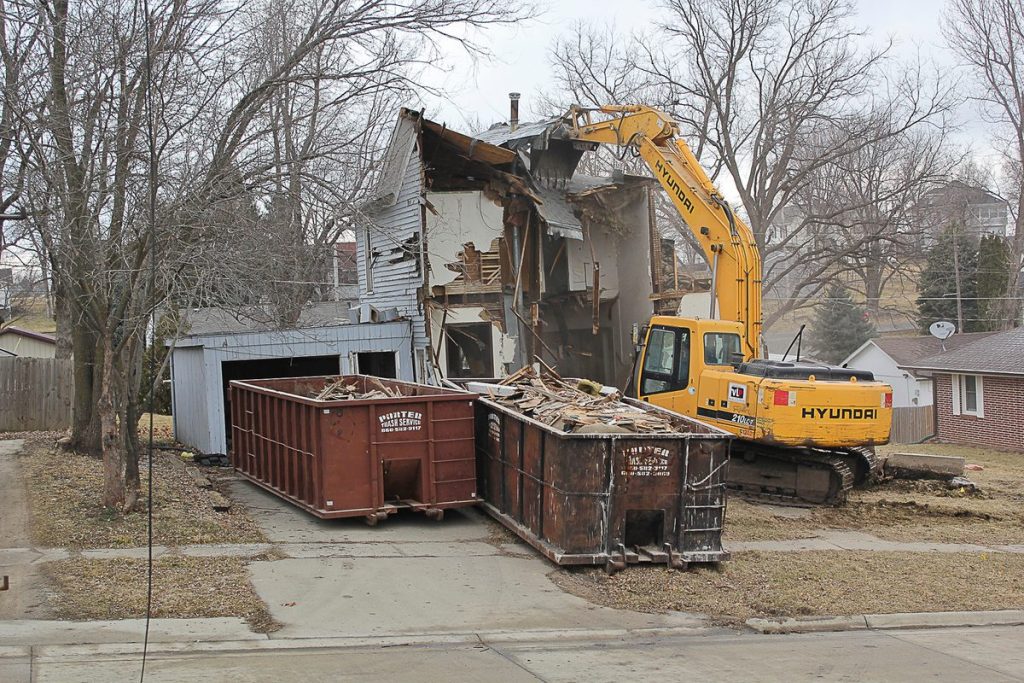
Mike Pope of Pope Dirt Work uses a track hoe to demolish a derelict house at 315 E. Thompson St. Thursday morning. The house is owned by local developer Travis Pierson, who intends to build a new single-family home on the site. Pierson says the City of Maryville’s decision to waive debris disposal and permit fees on such developments played a significant role in his decision to move forward with the project. He said he hopes more developers follow suit because Maryville is in need of more affordable housing.
On Monday, the Maryville City Council approved expansion of the Campus Town Redevelopment Incentive Program by making demolition, construction, and debris disposal fee waivers or reductions applicable to new development anywhere inside the town limits.
On Thursday, the first old house came tumbling down.
A derelict two-story residence at 315 E. Thompson St., which served last week as the site of a firefighter training simulation, was destroyed for real Thursday morning, and developer Travis Pierson has plans to erect a new single-family home in its place.
Under Revitalizing Maryville 2016 — the new name for the expanded CTRIP initiative — Pierson won’t have to pay a nickel in “tipping fees” for debris disposal at the municipal solid waste transfer station. Nor will he be charged for the requisite demolition and construction permits.
Pierson, who owns and operates First Class Plumbing, has been buying and remodeling homes for resale for the past 15 years through his development company, Early Morning Investments.
He bought the house on Thompson Street earlier this year because, even though the structure had been tagged unsafe, it was located in a nice neighborhood with good sidewalks, smooth streets, and newer homes close by. The area also offers convenient access to schools and churches.
Pierson said his plan is to construct a single-family home priced at around $150,000.
As it happens, that is precisely the target price range mentioned in the city’s comprehensive plan, which calls specifically for the creation of more affordable single-family housing in order to ease a tight labor market and spur economic growth.
In talking with city officials about his plans to build on the lot, Pierson said he was impressed by their flexibility and willingness to make sure the project was eligible under the new Revitalizing Maryville guidelines.
He offered particular praise for City Manager Greg McDanel, saying that McDanel’s vision and forward thinking are helping drive increased momentum for new development.
The Revitalizing Maryville incentive program, Pierson added, made his decision to build easier by subtracting several thousand dollars from his project costs.
“I hope more people take advantage of it,” Pierson said. “Maryville seems to be growing, and there is a need for affordable housing.”
He also noted that while there has been a significant amount of rental-housing construction over the past few years — much of it driven by CTRIP — single-family building has slowed.
That’s a trend that Pierson, who hopes to build two or three homes this year, plans to help reverse.
The move to expand CTRIP, which formerly applied only to about 40 blocks of mostly rental properties east of Northwest Missouri State University and west of Main Street, followed a decision by the council in January to lease the city’s solid waste transfer station to a consortium of local waste haulers late this summer.
Leasing the facility means that City Hall will control tipping fees at the station — the per-ton charge for dumping — for only another six months.
After that, the city will in effect become a transfer station customer, and will have to pay the consortium for all street sweepings and CTRIP debris deposited there beyond a 360-ton annual limit.
That window, McDanel said, created an opportunity between now and August for the city to offer demolition/construction permit fee waivers and tipping fee discounts beyond the Campus Town district.
In expanding CTRIP, the city has essentially turned one incentive program into several under the Revitalizing Maryville banner.
First, the new rules are meant to encourage new construction of single-family homes, along with rental and commercial properties, throughout the city. Another segment of the program applies to downtown and embraces remodeling of existing structures in addition to demolition and construction.
Eligible owners of rental and commercial properties receive a discount on tipping fees at the transfer station from $48 to $32 dollars a ton along with 100-percent fee waivers for demolition and construction permits.
The single-family residential program waives all tipping and permit fees and is designed, McDanel said, to provide an incentive for developers to build more “entry-level” homes.
Nodaway County Economic Development Executive Director Josh McKim said this week that easing the shortage of moderately priced homes in Maryville is a stated goal of local industry, which finds it difficult to attract new hires if workers can’t find a place to live.
Daily Forum publisher Phil Cobb contributed to this story.