Demolition, development incentives expanded
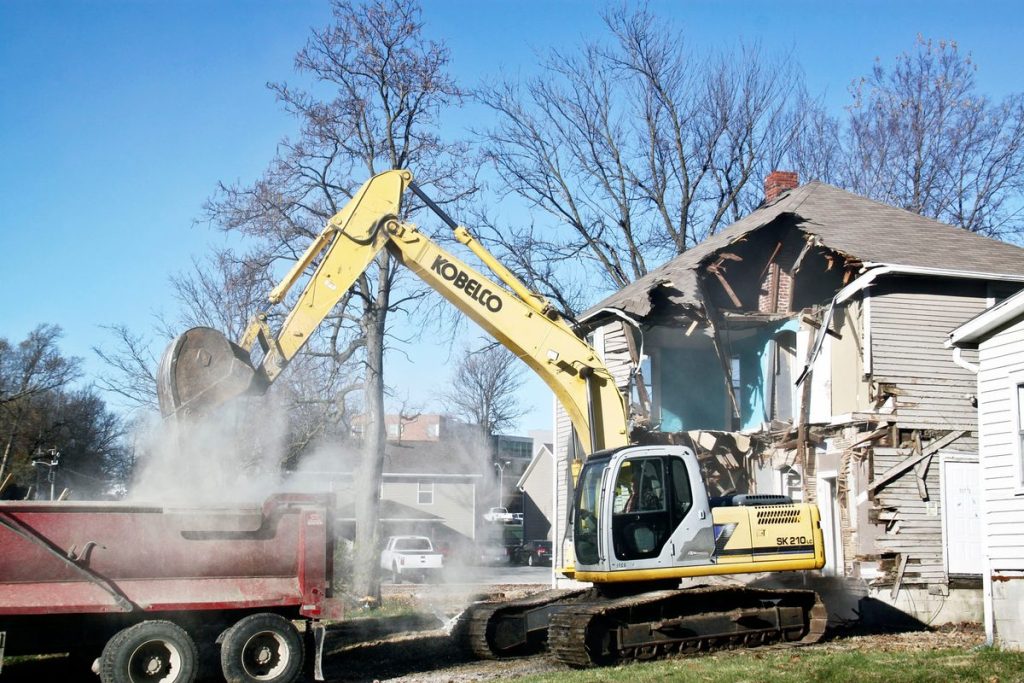
JIM FALL/DAILY FORUM
About 40 substandard or derelict structures, most of them old houses like this one that was razed last November, have been torn down locally since the Campus Town Redevelopment Initiative was established nearly three years ago. With that track record in mind, the Maryville City Council this week approved expanding the program, with various modifications, to include all of Maryville, including downtown.
Maryville City Manager Greg McDanel this week unveiled what he described as a “very aggressive and very special” proposal to significantly expand the city’s Campus Town Redevelopment Incentive Program, which was originally designed to encourage high-density housing construction in older neighborhoods to the east of Northwest Missouri State University.
That could mean a flurry of demolition and construction activity over the next few months, since by any measure the program, usually referred to as CTRIP, has been a success.
McDanel said waiving demolition debris disposal charges and construction permit fees for qualified property owners and developers who agree to tear down often-derelict structures and replace them with new buildings, usually apartments and duplexes, has played a major role in the removal of more than 40 substandard and unsafe buildings over the last three years.
According to city figures released late last year, the program, established in 2013, has generated nearly $25,000 in annual property tax revenue and almost $2 million in appraised value on $3.3 million worth of new construction.
And starting now, following a unanimous voice vote on Monday by the Maryville City Council, some form of CTRIP now applies to the entire city.
The move to expand the program follows a decision by the council in January to lease the city’s solid waste transfer station to a consortium of local waste haulers late this summer. That means City Hall will control tipping fees at the station — the per-ton charge for dumping — for only another six months.
After that, the city will in effect become a transfer station customer, and will have to pay the consortium for all street sweepings and CTRIP debris deposited there beyond a 360-ton annual limit.
That window, McDanel said, creates an opportunity between now and August for the city to offer demolition/construction permit fee waivers and tipping fee discounts beyond the 40-block Campus Town overlay district, which embraces much of the area between Main Street and the Northwest campus.
In expanding CTRIP, the city has essentially turned one incentive program into four.
The new efforts include the Revitalizing Maryville 2016 Initiative, a second program meant to encourage construction of new single-family homes, and a third strategy intended to encourage redevelopment and remodeling downtown.
Revitalizing Maryville 2016 applies to all residential, commercial, and industrial properties in the city. Eligible property owners will receive a discount on tipping fees from $48 to $32 dollars a ton at the transfer station along with fee waivers for all demolition and construction permits.
The single-family residential program waives all tipping and permit fees, and is designed, McDanel said, to provide an incentive for developers to build more “entry-level” homes priced under $150,000.
Nodaway County Economic Development Executive Director Josh McKim, who attended Monday’s council meeting, said easing the shortage of moderately priced homes in Maryville is a stated goal of the local industrial community, which believes scarce affordable housing is one reason for an increasingly tight labor market.
The third area of the CTRIP expansion plan pertains to downtown, an area defined in the city’s comprehensive plan as running north to south from Seventh to Jenkins streets and east to west from Vine to Fillmore.
Property owners in those blocks would be able to build new structures or remodel existing buildings without paying either debris disposal charges or permit fees.