Bogus bill surfaces at eatery
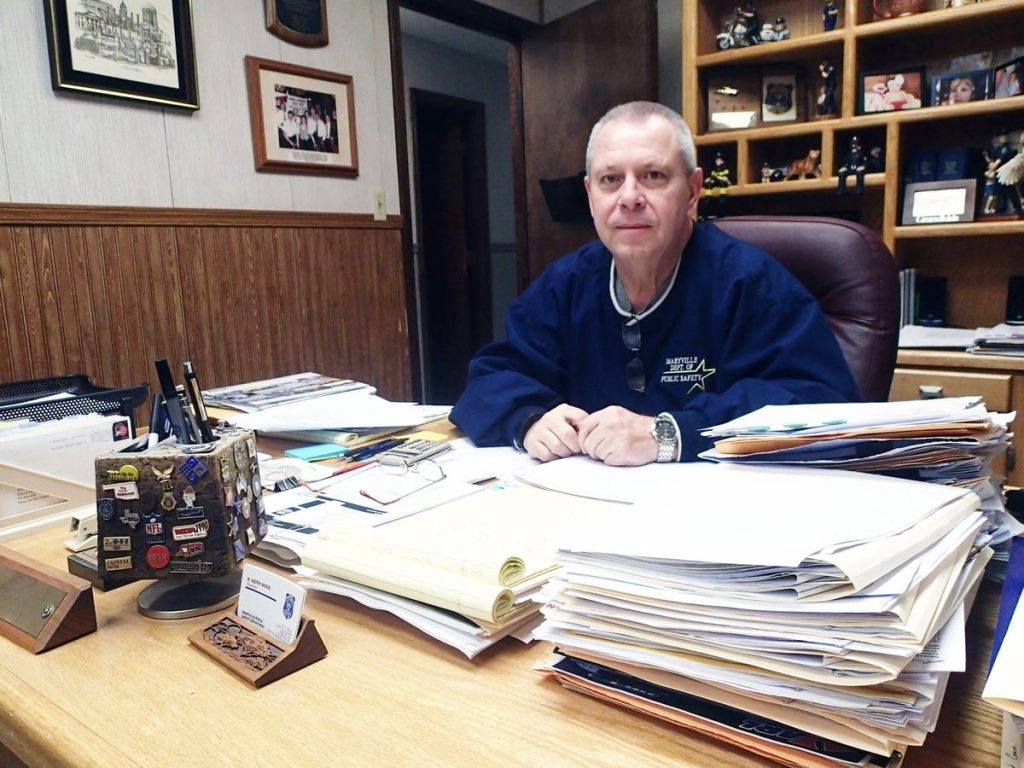
TONY BROWN/DAILY FORUM
In response to a recent counterfeiting incident, Maryville Public Safety Director Keith Wood said that criminals who make bogus money these days benefit from new technology in the form of advanced color printers capable of creating banknotes close in appearance to the real thing. However, fake bills are seldom perfect and can be easily detected by those who know what to look for.
What employees identified as a counterfeit $20 bill turned up recently at the Happy Garden restaurant located at 523 N. Main St. in Maryville.
Asked about the incident on Friday, Maryville Public Safety Director Keith Wood warned business owners, and anyone else apt to handle cash, to exercise caution, since the appearance of a single bogus bill means others are likely circulating nearby.
If you think you may be in possession of fraudulently printed money, Wood said, contact police immediately. Local authorities will then notify the U.S. Treasury Department, since counterfeiting is a federal offense.
According to information posted by the department at www.treasury.gov, anyone who suspects they have a counterfeit note, or who has information about counterfeiting activity, should immediately notify local police or the U.S. Secret Service, the federal agency charged with enforcing counterfeiting laws.
Other precautions include not doing anything to place yourself in danger, such as trying to return the bill to the person who passed it.
If possible, says the Treasury website, delay the passer with some excuse, get their description or a license plate number, and call the police.
Authorities also advise writing your initials and the date in the white border area of the suspect note, but to otherwise refrain from handling it.
Place the note inside a protective cover, such as a plastic bag or envelope, and surrender it only to a properly identified police officer or Secret Service special agent. Bad bills can also be sent via U.S. mail to the nearest Secret Service field office.
Wood said technology has given rise to big changes in counterfeiting, which was once the province of organized crime operations using exquisitely engraved metal plates and expensive printing presses to produce notes as close in appearance to the real thing as possible.
These days, Wood said, with the advent of advanced and relatively inexpensive color copiers, most counterfeiters operate on a vastly smaller scale, often running off just a handful of bills for personal gain.
“With today’s technology, counterfeiting is easy for anybody with a little bit of ingenuity,” Wood said.
One common practice is to bleach small-denomination bills until they turn white and then overprint them with a color image produced using a real $10, $20, $50, or $100 note. This method somewhat replicates the “feel” of the special paper used by the government to print money.
Bleached bills also limit the effectiveness of counterfeit detection pens, whose iodine-based ink changes color when applied to paper not manufactured from cotton fiber, which is what the government uses.
Detection pens are generally effective, however, in detecting fake notes printed on standard printer or photocopier paper.
Wood said that the best way to protect yourself from accepting bogus money is to learn what to look for on real bills, which contain a number of features that most counterfeiters can’t duplicate.
Here’s a crash course on what to look for from the Business Know-How website:
Hold the bill up to a light and look for a holograph of the face image. Both images should match. If a $100 bill image has been printed onto a bleached $5 note, for example, the hologram will display an image of Abraham Lincoln instead of Benjamin Franklin.
If you hold a genuine new-series bill (except the $5) and tilt it back and forth, the numeral in the lower right hand corner shifts from green to black.
Hold the bill up to a light to view the watermark in an unprinted space to the right of the portrait. The watermark can be seen from both sides of the bill since it is not printed on the bill but is imbedded in the paper.
Hold the bill up to a light to view the security thread. You will see a thin imbedded strip running from top to bottom on the face of a banknote. In the $10 and $50 the security strip is located to the right of the portrait, and in the $5, $20, and $100 it is located just to the left of the portrait.
If bills are held up to an ultraviolet (black) light, the $5 bill glows blue; the $10 bill glows orange; the $20 bill glows green; the $50 bill glows yellow; and the $100 bill glows red — if they are authentic.
Minute microprinting appears on the security threads: the $5 bill has “USA FIVE” written on the thread; the $10 bill has “USA TEN”; the $20 bill has “USA TWENTY”; the $50 bill has “USA 50”; and the $100 bill has “USA 100.” Microprinting can be found around the portrait as well as on the security threads.
Very fine lines have been added behind the portrait and on the reverse side scene to make it harder to reproduce.
Finally, do a comparison feel test. Simply compare the feel and texture of the suspected counterfeit to bills you know are authentic.
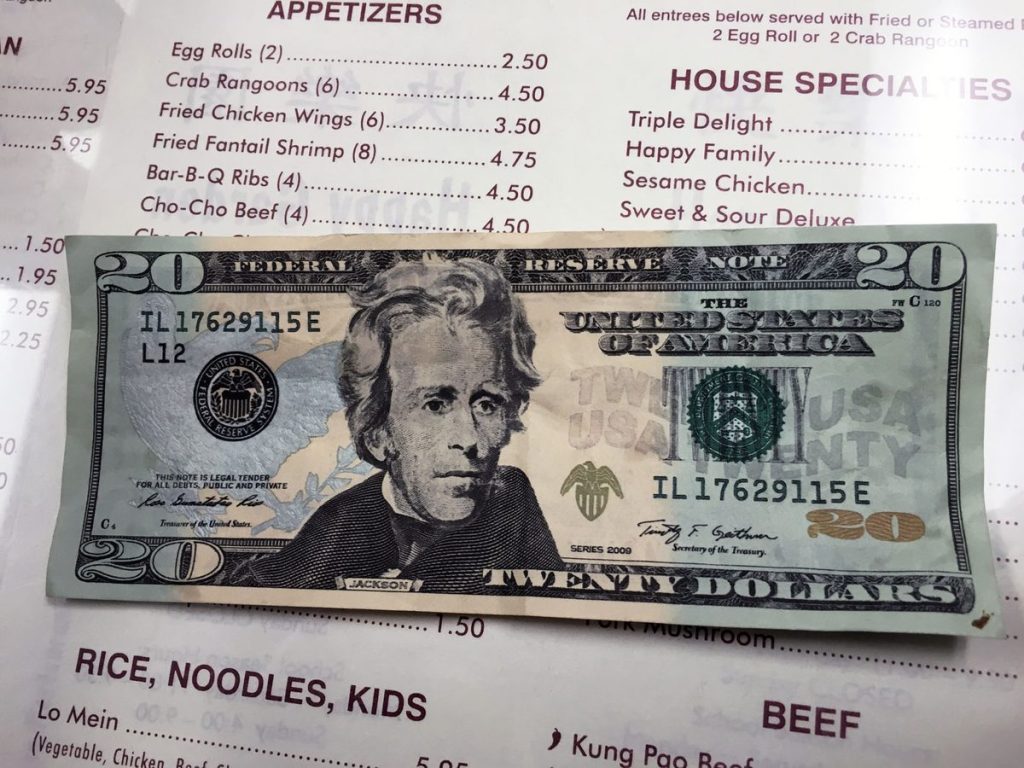
PHIL COBB/DAILY FORUM
This counterfeit $20 bill recently turned up at the Happy Garden restaurant in Maryville. Maryville Public Safety Director Keith Wood advised caution after the incident, since the appearance one fake bill probably means others are circulating as well.