102 River name still stumps historians
Jennifer Ditlevson Haglund
Historians can’t agree about the source of 102 River’s name. Some claim it could be a botched translation from the Osage people’s original wording for “Upland Forest” that French explorers understood to be “Cent Deux,” or 102. Others maintain that the name is tied to early settlers measuring one place to another.
Rivers can be named after just about anything. Across Missouri, river names span multiple languages, food items, flora, fauna, and colors.
Landform names carry stories and traditions that explain how the people interacted with and understood their environment.
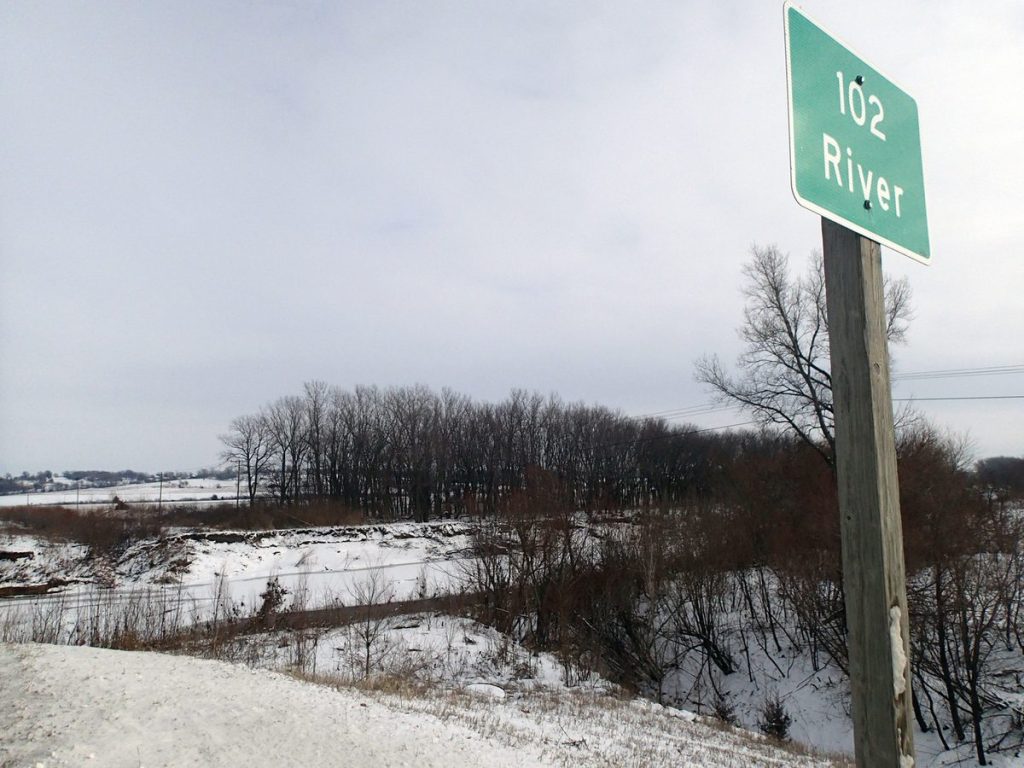
The history of the 102 River that is east of Maryville on U.S. Highway 136 remains unclear.
According to local historian Melissa Middleswart, historians have debated the source of the name for years.
“It’s literally one of those things that we will never know what is true,” Middleswart said.
The river, also known as One Hundred and Two River, is a tributary of the Platte River of Missouri, and begins just northwest of Hopkins. It is about 80 miles long.
Middleswart said that although it’s hard to know for sure, she tends to side with information documented in “A New History of Nodaway County Volume I: Indian Lands to 1859,” which was published in 1992 by Martha Cooper.
Cooper cited correspondence between H. Leavenworth and Capt. J.S. Gray from 1823 that referenced “102 Mile creek.”
According to the letters, Leavenworth advised Gray to take a route from the camp at Council Bluffs to Nodaway County. The distance between the two points, wrote Cooper, is the source of the name.
Another explanation is that the Sullivan Line that became the Missouri-Iowa border is approximately 100 miles north of the confluence of the Kansas and Missouri Rivers at Kansas City, Mo.
Brett Chloupek, an assistant professor of geography at Northwest Missouri State, tested the hypothesis with a quick drawing on Google Maps. The measurement proved to be close enough to convince him of the plausibility of the origin story.
“I am very inclined to believe that is the reason for its name, although I cannot be 100 percent certain,” Chloupek said.
“I’m not sure how they figured their mileage in a wagon, though,” said Tom Carneal, who is faculty emeritus at Northwest Missouri State University and former museum curator for the Nodaway County Historical Society.
Carneal said that while he was studying in the special collections at Stanford University Libraries, he found another explanation he finds more credible.
The name for 102 River, Carneal said, dates back to before the Louisiana Purchase when French explorers were traveling up the Mississippi River.
It’s been a long time since Carneal has looked at his notes, but Jacques Marquette and Louis Jolliet were traveling down the Mississipi River in the 1670s. They documented their interaction with the Osage people and drew maps of their journey. Some of these are available in the David Rumsey Map Collection at the same library where Carneal studied.
Robert Lee Ramsay, who was a professor of English at the University of Missouri in the early to mid-20th century, started a dictionary of Missouri place names. In it, he wrote that the river was a corruption of the Osage language.
In short, the French explorers heard something from the native people that they didn’t understand and it sounded close enough to “Rivière Cent Deux,” or River 102.
And, according to this viewpoint, the name stuck.
Carneal said he considers Ramsay’s work to be the most reliable.
It wouldn’t be the first time river names have been lost in translation. In the United States, hundreds of river names have been changed from what native groups had called them.
A small amount of research reveals that the Mississippi River got its name from a French rendering of an Anishinaabe word for “Great River,” and the Ohio River is an adaptation of Iroquoian for “Good River.”
“One side thinks they’re right,” said Middleswart. “But really, no one is ever going to know the right answer.”