Mayor voices support for closing solid waste station
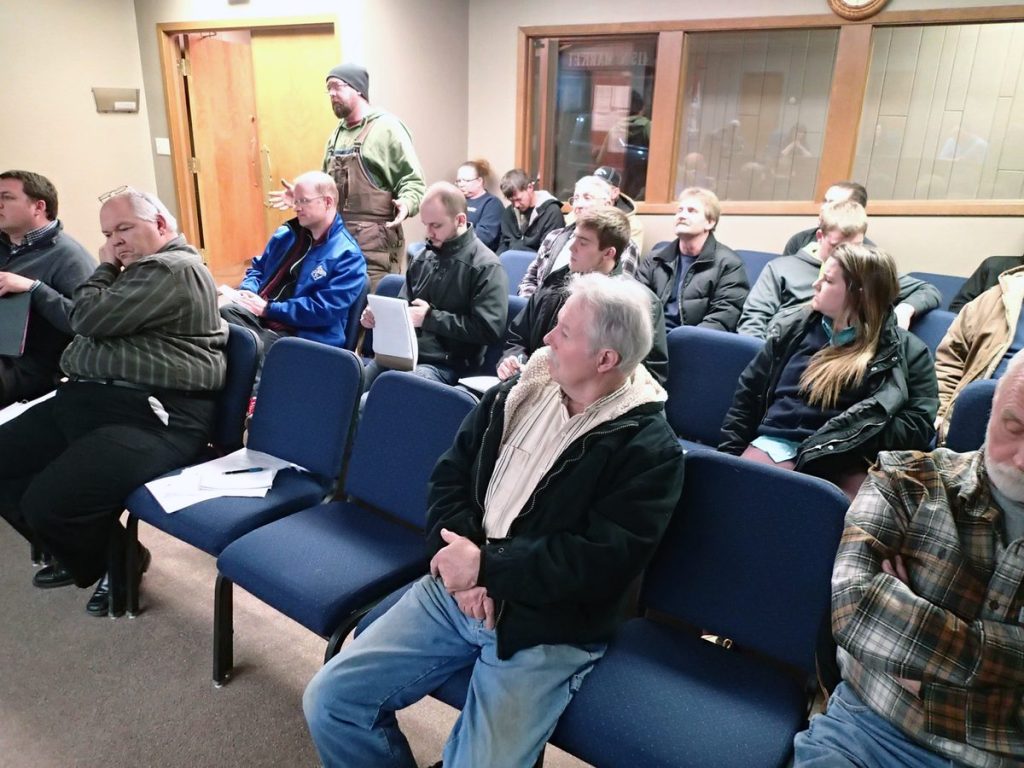
TONY BROWN/DAILY FORUM
Chris Mozingo of Mozingo Sanitation, standing, addresses the Maryville City Council this week. Mozingo’s company is one of three local garbage haulers that have formed a co-op seeking to lease the municipal solid waste transfer station, which has operated at a loss for the last several years. A rival bid was submitted by Rock Port-based American Recycling & Sanitation. The council is currently debating whether to grant a contract to one of those two entities or close the station altogether.
Two weeks prior to a self-imposed Maryville City Council deadline for choosing a course of action with regard to a municipal solid waste transfer station that consistently fails to produce enough revenue to cover operational costs, the governing board appears still undecided about the way forward.
Following a series of council discussions on the issue last year, which included input from both the public and a half-dozen or so local garbage haulers, the five-member board appeared to be moving toward leasing the transfer station out to one of two entities that submitted bids on Dec. 1.
During Monday’s regular session, however, Mayor Renee Riedel, who is to cast one of five votes Jan. 25 that will decide the fate of the station, said she believes the time has come for the city to consign waste disposal to the private sector.
Riedel, who noted she was not speaking for the rest of the council, said she favors closing the station, thus forcing local haulers to use other facilities, which for most would likely mean trucking refuse to Porter Trash Service’s Highway 136 Transfer Station a few miles east of town.
After representatives from Rock Port-based American Recycling & Sanitation and the Maryville Trash Cooperative each spent time arguing the merits of their respective bids, Riedel wondered aloud why solid waste disposal is only area in which the city is forced to negotiate with competing firms.
“How does it make sense that the city is in the trash business?” she said.
Following the meeting, Riedel clarified her remarks, stating that she believes the city has no role in striking bargains with private vendors, and that she plans to vote for closing the station should such a motion be made and seconded at the next regular council session.
During give-and-take discussion between the haulers council members on Monday, both Riedel and Councilman Tim Shipley said input from citizens indicates there is a “misconception” that the city plans to “municipalize” trash service by contracting with a single hauler that would serve the entire town.
That option was among several put forward by city staff last year, but no longer appears to be something the council is seriously considering.
“I can’t envision a scenario where that is likely,” said Shipley, adding that “the public has been very vocal” about wanting to keep haulers many local residents have used for years.
Chris Mozingo of Mozingo Sanitation, one of three companies comprising the Maryville Trash Cooperative, said he fears closing down the city’s transfer station will leave Porter without competition, a situation, he said, that will ultimately lead to higher “tipping fees.”
Tipping fees consist of the amount of money per ton haulers pay to dump refuse at a transfer station, where it is compacted, loaded onto trucks, and taken to an approved landfill. Maryville built its station after the Missouri Department of Natural Resources ordered the city landfill closed in 2001.
Always intended to be self-funding, the station essentially broke even for a number of years until Porter opened its facility in 2012. Since then, the city’s solid waste operation has experienced decreased tonnage and deficits of around $100,000 a year, a shortfall subsidized through the General Fund.
“If there is no competition the price is going up. I guarantee it,” said Mozingo, who told the mayor that unloading his trucks at a rival hauler’s facility would be like “buying food from Applebee’s” in order to serve customers at Carson’s Sports Grille, the downtown eatery of which the mayor is part owner.
Closing the municipal transfer station “would essentially put us out of business,” Mozingo said.
Councilman Jerry Riggs, an accountant by profession, questioned the viability of the lease offers, noting that both American Recycling and the co-op seemed to have based their bids on expectations that garbage volume will increase.
If the city is unable to cover its costs for operating the station, what makes the haulers think they will be able to do any better, he asked.
Jack Kelly of American Recycling responded that he believed his company would be able to control costs and boost tonnage through sound management and efficient business practices, but did not offer specifics.
As for the bids themselves, which the council will presumably consider at its next meeting, American recycling is offering to pay $500 a month in transfer station rent or provide 12.5 tons worth of free disposal for street sweepings and other municipal waste annually. Otherwise, the city would pay $40 per ton while receiving a $4-per-ton fee for other refuse.
In addition, American has proposed a maximum $60 tipping fee for private haulers, an amount that Kelly said is negotiable depending on the market.
The Maryville Trash Cooperative has offered to pay the city $100 a month in rent plus free disposal of street sweepings and other waste up to 360 tons a year. Haulers would pay a tipping fee of $45 per ton.
The Porter transfer station currently charges $48.
Porter Trash owner Dennis Porter has stated publicly he will work with both the city and his fellow haulers in order to keep tipping fees reasonable if the city’s station closes.
Should the Highway 136 facility become Nodaway County’s only transfer station, Porter pledged to offer contracts freezing tipping fees at their current level through 2020. After that, he said, prices would likely increase about 3 percent due to anticipated higher costs for hauling compacted refuse to distant landfills.
In addition, Porter said he would accept the city’s street sweepings at a discounted cost of $5 per ton over cost.
According to an analysis by city staff based on current tonnage, the American Recycling proposal would net the city an estimated $9,600 a year, while the co-op offer would cost the city around $1,000, since municipal volume, including debris related to Campus Town Redevelopment Incentive Program demolitions, totals just over 400 tons, slightly exceeding the co-op’s 360-ton limit.
Should a majority of the council vote to close the station, operations there would cease around the middle of August. The station’s sole employee would then be reassigned to a Public Works maintenance crew.
If the governing board awards a contract to one of the two bidders, the selected entity would begin running the station on Aug. 1.