Northwest commemorates Montgomery bus boycott
ALANNA WOLF-ARMSTRONG Staff Writer
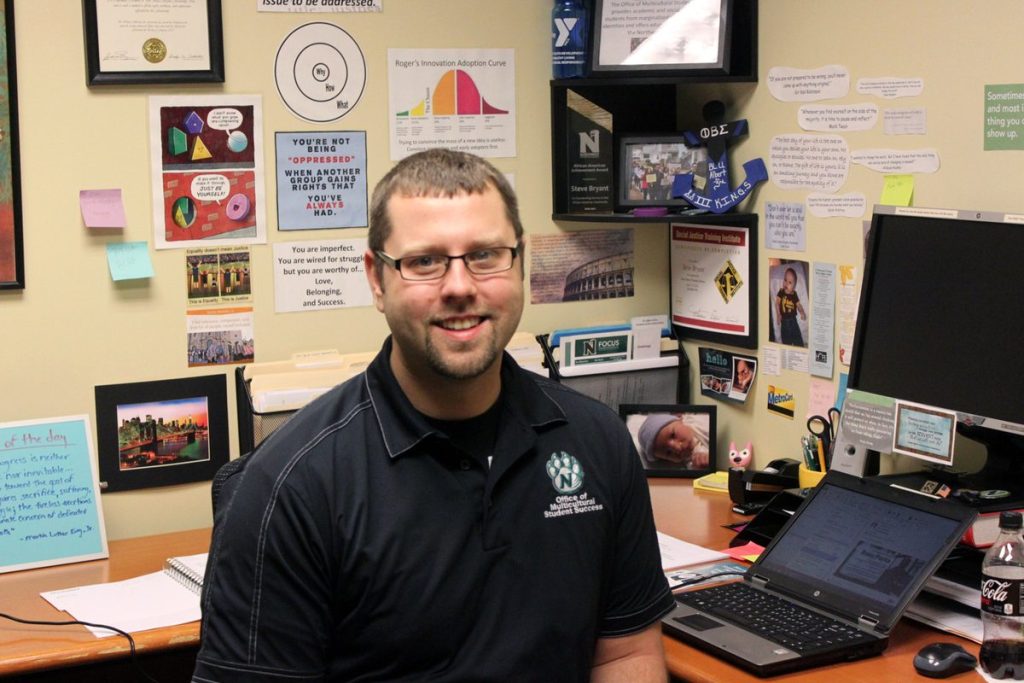
Steve Bryant, director of Multicultural Student Success at Northwest Missouri State University, is one of the organizers of today’s campus tribute to the late civil rights activist Rosa Parks. It was Parks’ refusal to give up her bus seat to a white passenger that led to the Montgomery (Alabama) Bus Boycott, one of the signal events of the U.S. civil rights movement of the 1950s and ’60s.
On Dec. 1, 1955, Rosa Parks, an African-American seamstress from Montgomery, Alabama, initiated a key event in the U.S. Civil Rights Movement when she refused to give up her seat on a public bus to a white passenger.
Parks, who died in 2005, was arrested for civil disobedience, and her action sparked the Montgomery Bus Boycott, a landmark protest that eventually led to the passage a decade later of federal civil rights legislation and the end of “Jim Crow” segregation in the American South.
The boycott, which lasted for several months, also resulted in a 1956 court case in which a U.S. District Court judge found Alabama’s racial segregation laws to be unconstitutional with regard to public transportation.
The city of Montgomery appealed, but the decision was upheld by the U.S. Supreme Court.
Today at noon Northwest Missouri State University will host an event in the J.W. Jones Student Union marking the 60th anniversary of Parks’ protest.
Hosted by Northwest’s Office of Multicultural Student Success, the gathering will feature student performances and a short film about Parks’ life.
A soup luncheon will follow along with continued discussion about the impact of Parks’ activism and the current state of civil rights and social justice in America.
“This event is partially to celebrate Rosa Parks and her stand against segregation, but it’s also partially to recognize that the civil rights process has been a slow one,” said Steve Branch, director of multicultural student success at Northwest.
“It’s been 60 years since Rosa refused to give up her seat, but there is still a lot of work that needs to be done in regards to civil rights, and even just basic human rights.
“We really just want to keep issues like this fresh in people’s minds. We want to spread the message that we are all part of the solution to help improve social justice, and that we all need to work toward ending racial discrimination on our campus, in our community, and in our society.”