Former school hidden under remodeled home
Jennifer Ditlevson Haglund
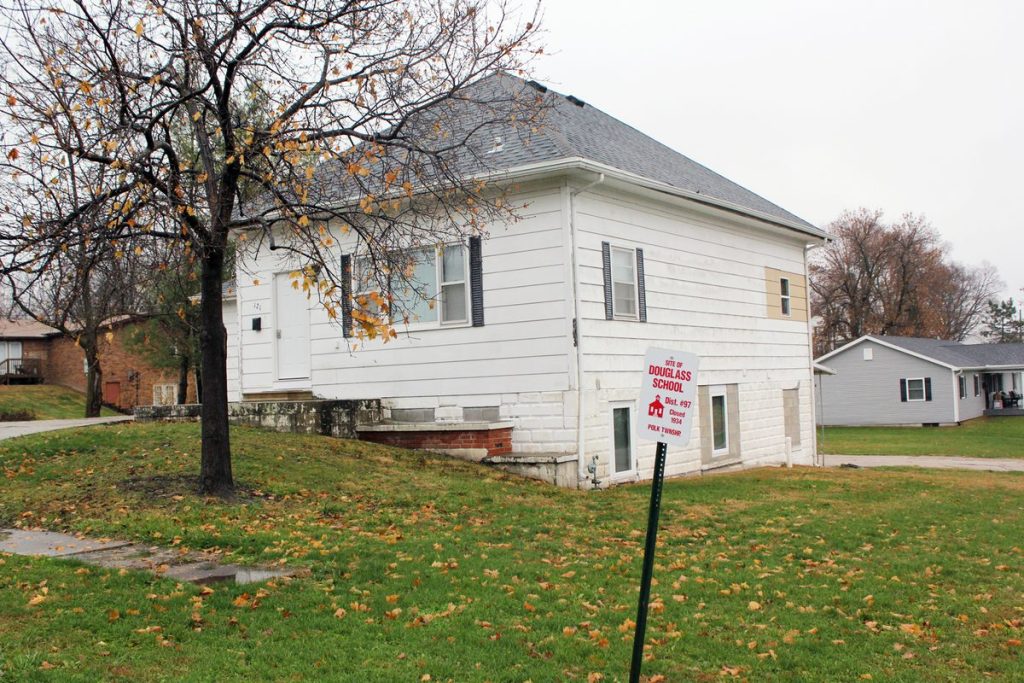
A small sign marks the location of the former Douglass School, now refurbished as a house, which was built to serve African-American children during the segregation era. The school closed in 1934 for lack of students and was later used as a community center, nursery, and private residence.
From the outside, the building on the corner of Water and East Jenkins streets looks like a simple white house, but its bones tell another story.
Today, the residence is nearly unrecognizable as the school for the African-American children of Nodaway County that first opened its doors more than 140 years ago.
Since then, ownership of the building has changed more than half a dozen times. Due to numerous renovations, the structure looks little like the square, white schoolhouse it used to be.
When Tiffany and Ben Scott bought the house four years ago, they considered remodeling it and living there.
“The house we’re in barely won,” Ben said.
The Scotts live in a house directly east of the property now, and they currently rent the old schoolhouse. As they were updating the old Douglass School, they found pieces of the past.
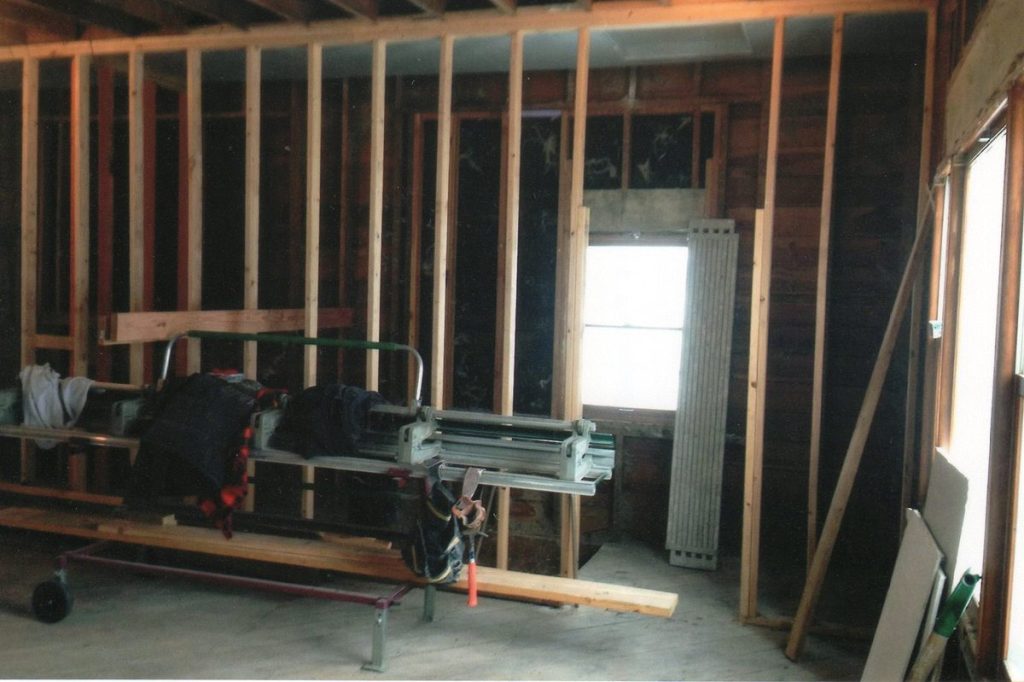
When the Scotts finished the basement a couple of years ago, they found the outlines of the original windows, which had been significantly reduced in size. In addition, much of the original frame structure still remains. The Scotts extensively photographed the remodeling process, so they were able to share their findings.
“It’s got really neat character,” Tiffany said.
Ben said the building’s original design creates a unique living space with 10-foot ceilings and a living room that measures 20 feet by 20 feet, rare dimensions in a modern home.
“My problem is I get attached to these homes and their stories. I have a hard time letting go,” Ben said. “I could live in it in a heartbeat.”
Retired teacher David Primm of Ravenwood acknowledged the structure in a historical record of area schools in “Tales of Nodaway County,” which was published in 1977.
In 1986, Martha Cooper collected ephemera related to the school in “Life, liberty, and the pursuit of happiness, Nodaway County, Missouri: a Black history 1840-1940.” The chapter on the school includes enrollment lists, newspaper articles, Board of Education minutes, and recitation programs.
The Douglass School, originally identified as School No. 3, operated from 1872 until it closed in 1934 due to an insufficient number of students and lack of funding for a full-time teacher. Throughout the school’s existence, it periodically closed for short periods due to low or irregular attendance.
According to Cooper’s research, Maryville couldn’t get enough votes to integrate the schools, so they remained separate.
In 1918, a fire in the chimney damaged the school and it had to be rebuilt.
Ben Scott said that when he and Tiffany were replacing beams and removing the original chimney they found charring in the rafters.
According to Tiffany, she and Ben couldn’t keep some of the remaining original structure intact for safety reasons. The floors had sagged nearly three inches and had to be replaced.
“We’d have loved to redo it, but we had to take every board up to get the level the same,” Ben said. “It’s hard because you want to keep it, but you can’t.”
Minutes from the May 14, 1931, Maryville Board of Education indicate that the dwindling number of students could have been related to tension created by the lynching of Raymond Gunn on Jan. 12.
Records show that Gunn’s younger siblings were attending the Douglass School fewer than five years before the incident.
The board voted to keep the school open as long as there were “enough students” and “provided there is not too much opposition by the public.”
After the last students left, the structure was used as a community center in the 1930s and then a nursery in the 1940s. In 1945, it was sold to Ernest Glover as a private residence.
Sandy Davison of Hopkins lived there with her parents, Etta Mae and Loren “Shorty” Langley, and brother Harold Langley from 1970 to 1992. Davison’s mother lived there until she died in 2009. She and her brother sold the house to the Scotts.
Davison said she grew up knowing her house used to be a school, but she didn’t notice much evidence of the fact because her father was always remodeling and repurposing rooms. Two bedrooms and a bathroom were added in the late 1970s.
“It’s kind of a running joke because my family would always ask, ‘Where’s the bathroom this time?’ when they would come in from out of town,” Davison said.
Davison did recall there had been a raised area on the south side of the home in the kitchen and living room that the family guessed had been a stage.
The address changed when the entrance moved from the south side to its current position on Water Street, and where the door used to be a large window was installed.
A dirt slope covers the north and west sides of what used to be the first floor, but at one time the entire structure was exposed.
Ben and Tiffany plan to paint the house white in spring 2016.
“Right now, it’s kind of a hidden treasure because people don’t realize how nice it is on the inside,” Tiffany said.
The structure has been altered too much to qualify for the National Register of Historic Places, but the Nodaway County Historical Society is still interested in documenting the building’s past.
Anyone with information about the old school can call the society at 660.582.8176.
Jennifer Ditlevson Haglund
When Ben and Tiffany Scott of Maryville renovated the old Douglass School on Water Street, they discovered the outlines of big frame windows long since reduced in size when the structure was converted to other uses.