“Drop in the lap” adoption required readiness
Jennifer Ditlevson Haglund
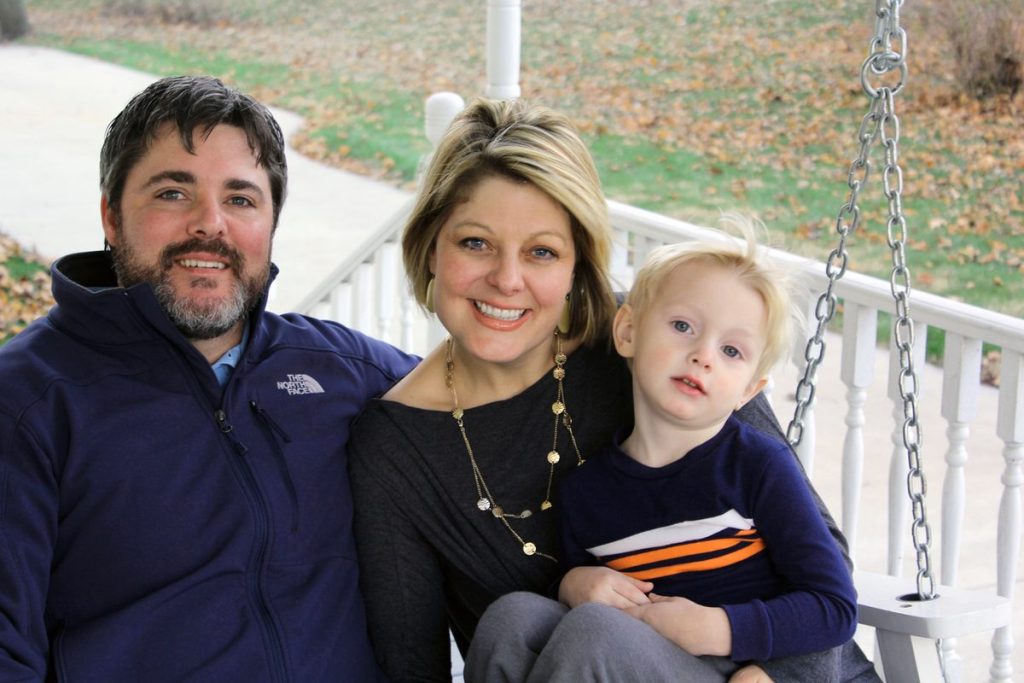
Tim and Nancy Shipley of Maryville told their adoption agency that they would be ready for a child at any time. It was still a surprise when they found out they had 10 days to prepare to meet their son, Renner, who is now 3.
EDITOR’S NOTE: This is the third in a series of stories about Nodaway County families and their experiences with different aspects of adoption. November is National Adoption Month.
When Tim and Nancy Shipley began the adoption process, they knew they could face some challenges. They were warned that dealing with finances, paperwork, home studies, and all the other preparation would require patience.
For many adoption is a stop-and-go situation, but the Shipleys got their green light quicker than they expected.
“It was called ‘a drop in the lap,’” Nancy said.
The Shipleys finished the paperwork with Lifetime Adoption, based in Grass Valley, Calif., and then completed their home study in May 2012. The agency notified them in July that a birth mother was interested in their profile, but they didn’t hear anything until October.
Nancy called the agency just to check in, and she found out that the birth mother had just made the decision to move forward. Ten days later, Tim and Nancy were in Fort Smith, Arkansas, to meet their son Renner.
“It was very quick effort, and we had a lot of people who helped us,” Nancy said.
Although they had already childproofed the home, they still scrambled to get ready. In addition to preparing for the long-term, they also had to prepare for living in a hotel during the waiting period for the adoption to be finalized.
“The tough part about any birth, whether it’s the traditional route or through a nontraditional route, you never know if it’s going to through,” Nancy said. “So we always had in the back of our minds that this (might) not come to fruition.”
Nancy spoke from experience. Before adopting Renner, she and Tim had two failed pregnancies and an unsuccessful surrogate pregnancy. Nancy said the complications were due to her having Type 1 diabetes.
Since Renner was born, the Shipleys have made an effort to share his history with him.
“Now that he’s older and he’s understanding more, I don’t really know how he interprets it and understands it, but it’s something we talk about openly,” Nancy said.
Nancy said she and her husband choose to discuss Renner’s past in hopes that he will not be shocked as he gets older.
“We want him to understand that our family became a family through a different route, and that it’s okay and totally normal. It’s nothing we’re ashamed of or afraid of him knowing,” Nancy said.
Although the Shipleys do not have direct contact with Renner’s mother, they can see how she is doing through her unprotected Facebook profile. If Renner ever decides he would like to know more, the Shipleys have his original birth certificate and his birth mother’s contact information.
“We don’t consider lightly the gift she afforded us,” Nancy said.
The Shipleys are currently updating their records with Lifetime Adoption to adopt another child.
“We want Renner to have someone else in his world that is his family,” Nancy said.
In expanding their family, Nancy said she and Tim are also acknowledging Renner’s birth mother’s request that he grow up in home surrounded by loved ones.
They are open to another “drop in the lap” situation, and they’re ready. This means they could receive a call from the agency and need to get to the child as soon as possible.
Before they knew how they would have children, Nancy said people would tell the couple, “Just adopt.”
“The phrase ‘just adopt’ is a major understatement,” Nancy said.
“Adoption is painstaking, very complicated, very expensive, and very time consuming,” Tim said. “People need to be prepared. It’s not something you can just walk into an office and take care of.”
Tim said people also need to be prepared for disappointment because there’s never a guarantee, and laws vary from state to state.
“There’s really an unlimited amount of research you can do,” he said.
Renner’s legal situation was unique because of his ethnic heritage. He is one-quarter Native American, so the Shipleys had to get the approval from the tribal leaders who had the first right of refusal.
“That is incredibly important because there have been all kinds of cases where the proper steps weren’t followed, and that’s where you run into challenges with long-term placement,” Nancy said.
The legal aspects of finalizing an adoption, Nancy said, can be a burden for adoptive families, particularly if they are open to such a quick placement.
Other legal hurdles include identifying the father because, depending on the state, both parents need to agree with regard to the child’s future.
“As cumbersome as the adoption process is, we didn’t do the hard part,” Nancy said. “The hard part is what the biological parents did.”
Nancy and Tim said they opted for domestic adoption for several reasons and, in addition, had to consider such factors as combined average age, health risks, marital history, and their ability to take time away from work.
“We wanted to support whatever opportunities there were within the U.S. because there are so many people right here who need good homes,” Nancy said.
In Nodaway County there are 37 children in foster care and six licensed homes to care for them. Twenty-six percent of these children are older than 12. In the past five years, 13 foster children have been adopted in the county.