Whodunit writer tells how to do it
Jennifer Ditlevson Haglund
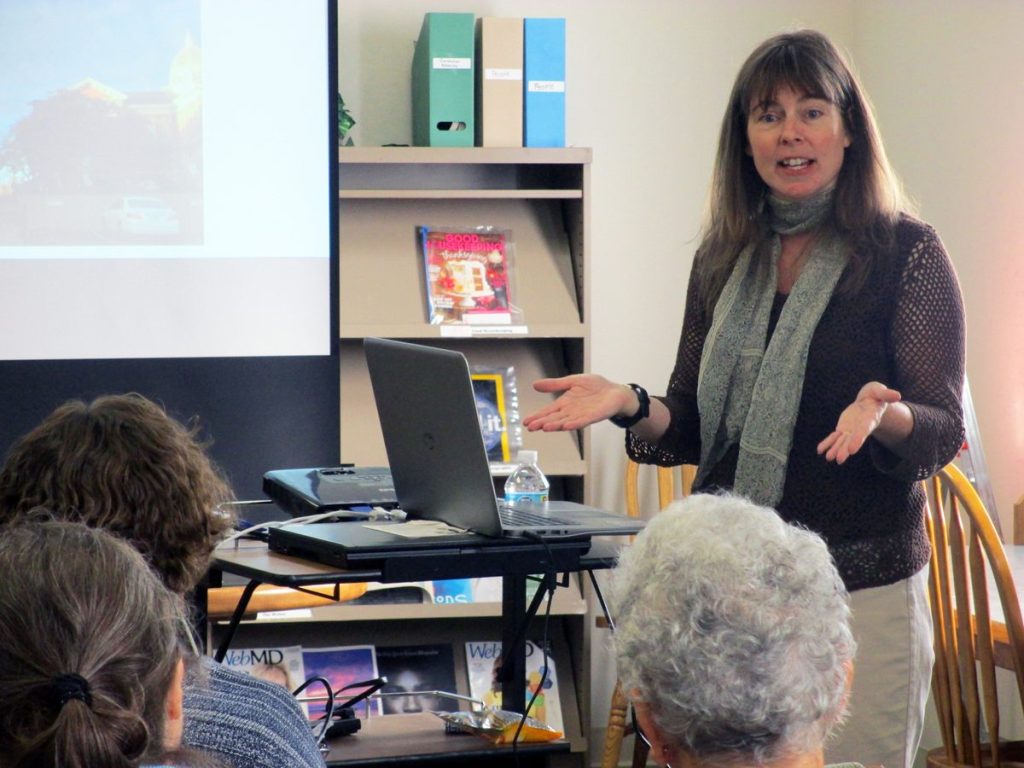
Novelist Anna Loan-Wilsey of Ames, Iowa, described her research processes for writing the Hattie Davish series of cozy mysteries Saturday at the Maryville Public Library to the Maryville Chapter of the Missouri Writers Guild.
When Anna Loan-Wilsey writes historical fiction, the plot might be her own invention. The details, however, are grounded in fact.
In a presentation to the Maryville chapter of the Missouri Writers Guild on Saturday at the Maryville Public Library, Loan-Wilsey explained the importance of accuracy and authenticity in the genre.
Loan-Wilsey writes “cozy” mystery novels set in the 19th Century that follow the adventures of a traveling secretary and amateur sleuth named Hattie Davish.
“Cozies” are a subgenre of crime fiction in which sex and violence are downplayed or treated humorously, and the crime and detection take place in a small, socially intimate community.
Since her first novel, “A Lack of Temperance,” was published by Kensington Press, Loan-Wilsey has written four books in the Hattie Davish series and is currently working on a fifth.
Each novel takes place in a different location, which has prompted Loan-Wilsey to visit Eureka Springs, Ark.; Galena, Ill.; Newport R.I.; and St. Joseph. The forthcoming novel takes place in Washington D.C.
“It’s a challenge for me because that means I have to start over fresh every single time, but then that’s the fun part, too,” Loan-Wilsey said. “I love the research aspect of writing historical mysteries.”
The author said she has several colleagues who write well without ever seeing the settings of their books, but she finds field research essential.
“For me, the most important aspect of the research is the site visit,” she said.
For Loan-Wilsey, site visits allow her to build a more believable world for her readers. Without feeling the weather or checking out the terrain, she couldn’t write with confidence.
“A Deceptive Homecoming,” her most recent novel, takes place in St. Joseph. This challenged Loan-Wilsey more than her previous novels because of the size of the city, which is much larger than any other she has chosen as a setting.
Making genuine scenes required a wider survey of the landscape, walking the streets, and studying documents contemporary with the novel’s setting.
Because the St. Joseph novel referenced Hattie’s growing-up years, Loan-Wilsey also had to spend time researching two different eras.
With a background in library science, Loan-Wilsey values good research. In her presentation, she said she relies on libraries and historical societies that house crucial artifacts and documents she couldn’t find anywhere else.
When researching “A Deceptive Homecoming,” Loan-Wilsey examined an array of archival material. Newspapers, city directories, photo books, Sanborn maps, and locally published history records helped bring her characters to life.
Sanborn Maps is an American publisher of historical and current maps of U.S. cities and towns. The maps were initially created to estimate fire insurance risks.
For example, Loan-Wilsey created Hattie Davish with a love of fashionable hats. Learning where milliners worked in the 1890s in St. Joseph gave Loan-Wilsey a place to put her character.
Research isn’t just for site visitations. To avoid anachronisms in her writing, Loan-Wilsey regularly consults books written about the period regarding dress, transportation, etiquette, and idioms. She also checks etymology sources to make sure she uses appropriate vernacular.
“I do it 30 times a day,” Loan-Wilsey said.
Loan-Wilsey’s fifth book in the series will fulfill her current contract with Kensington Press, but she said she sees more adventures in Hattie’s future.
“She still hasn’t gone out West yet,” Loan-Wilsey said.
Shari Barr of Villisca, Iowa, said she’s looking forward to reading the series. Barr writes Christian mysteries for girls for Barbour Publishing, and her favorite genre is historical fiction, so she was particularly interested in Loan-Wilsey’s approach to recreating the 19th Century.
“I think what drew me was the decorative detail (people in the Victorian era) had for everything, and it appealed to me,” Loan-Wilsey said.
Loan-Wilsey said the period also attracted her because she presumed it to be more genteel than modern times. Research has since changed that opinion, she said, and these days she is more fascinated with the parallels between the late 19th and early 21st centuries.
“The technological changes were as drastic as today,” she said. “Things like electricity, railroads, the typewriter — the typewriter instantly made Hattie Davish an independent woman. How revolutionary is that?”
Susan Cronk of Arkoe, the current president of the Maryville chapter of the Missouri Writers Guild, said she also shares the enthusiasm for the period. Cronk has self-published two nonfiction and six fiction works through CreateSpace from Amazon.