Project Lead the Way launched
CHRIS ROUSH/DAILY FORUM
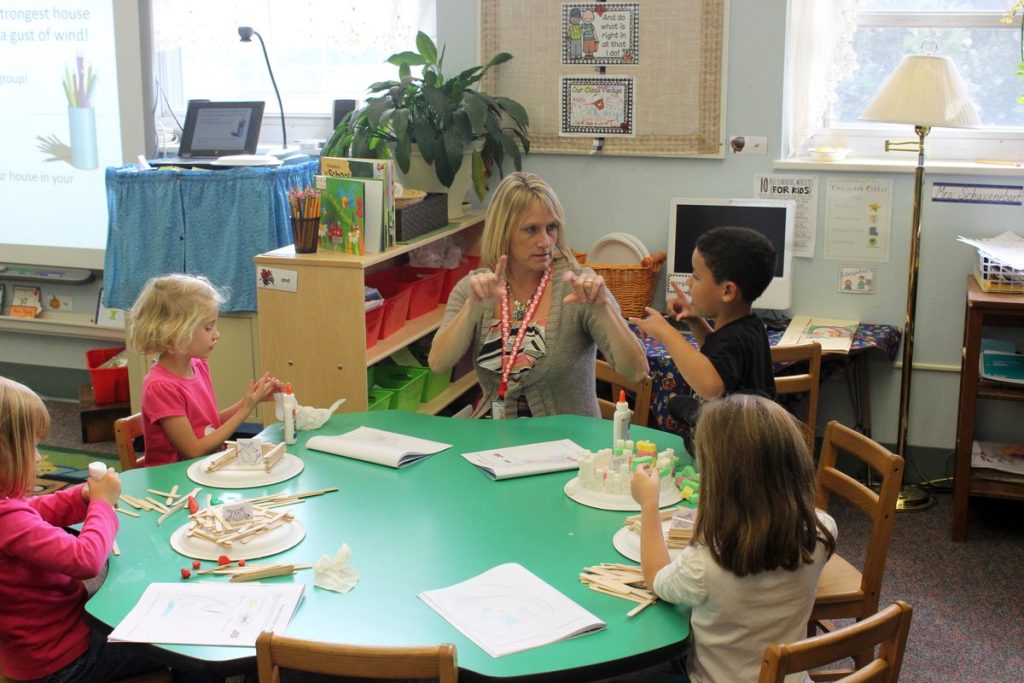
Northwest Missouri State University American Sign Language instructor Marcy Roush works with students at Horace Mann Laboratory School Tuesday afternoon. Horace Mann has become the first elementary school in the area to adopt classroom approaches developed by Project Lead The Way, a non-profit organization that develops curricula emphasizing science, technology, engineering, and mathematics.
Over the past few years, area middle schools and high schools have integrated Project Lead The Way materials into classroom learning activities. But until this fall, no local elementary schools had joined the program.
Project Lead The Way is a non-profit organization that develops STEM curricula for use by elementary, middle, and high schools and provides professional development training for instructors.
STEM is an acronym denoting education efforts geared toward science, technology, engineering and mathematics.
After piloting PLTW in 2014-2015, Horace Mann Laboratory School on the campus of Northwest Missouri State University officially adopted the curriculum at the start of the current school year.
School officials say the STEM-based program, called PLTW Launch, is designed to encourage children to become problem solvers.
On Tuesday, teachers and staff from around the area visited Horace Mann to see PLTW Launch in action during a Carnegie STEM Excellence Pathway workshop.
“We wanted participants to see what it looks like at the elementary level and how easy it is to implement it,” Horace Mann Principal Sandy Seipel said. “There’s a large teacher-training component to it, but once you have that training it’s all about getting the kids to understand the design process.”
Carnegie STEM Excellence Pathway is a program designed to evaluate STEM integration in the classroom. Seipel described the initiative as an assessment tool that measures effective delivery to students across 20 different STEM areas.
At Horace Mann, there are four PLTW modules for each grade level, kindergarten through fifth grade. Each module is composed of approximately 10 hours of instruction over a two-week period.
“We need to get students interested in the STEM areas,” Seipel said. “Research tells us that students lose interest in science by the time they get to middle school because they find it boring.
“It’s really important that we show them it’s not boring, and that career development is tied to what we do in our classroom. It’s really about inspiring teachers, and that translates to our students learning more.”
Seipel said PLTW offers children a chance to develop the kind of practical skills used by engineers and scientists.
“It’s learning from mistakes. Engineers have to keep trying to do things to get better and to make changes. They have to be able revise, and that’s what we’re teaching the kids,” Seipel said.