
UPDATE: City budget balances thrift, new spending
TONY BROWN/DAILY FORUM
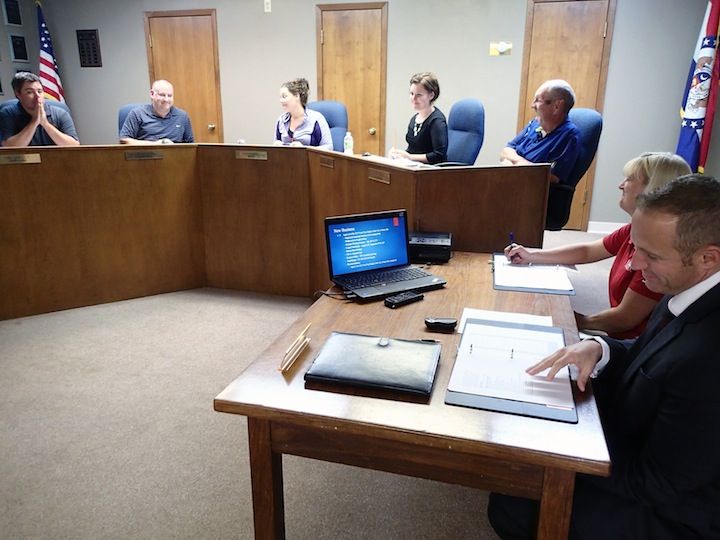
Members of the Maryville City Council are shown moments after approving the $27 million 2015-2016 municipal budget. Pictured from left behind the council dais are Tim Shipley, Jason McDowell, Mayor Renee Riedel, Rachael Martin, and Jerry Riggs. Seated at left are Maryville City Clerk Sheila Smail and City Manager Greg McDanel.
After two intense days of strategic planning in July and a series of lengthy, detailed workshops over the past four weeks, decision time arrived this week for the Maryville City Council, which took a mere half-hour to approve a $27.2 million budget for the new fiscal year that begins Sept. 1.
The city’s 2015-2016 spending blueprint totals about $5 million less that the budget for the current year, which included significant spending for Maryville’s new $13.7 million sewer treatment plant.
In addition, next year’s budget trimmed dollars in several areas as a result of diminished capital improvement funds available from a half-cent sales tax. Remaining revenue from the tax is largely earmarked for servicing debt incurred to finance completed projects, such as the reconstruction of South Munn Avenue and Depot Street.
The resulting “priority based” budget means several entities relying on municipal appropriations will get less support than they asked for.
Among those is the New Nodaway Humane Society, which received $82,800 in operational funding for its local animal shelter during the current fiscal year and had requested a $1,000-a-month increase to $94,000 for 2015-16.
However, with the expiration of the society’s municipal contract and increased pressure on the city’s General Fund due to the scarcity of capital improvement revenue, the appropriation for the no-kill shelter was pared back to $60,000.
Maryville City Manager Greg McDanel said the society’s board was informed of the reduction prior to Monday’s meeting.
On Tuesday, McDanel noted that the city continues to support the society through a contract for animal control and said that in 2014 provided the non-profit organization with $114,000 following a request for additional funding.
“In tighter budget years, it is crucial for the city to perform its due diligence and ensure scarce resources are allocated for a wide variety of services,” McDanel said. “The reduced amount of funding toward animal control of $60,000 reflects those tough deliberations.”
He added that the new budget includes an additional $12,000 toward a planned LED lighting project to assist the shelter in reducing electricity costs over the long term. The city is considering switching to LED fixtures at several municipal facilities as well.
Improved energy efficiency at the shelter is a stated goal for the society, since the building must operate 24 hours a day, seven days a week and maintain state-imposed heating and cooling levels designed to protect animal health and welfare.
“Our partnership with NNHS will continue to be evaluated over the next year as we attempt to assist them as much as responsibly possible,” McDanel said.
Other organizations funded at less-than-requested levels include the Maryville Downtown Improvement Organization, which asked for $10,000 and received $2,000, and the Community Improvement Foundation of Northwest Missouri, which also asked for $2,000, but got half that.
Additional reductions for next year include a cut in street overlay spending from well in excess of $600,000 to a little more than $300,000.
Budget winners include City of Maryville employees, who will receive a total of $120,355 in wage hikes tied either to market-based increases or merit pay. That figure assumes full staffing and the creation of no new positions
Among the highlights of this year’s General Fund budget is $108,270 earmarked for engineering of proposed pedestrian and traffic-flow improvements along the often-congested South Main Street corridor.
Design work is expected to continue over the next two years, and the current budgeted total includes an $86,000 Missouri Department of Transportation grant that has yet to be approved.
Water-sewer items proposed for 2015-2016 include a $325,000 trunk line replacement and the relining of 100 of the city’s more than 800 manholes at a cost of $225,000.
Five hundred thousand dollars has been set aside for improvements to the southwest lift station on the south side of Route V, but McDanel said the line item, for now at least, is a “placeholder,” since the city staff hopes to receive a state Community Development Block Grant to pay for at least part of the project.
The proposed budget sets aside $250,000 for painting the interior of the city’s main water tower at the terminus of West Edwards Street and $80,000 for installation of a new Mattie Street water line.
Capital spending at Mozingo Lake Recreation Park will total about $2 million, including $652,000 in capital outlays. That figure embraces a $390,000 “placeholder” for development of a proposed $3 million conference center the city wants to build in conjunction with a privately developed lakeside hotel.
McDanel said significant new development at the park is possible due to significant reserves and increasing user-fee income. He added, however, that facilities and operations at the 3,000-acre park remain dependent on revenue from a half-cent Mozingo sales tax that expires in 2017.
McDanel said renewal of the tax, which will likely go before voters in April, is “critical” in terms of the park’s fiscal viability.
Also incorporated into next year’s budget is a proposed $3.3 million runway and taxiway renovation project at Northwest Missouri Regional Airport, more than 90 percent of which will be paid for through a Federal Aviation Administration Airport Improvement Program grant.
The city is responsible for a $330,000 match, which is being financed through using a Missouri Department of Transportation Statewide Transportation Assistance Revolving Fund loan to be paid back over 10 years at slightly less than 2 percent interest.
McDanel said pavement at the airport had degraded to the point where “pilots simply don’t want to land,” and that planned upgrades would set the stage for re-branding and marketing efforts similar to those used to raise the regional profile of the offerings at Mozigno Lake.
Fairly recent improvements at the airport, he noted, include the addition of a jet fuel island and construction of a new terminal building in the early 2000s.




