
Stream bank projects delayed by high bids
TONY BROWN/DAILY FORUM
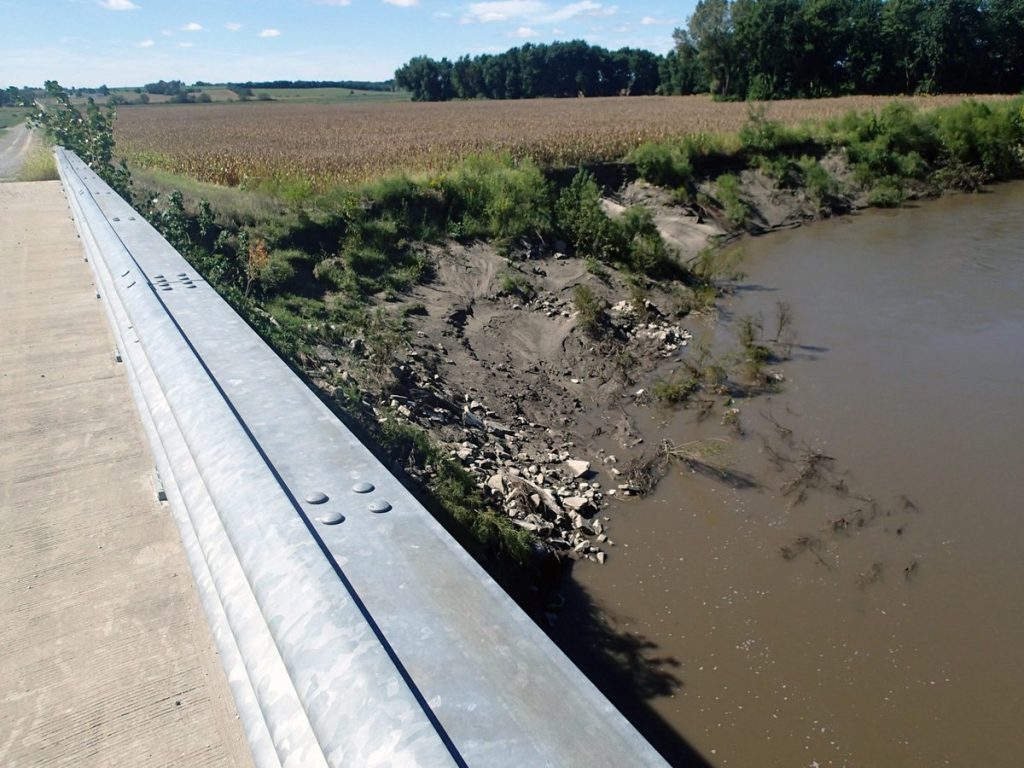
The Nodaway County Commission’s efforts to secure federal funding for stream bank stabilization at erosion sites near four bridges on rural roads north of Maryville, including this spot on the One Hundred and Two River at 220th Street, ran into trouble last week when contractor bids exceeded project estimates set by the Natural Resources Conservation Service.
An effort to slow stream bank erosion that promises to undermine several rural bridges in northern Nodaway County hit a snag last week after contractor bids for lining the banks with riprap came in higher than estimates provided by the USDA’s Natural Resources Conservation Service.
The Nodaway County Commission has been working with NRCS this summer to move the stream bank stabilization project forward, but Friday’s bid opening means the project will likely be delayed until 2016.
During the proposal’s initial stages, NRCS proposed providing nearly $900,000 in federal funds for riprapping banks near as many as a dozen bridges in various parts of the county in exchange for a $224,000 local match.
Due both to the size of the match and an Oct. 15 project deadline, the commission decided earlier this summer that it would accept funding for four locations only.
Targeted stream banks include three locations along the One Hundred and Two River north of Maryville near bridges east of Highway 148 on 220th, 190th, and 180th streets. A fourth endangered bridge, bid out as a separate project, spans Norvey Creek on Liberty Road, southeast of Hopkins.
All four projects were to have been carried out prior to the end of the year.
That timetable was interrupted Friday when the only two bids submitted, by BRS Construction in Edina and Young General Contracting in Poplar Bluff, exceeded NRCS’ $602,000 estimate, a total that includes a $150,000 local match.
Young was the low bidder at $710,000, but the three-member commission indicated the offer would be rejected. The BRS offer came in at nearly $737,000.
In an attempt to save the stabilization project, and with the clock ticking toward an Oct. 7 deadline for the Norvey Creek site and a Dec. 15 deadline for the One Hundred and Two River locations, NRCS District Conservationist Chris Rader said she would request a 120-day extension from her agency.
Rader’s colleague, NRCS area engineer Brad Schreck, said he would meet with the contractors in an effort to find out why the bids were significantly higher than agency estimates.
Should NRCS determine that the bids were justified by actual project costs, Schreck said it is possible the agency will shift funding from the original $896,000 allocated for all 12 bridge sites in order to provide more dollars for the four stream bank locations identified by the commission.
However, Schreck said there were “no guarantees” that such flexibility is possible.
South District Commissioner Robert Stiens said the commission limited the stream bank initiative to four sites because the scope of work would have been difficult to complete in the time allowed, and because the 25 percent match requirement would have put too much strain on a transportation budget already stretched by emergency repairs to flood-damaged bridges and drainage tubes.
He said the commission reviewed all of the sites and picked the four it believed were most at risk of being undermined by erosion.
Even with federal funds covering 75 percent of the cost, riprapping crumbling stream banks is an expensive chore, but one with which the commission would like to proceed in as many locations as possible, assuming NRCS requirements can be met and matching funds are available.
Keeping stream banks intact, North District Commissioner Robert Westfall pointed out, is less expensive than replacing washed-out bridges.
“We want to fix the stream and save the bridge,” he said.




