Nodaway County producers experience high prevented planting numbers
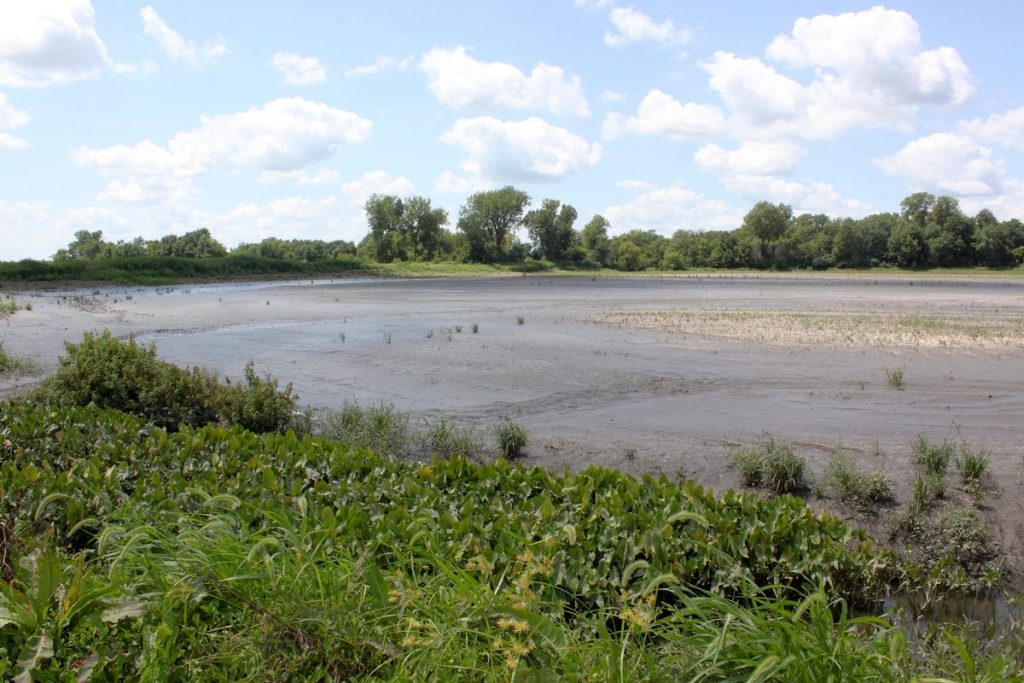
KAITY HOLTMAN/DAILY FORUM
Nick Barmann’s soybean field on the east side of the 102 River, north of Route U, near Arkoe sits unaccessible due to standing water and surrounded by thriving weeds. While Barmann was able to plant parts of this field, much of it was unaccessible from the start of soybean planting season. He said his prevented plant acres were pretty spotty, but this field did have the most out of any of his crop ground.
A wet, cloudy and cool spring and early summer delayed planting season in Nodaway County and parts of Missouri and Iowa. With muddy fields and standing water in their way, many producers pushed the limits of planting deadlines set for crop insurance.
A phrase began circling the county and much of the region that hadn’t been heard in quite some time – prevented planting.
The Missouri Farm Service Agency (FSA) announced that county offices could accept prevented planting claims for all appropriate crops until July 15, as long as producers took the necessary steps.
Because this county is one of the largest counties in the state, much of which is covered in crop ground, Nodaway County FSA Executive Director Tim Dreier said they just completed all of the appointments made by producers to turn in final crop reports in early August.
“Nodaway County had 666 farms report prevented planting,” Dreier said.
To break that down by acres, 28,542 acres of corn and 15,180 acres of soybeans were turned in as acres unable to plant, for a total of 43,722 acres.
“Our five-year average planted acres for each crop are approximately 125,000 corn and 142,000 beans,” he said. “So, about 22.8 percent of our typical corn crop is prevented and about 10.7 percent of the bean crop is prevented. Overall that is 16.4 percent prevented.”
The U.S. Department of Agriculture’s (USDA) National Agricultural Statistics Service (NASS) released crop production report on Wednesday, Aug. 12. The release included data for 2014 and projected data for 2015 as of Aug. 1.
According to NASS, the area planted in corn is estimated at 3.20 million acres, unchanged from the previous estimate but down 9 percent from last year.
Harvested area, forecast at 3.05 million acres, is unchanged from the previous forecast but down 10 percent from 2014.
Based on Aug. 1 conditions, Missouri’s corn yield is forecast at 150 bushels per acre, down 36 bushels from 2014. Production is forecast at 458 million bushels, 27 percent below the previous year.
Looking at statewide soybeans, planted area is estimated at 5.10 million acres, down 11 percent from the June estimate and down 10 percent from last year.
Harvested area, forecast at 4.95 million acres, down 12 percent from 2014. Production is forecast at 188 million bushels, down 28 percent from 2014 and the lowest level since 2012.
Based on Aug. 1 conditions, the Missouri soybean yield is forecast at 38 bushels per acre, an 8.5 bushel, or 18 percent, decrease from 2014. If this yield is realized, this will be the biggest year-to-year drop since 2004-2005, according to NASS statistics.
“Those years (2004-2005) were similar to the last two in that we had record yields in both 2004 and 2014,” said NASS Statistician Bob Garino. “In 2004, we had great conditions for soybeans and were substantially higher than any year before. In 2014, we had a new record but it was just 1.5 bushels higher than the 2004 record.”
Garino pointed out, using the chart below, that if one were to remove 2004, it would be obvious that the 2005 yield of 37 bushes per acre was among the best over the last 10 years, but weather conditions were more normal.
“So yield returned to a level corresponding to a good yield given typical conditions,” Garino said. “That’s true in some sense this year, even if we didn’t have all of the rains, chances are weather conditions would be more typical and the yield would fall back some.”
The consistently diagonal line in the chart below represents the trend in yield since 1980. Anything on the line represents the expected yield given fairly normal weather conditions, according to Garino.
“You can see the 37 bushels/acre yield in 2005 is on the line,” he said. “This year’s estimated yield is below the line. That’s due to the poor conditions we’ve had this year with the wet weather delaying planting, which reduces yield, along with uneven stands due to excess water on fields.”
The most recent NASS crop progress report shows that crops continue to make progress, even though that progress lags the five-year average and 2014 numbers.
Statewide, corn progressed little this week, moving to 93 percent in the silk stage, 68 in the dough stage, and 31 percent in the dent stage. These numbers are actually only slightly behind the 2014 and five-year average numbers. Northwest Missouri lags the rest of the state at 88 percent in silking and 51 percent in dough stage.
On the contrary, soybeans made strides of progress this week, with 58 percent blooming and 27 percent setting pods. One week earlier only 46 percent had bloomed and 20 percent had set pods. Soybeans still have much progress to make, lagging the five-year average of 80 percent bloomed and 45 percent setting pods during this week. Again, northwest Missouri lags the state with 50 percent blooming and 15 percent setting pods.
The majority of both crops, across the state and in northwest Missouri fall are showing good to fair crop conditions.
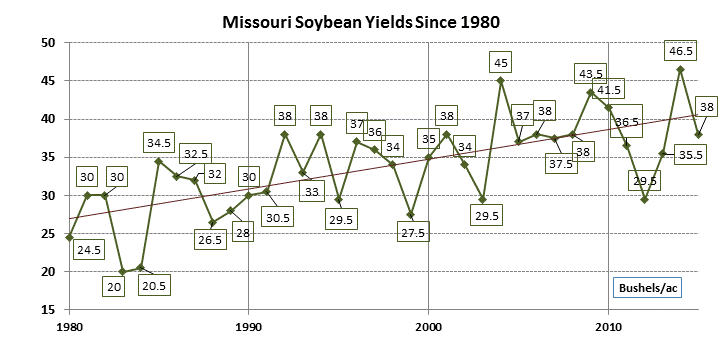
GRAPH COURTESY OF USDA/NASS
The U.S. Department of Agriculture’s National Agricultural Statistics Service keeps yearly records of all crop progress and statistics. This chart shows how Missouri’s soybean yield has consistenly increased over the last 35 years, due to technological advances.