Local student awarded chemistry fellowship
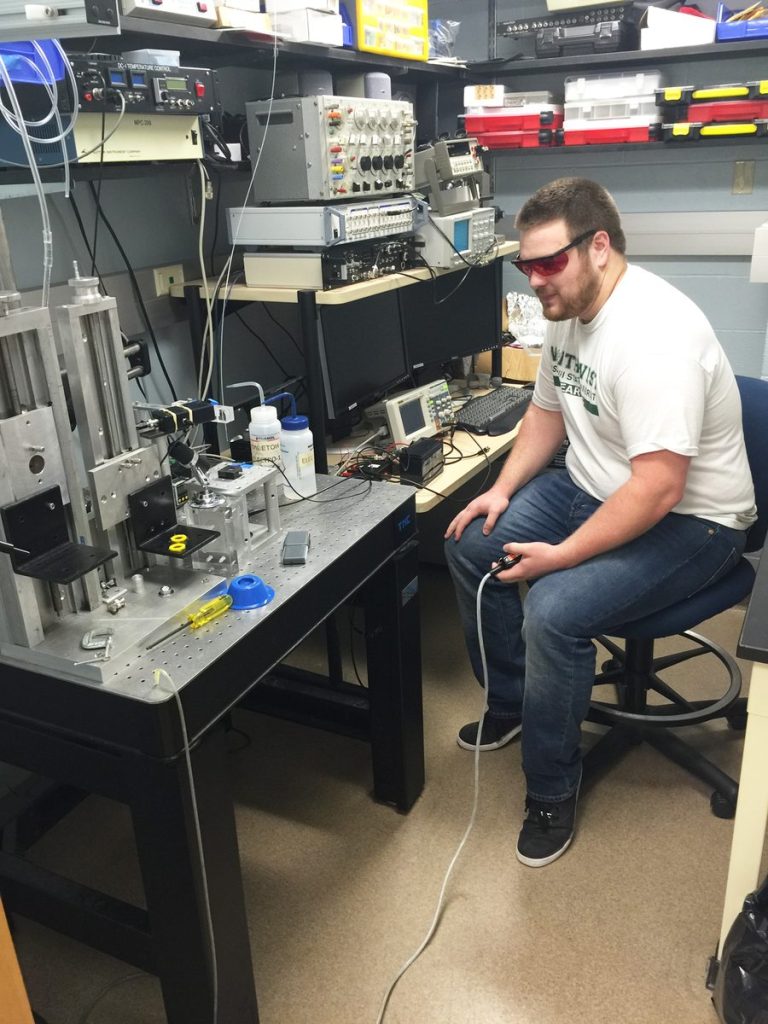
SUBMITTED PHOTO
Daniel Johnson, of Maryville, a senior chemistry major at Northwest Missouri State University, is conducting nanotechnology research this summer as a Stevens Fellow. The Fellowship is allowing Stevens to take part in research being conducted by Gary Baker, an assistant professor of chemistry at the University of Missouri-Columbia, and Abdul Mottaleb, an analytical chemist at Northwest.
MARYVILLE, Mo. — Northwest Missouri State University student Daniel Johnson is spending his summer learning and applying nanotechnology techniques related to cancer detection.
Nanotechnology is a rapidly developing field of study that deals with the manipulation of matter on a molecular or atomic scale — objects so small they are measured in nanometers, a unit of length equal to a billionth of a meter.
Northwest’s nanotechnology program is headquartered in the Dean L. Hubbard Center for Innovation and Entrepreneurship on the Northwest campus.
“We plan to be able to detect cancers of smaller mass and volume than other methods currently in use at a very low cost,” said Johnson, who grew up in Maryville. “The end use of the nano-particles is to use them to detect cancer cells.”
Johnson, a senior chemistry major, is a recipient of the prestigious Stevens Fellowship, which has allowed him to take part in a research conducted by Gary Baker, assistant professor of chemistry at the University of Missouri-Columbia, and Abdul Mottaleb, an analytical chemist at Northwest.
Johnson’s work with Baker’s team, which also includes several Ph.D. candidates, embraces the testing of non-toxic particles that scientists believe can help detect small malignant tumors.
The fellowship is providing Johnson with a chance to learn about the syntheses and characterization of various nano-materials — or the creation and analysis of new materials — through something called photoacoustic spectroscopy.
In simple terms, Johnson shines a laser on tiny particles and listens to the sound waves they create in an effort to determine how well the particles can detect cancer.
“This internship will be very useful to Daniel in that it will provide professional experience that he can include on his resume,” said Michael Hull, assistant professor of chemistry at Northwest. “Additionally, he will gain exposure to what it means to work as a professional chemist as well as picking up several new skills.”
Earlier in his Northwest college career, Johnson worked with Mottaleb and a group of his fellow undergraduates on a project that led to the students presenting findings at a national meeting of the American Chemical Society in Denver, Colorado.
He is also studying synthesis techniques with Hull through the study of haloalkanes, a group of chemical compounds containing one or more halogens, and the only group in the periodic table containing elements in three of the four main states of matter at standard temperature and pressure.
“A lot of the skills used to do research can be applied in many fields,” Johnson said. “Things like searching the literature for similar work, data analysis and general problem solving are common themes in research.
“The experience I gained working with Dr. Mottaleb and Dr. Hull prepared me for the work environment that I am currently in.”
After graduating from Northwest in December, Johnson plans to attend graduate school and purse a career in ultrafast laser spectroscopy research.