County seeks disaster funding eligibility
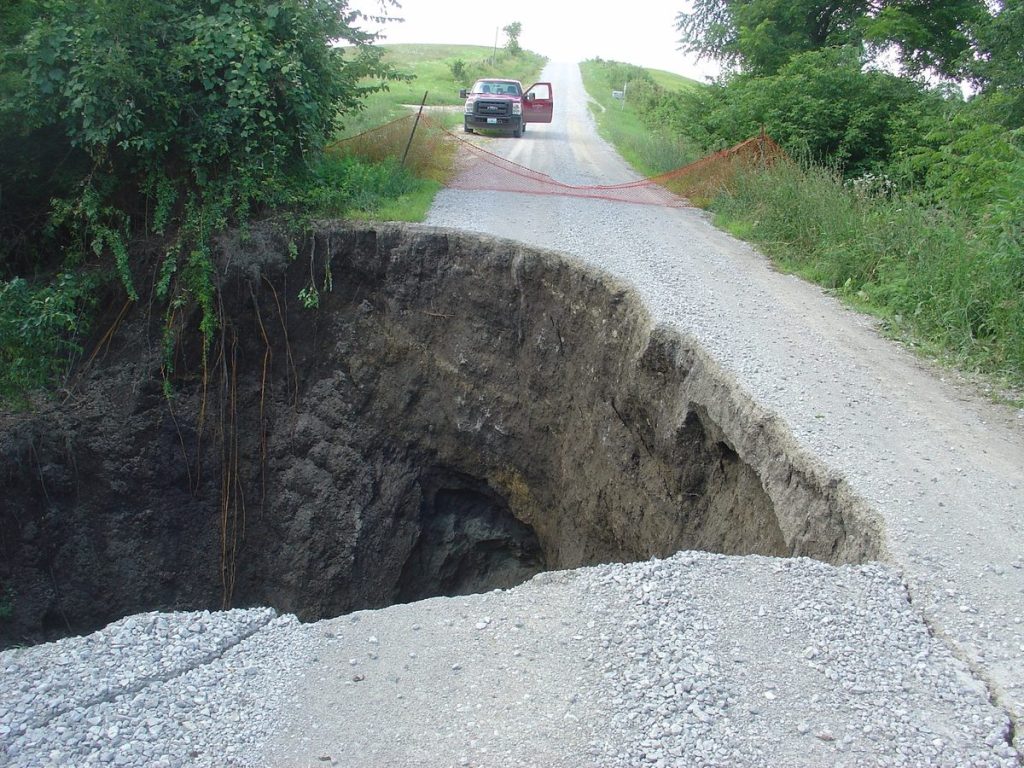
NODAWAY COUNTY PHOTO
Heavy rainfall earlier this month caused a portion of this gravel road near Route F southeast of Maryville to collapse. County officials report that more than 30 tube crossings and bridges were damaged by mid-July flooding and estimate repair costs at between $600,000 and $750,000.
The County Commission is working with emergency management coordinator Christy Forney in an effort to get Nodaway County added to a weather-related disaster declaration request issued July 21 by Gov. Jay Nixon.
Nixon’s request asked that the federal government declare a major disaster for 70 of Missouri’s 114 counties “as a result of the prolonged severe storm systems that have generated tornadoes, straight line winds, torrential rain, hail, flooding and flash flooding across large portions of the state since May 15.”
The storms, Nixon wrote, have resulted in at least ten deaths statewide and extensively damaged roads, bridges and other public infrastructure.
Forney said Friday that county officials didn’t submit an initial request to be included in the declaration request, but changed their minds following a string of mid-July storms that cleared gravel from rural roads, eroded bridge approaches and washed out drainage tubes.
The series of storms produced at least one tornado, which destroyed part of the sprawling Graham Seed Cleaning complex the night of July 15 in southwestern Nodaway County.
South District Commissioner Robert Stiens said Friday the cost to repair damage to roads, bridges and drainage tubes is estimated at between $600,000 and $750,000.
During the commission’s regular Friday session, Road and Bridge Supervisor Larry Dougan submitted a list of about 35 locations across the county where infrastructure has been affected by severe weather over the past couple of weeks.
In addition to bridges and tube crossings, Stiens said heavy rainfall swept the gravel from many unpaved roads, which are largely the responsibility of the county’s 15 townships. Should federal funding be approved, Stiens said the commission would meet with township officials in an attempt to determine the extent of assistance needed by each of the political subdivisions.
“Beginning in mid-May, more than half of Missouri has been hit by a damaging and prolonged weather system that’s brought record rainfall to much of the state and led to extensive damage to public infrastructure and private property and led to tragic deaths,” Nixon stated in his message to federal emergency management officials. “Communities across the state have been hit with extensive response and rebuilding expenses. I’m asking that federal assistance be available to help with that effort.”
Nodaway was virtually the only spot in the region not on Nixon’s initial list, which included all five neighboring counties: Andrew, Atchison, Gentry, Holt and Worth.
Nixon first declared a state of emergency in Missouri on June 18. That order activated the State Emergency Operations Center and enabled the state to mobilize resources, including the State Emergency Management Agency, to assist local authorities.
Earlier this moth, Nixon extended the state of emergency until Aug. 14.
The July 21 disaster declaration request encompasses the following 68 counties: Adair, Andrew, Atchison, Audrain, Barry, Bates, Benton, Buchanan, Caldwell, Chariton, Christian, Clark, Clay, Clinton, Cole, Crawford, Dade, Dallas, Daviess, DeKalb, Douglas, Gentry, Harrison, Henry, Hickory, Holt, Jefferson, Johnson, Knox, Laclede, Lafayette, Lewis, Lincoln, Linn, Livingston, McDonald, Macon, Maries, Marion, Miller, Moniteau, Monroe, Montgomery, Morgan, Osage, Ozark, Perry, Pettis, Pike, Platte, Polk, Putnam, Ralls, Ray, Ste. Genevieve, Saline, Schuyler, Scotland, Shannon, Shelby, Stone, Sullivan, Taney, Texas, Washington, Webster, Worth and Wright.
In addition, the Governor is seeking “individual assistance” for 15 counties: Barry, Clay, Christian, Greene, Jackson, Jefferson, Knox, Lewis, Lincoln, Marion, Osage, Ray, Ste. Genevieve, Stone and Webster. Each of those counties, except for Greene and Jackson, is also included in the request for public assistance.
Individual assistance means individuals and households can seek federal assistance for uninsured losses from severe weather and flooding. Public assistance allows local governments and non-profit agencies to seek emergency funds for weather-related response and recovery.
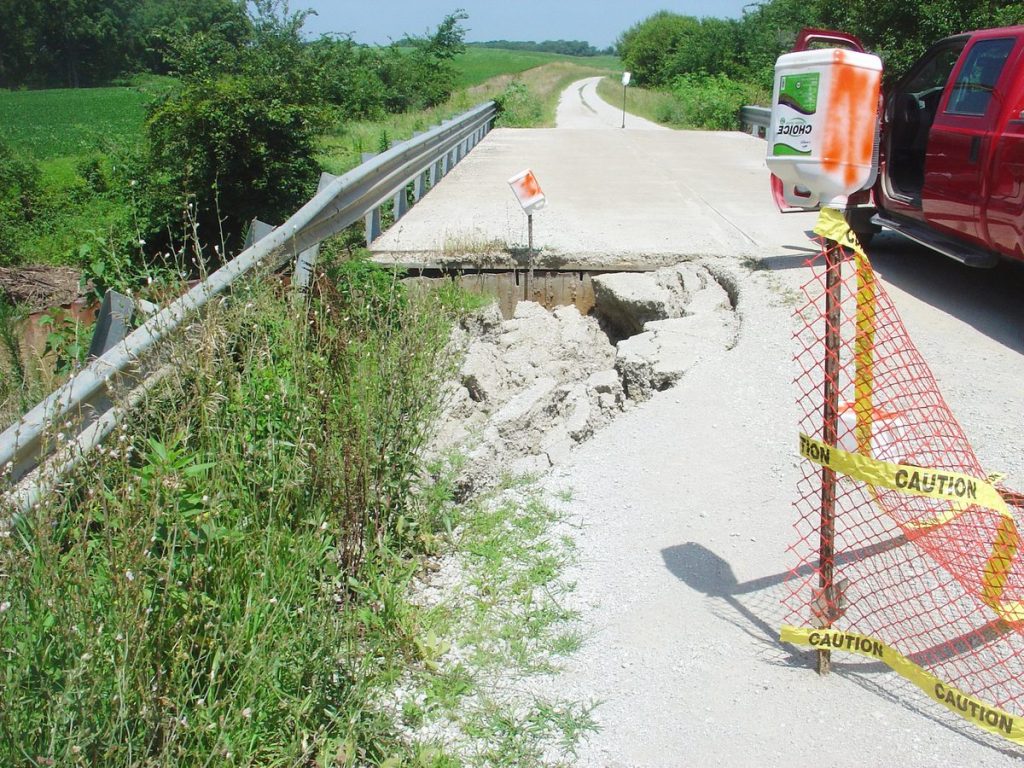
NODAWAY COUNTY PHOTO
Though no bridges were destroyed by July’s severe weather in Nodaway County, a number were damaged as rushing water ate away at the approaches to creek and river crossings. In an attempt to secure federal disaster funding, Road and Bridge Supervisor Larry Dougan last week compiled a list of about 35 locations across the county where infrastructure has been affected by heavy rain and flooding.
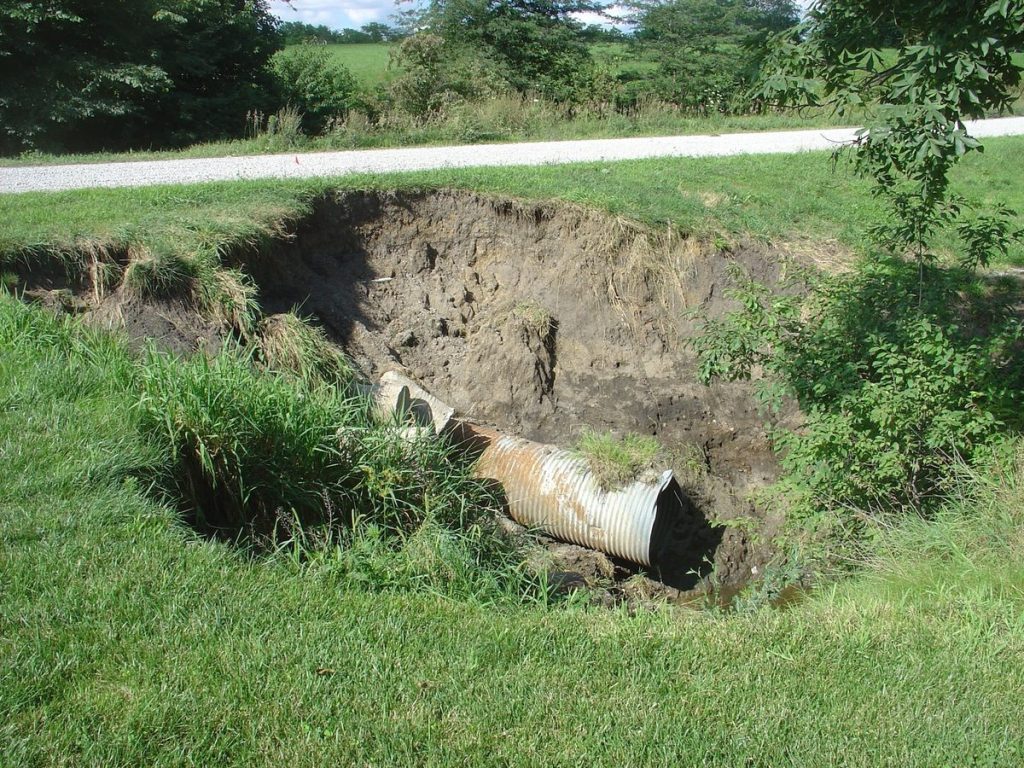
NODAWAY COUNTY PHOTO
A drainage tube lies exposed in a hole eroded along the side of a gravel road in rural Nodaway County. July’s heavy rains inflicted widespread damage on the county’s road and bridge infrastructure, leading officials to seek inclusion on Gov. Jay Nixon’s recent request for federal disaster funds.