NoCoMo reports solvency, safety
TONY BROWN/DAILY FORUM
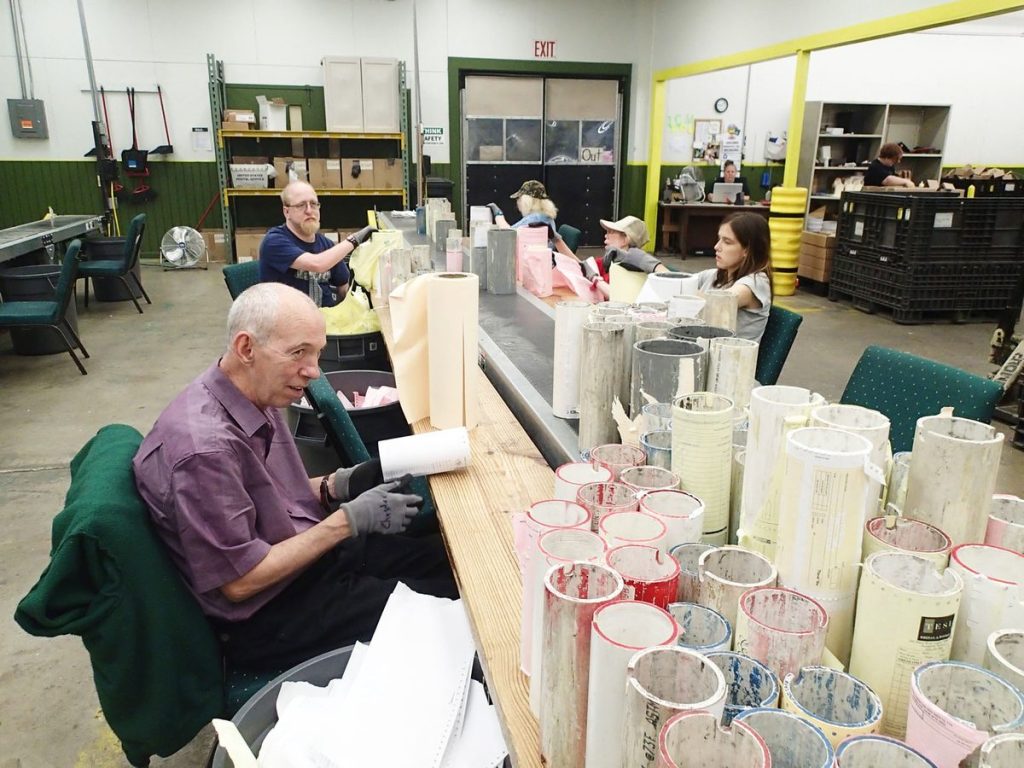
Employees strip paper business forms off end rolls while working on the NoCoMo Industries Inc. sheltered workshop assembly and sorting line Wednesday morning. On Wednesday, the workshop’s Board of Directors reviewed a report from General Manager Nicki Samson detailing the organization’s fiscal and operational health five years after the debt-ridden facility was nearly closed by the state for a litany of health and safety violations.
The NoCoMo Industries Inc. sheltered workshop Board of Directors this week reviewed a report from General Manager Nicki Samson summarizing Samson’s first five years at the helm of the manufacturing and recycling complex that provides jobs to about 45 local residents coping with cognitive and developmental disabilities.
Board President David Lawyer said Wednesday the report offered a snapshot of the progress NoCoMo has made since a May 2010 site inspection conducted by Fulvio Franzi, director of the Missouri Department of Elementary and Secondary Education’s sheltered workshop division.
Following the inspection, Franzi declared the facility to be in violation of numerous health and safety violations, many of them related to piles of discarded clothing and household items that had accumulated at the workshop, which at that time operated a thrift store in downtown Maryville.
Stacks of trash, junk and garbage, along with the general state of affairs at the South Newton Street facility, Franzi wrote at the time, meant the workshop failed “to meet the most basic standards of most places of work, much less regulatory compliance.”
Specific violations included faulty fire safety systems, trip hazards, unsanitary restrooms and break areas, unsafe electrical connections, improperly stored chemicals and “a total disregard of housekeeping standards and principals.”
The workshop was also a mess financially, according to Samson’s report, which noted that in July 2010 the operation paid $15,000 in wages and posted only $13,000 in gross sales. After paying rent, utilities and other expenses, NoCoMo recorded a $6,000 loss for the month, she recalled.
In addition, according to the report, there were no cash reserves, and the non-profit, state-subsidized corporation was struggling to pay off a $76,000 mortgage.
Given 90 days by Franzi to make major changes or face closure, Samson, who was hired by Lawyer and a reconstituted board in July 2010, said workshop staff and supporters undertook what seemed an almost impossible task.
Months of hard work and tough decisions, including firing and hiring of staff, followed, but five years later, Lawyer said Wednesday, NoCoMo is debt free, fully certified with regard to health sand safety, and fiscally sound.
“If we were a publicly traded company, our stock would be going through the roof,” said Lawyer, a senior manager at the Deluxe Corporation manufacturing plant in Maryville. “It’s been astounding to me how we’ve gotten from where we started to where we are today. I told the board five years ago that time was going to be the test, but I never thought we would pass that test like we have.”
Today, NoCoMo, which has shed the thrift store, consists of three basic production operations comprising custom-built pallets and crates; a packaging, fabrication, assembly and sorting line; and a recycling center.
The workshop’s $650,000 annual budget includes $130,000 in state funding under Senate Bill 40, which provides for a voter-approved property tax levy, and about the same amount of money from DESE earmarked for operational expenses. The remainder, nearly $400,000, comes from contracted sales of workshop services and products to private sector companies and is used to pay wages.
Samson’s report states NoCoMo’s asset-to-liability ratio has gone from 2.8 (dollars) to 1 in 2010 to 50.7 to 1 today. In addition, the organization is debt free after paying off its mortgage in 2013.
On other fiscal fronts, Samson said the workshop has managed to bank significant cash reserves, but has yet to achieve the six- to nine-month operational cushion recommended by the DESE.
As a corporate manager, Lawyer is pleased with the workshop’s hard-earned solvency, but he said the improvements he is most proud of have to do with the conditions enjoyed by workers.
“We have an employee-driven safety committee,” he said. “People have ergonomically correct chairs — an environment to work in that is worlds apart from what it was.
“The employees have been the biggest winners in this process. There’s better climate control. It’s warm in the winter and cool in the summer, and that’s important for these people. It’s the health, safety and cleanliness; the entire working environment from head to toe.”
Other points of progress mentioned in Samson’s report include:
• Award of a $100,000 DESE grant to buy bailers, a skid loader and other equipment used to expand the recycling operation, which now embraces a partnership agreement with Porter Trash Service for the collection of recyclable materials over a five-county area.
• Award of a grant that allowed the workshop to replace its lighting system and receive a $10,000 rebate from Kansas City Power & Light, an amount equivalent to about eight months’ worth of electricity bills.
• Award of additional grants for forklifts, a pickup truck/trailer and new woodshop equipment.
• Installation of an upgraded telephone and paging system.
• Installation of new fire alarms and fire extinguishers with the assistance of donations from the Maryville Pride Lions Club, Knights of Columbus and the Fraternal Order of Eagles.
• A grant award for a pair of new heat pumps and upgrades to restroom facilities, including new handicap-accessible restrooms serving the cafeteria area.
Samson, like Lawyer, said the long list of improvements to the physical plant has contributed to positive changes in the workshop’s corporate culture.
Asked to name the biggest change at NoCoMo over the past five years, Samson responded at first with a single word.
“Camaraderie,” she said.
“Camaraderie and the true sense of being a team working together. We are the NoCoMo team, and we stress that everyone is a member.”