
Sheriff’s Department purchases body cams
TONY BROWN/DAILY FORUM
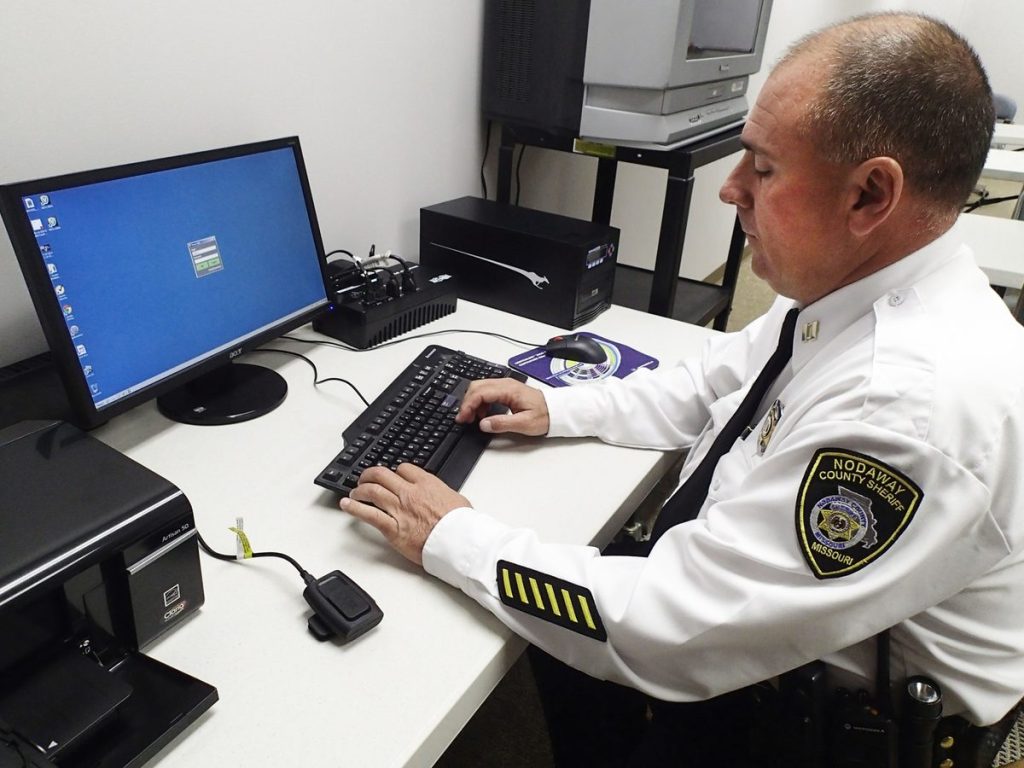
Capt. David Glidden downloads audio/video files from one of the Nodaway County Sheriff’s Department’s new body-worn cameras, pictured at left. Glidden said the cameras have enough storage capacity to record continuously throughout at least one duty shift, and probably two or three. However, deputies will download the devices daily at the conclusion of their tours. Body cameras are being issued to 13 uniformed county officers, including Sheriff Darren White, 11 deputies and a bailiff and should be fully deployed by the end of next week.
The Nodaway County Sheriff’s Department has joined what is becoming a universal trend in law enforcement and will equip all of its officers with body-worn cameras.
Sheriff Darren White said Wednesday the cameras, which have arrived from the manufacturer and are currently being charged and programmed, should be in use by the end of next week and were purchased after an extended period during which the department tested various makes and models.
White called such cameras “the wave of the future in law enforcement,” and “an asset in both criminal prosecution and in the prevention of frivolous litigation.”
The Nodaway County Commission budgeted $15,000 for the acquisition of Sheriff’s Department cameras during the current calendar year. In a report to the commission earlier this spring, Deputy Jamie Vicker said he anticipated that amount would be sufficient to purchase both body cameras and car cameras for the department’s 12-vehicle patrol fleet.
Several vehicle cameras are already in use by the department. Body cameras are being issued to 13 uniformed officers, including White, 11 deputies and a bailiff.
The sheriff’s office will be the fourth local agency to deploy body cameras in the field. Maryville Public Safety officers started wearing body cams two years ago, long before the devices became a hot topic following the fatal shooting of Michael Brown by former Ferguson police officer Darren Wilson.
Other Maryville-based agencies equipped with wearable cameras include the Northwest Missouri State University Police Department and the Nodaway County Ambulance District.
Though mini-cam technology has been around for a while and is proving increasingly reliable and easy to operate, equipping officers and patrol cars with portable cameras is not as simple as it sounds. Agency administrators have all sorts of issues to sort through, such as when the cameras should be turned on and how long hundreds, or thousands, of hours of video records should be stored.
Storage and access are especially important concerns, since video files take up a lot of server space, and departments must guard against accidental, or intentional, deletions.
Such concerns have yet to sort themselves out. Northwest police, for example, hang on to their videos for 30 days. Departments in other cities have created policies requiring electronic images to remain on file for several years.
White said his department also plans to use a 30-day window for retaining audio/video files unless the recordings figure in an investigation. He added that an overall policy provided by the cameras’ manufacturer, VieVu, appears to cover most concerns and is being adopted, at least for the time being.
Deputies, White said, will be required to keep the cameras turned on anytime they are dealing with the public.
“Pretty much if you have contact with citizens, they need to be on,” White said. “That way it keeps everybody on the up and up.”
Sheriff’s Capt. David Glidden said the cameras have enough storage capacity to continuously record both audio and video throughout at least one duty shift, and probably two or three. Deputies will download the devices onto a storage drive each day at the conclusion of their tours.
The cameras were purchased from VieVu for a total of $11,000 to be paid over three years. Included in that cost is an unconditional warranty under which cameras damaged for any reason will be replaced free of charge.




