Veterans’ legacies written in stone
TONY BROWN/STAFF WRITER
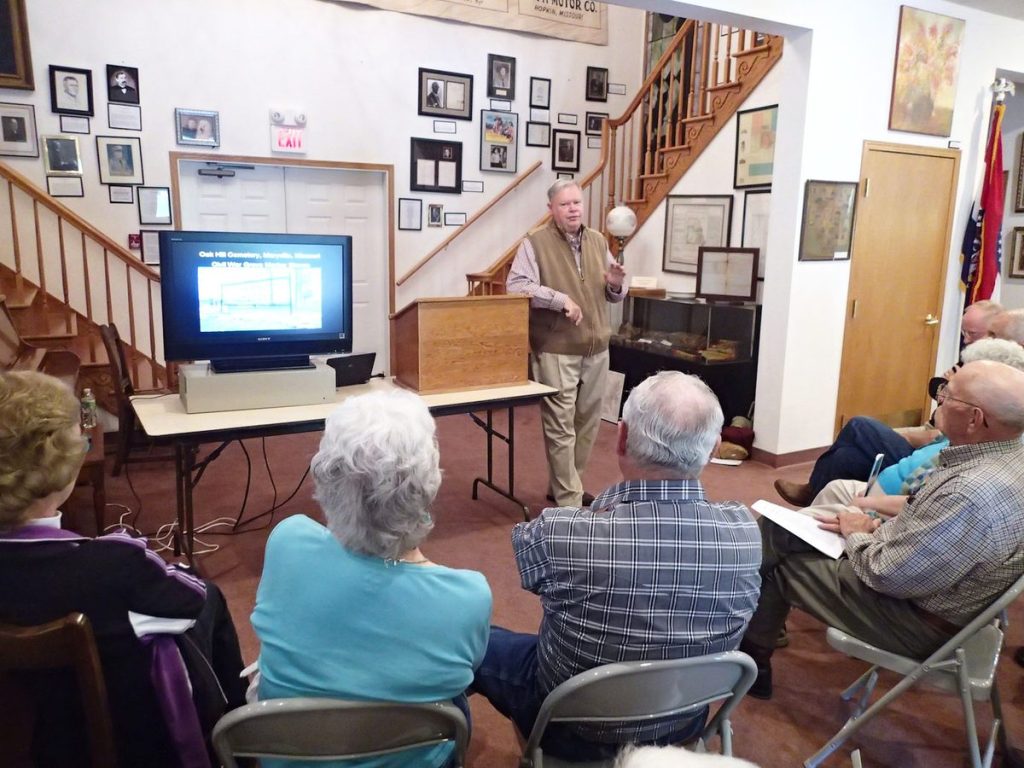
Retired Northwest Missouri State University Professor George Gille is shown giving a presentation Saturday regarding the development of federally issued headstones used to mark the graves of Union veterans of the American Civil War. More than 50 of the small, rectangular stones, engraved with the Union shield, still stand at Oak Hill Cemetery in Maryville.
This spring marks 150 years since the American Civil War ended, but the impact of that epochal conflict still echoes deep within the nation’s consciousness and has left physical reminders stretching from the great battlefields of Virginia to the graveyards of Nodaway County.
Curiosity about the more than 50 Civil War veterans buried at Oak Hill Cemetery in Maryville drew about three dozen people to the Nodaway County Historical Society Museum on Saturday for a presentation by a couple of retired Northwest Missouri State University professors, Bob Bohlken and George Gille.
According to Gille and Bohlken, who has written a brief history about Nodaway County and the war, it was the Grand Army of the Republic, a Union veterans’ organization established in 1866, that first called for the establishment of an annual day of remembrance for U.S. soldiers who fell in battle during the nation’s bloodiest conflict.
“Memorial Day, or Decoration Day as it was then called, was instituted in 1868 for Union soldiers,” said Bohlken, adding that John A. Logan, a retired Union general, officiated at the first official Decoration Day ceremony.
The event was held at what is now Arlington National Cemetery, the former plantation and residence of Confederate commander Robert E. Lee. Lee’s home was confiscated by federal troops after the war began in 1861.
Following World War I, Bohlken said, Memorial Day was expanded to include all veterans who served during wartime. Originally held on May 30, the date was changed in 1971 to the last Monday in May.
As the concept of Memorial Day developed, so did an effort by the federal government and others to permanently mark the graves of fallen soldiers and deceased veterans.
“The military has always had a commitment to mark the graves of soldiers,” said Gille, whose has made something of a specialty of Internet-based genealogical research.
But after the first battle of Manassas, also known as Bull Run, Gille said the U.S. Department of War realized keeping track of what would soon become tens of thousands of casualties was going to be a mammoth job.
As a result, unit commanders were ordered to keep track of fatalities and mark graves. In addition, the Quartermaster Corps was told to support this effort by providing grave markers and logbooks.
“The first markers were simple wooden planks, rounded at the top, with either a full inscription or just a number,” Gille said. The shape of those wooden markers was similar to marble headstones issued later, a number of which can still be seen at Oak Hill.
In 1873, the War Department decreed that all such markers were to be of a standard size and bear inscriptions stating the soldier’s rank, name, home state and unit.
Initially, Gille said, tombstones were provided only for soldiers buried in military cemeteries, but in 1879 Congress extended the privilege to private and municipal burial sites.
One of the veterans buried beneath an official government marker at Oak Hill is Thomas J. Gaunt, whose ornate Victorian home now serves as the official residence of the president of Northwest Missouri State University.
The owner of a successful nursery, Gaunt was born in England in 1830 and died in 1901. He joined Company B of the Missouri Home Guard in 1862 and later helped organize the 36th Regiment of the Missouri Militia, which was tasked with hunting down Confederate guerillas. Gaunt mustered out of Company G in July 1864 as a captain.
Another prominent Maryville citizen who lies at rest beneath a government-issued marker is Cyrus Anthony, a New Jersey native who ended the war as a captain with the 51st Illinois Infantry prior to moving to Nodaway County and practicing law.
Anthony served as both Nodaway County attorney and Maryville city attorney in the mid-1870s and died on Feb. 15, 1926, at age 86.
Gille said Federally issued stones marking the gravesites of Union veterans can also be found at cemeteries in Burlington Junction, Graham, Hopkins, Quitman and Elmo.