Keepers seek sweeter life for bee colonies
TONY BROWN/DAILY FORUM
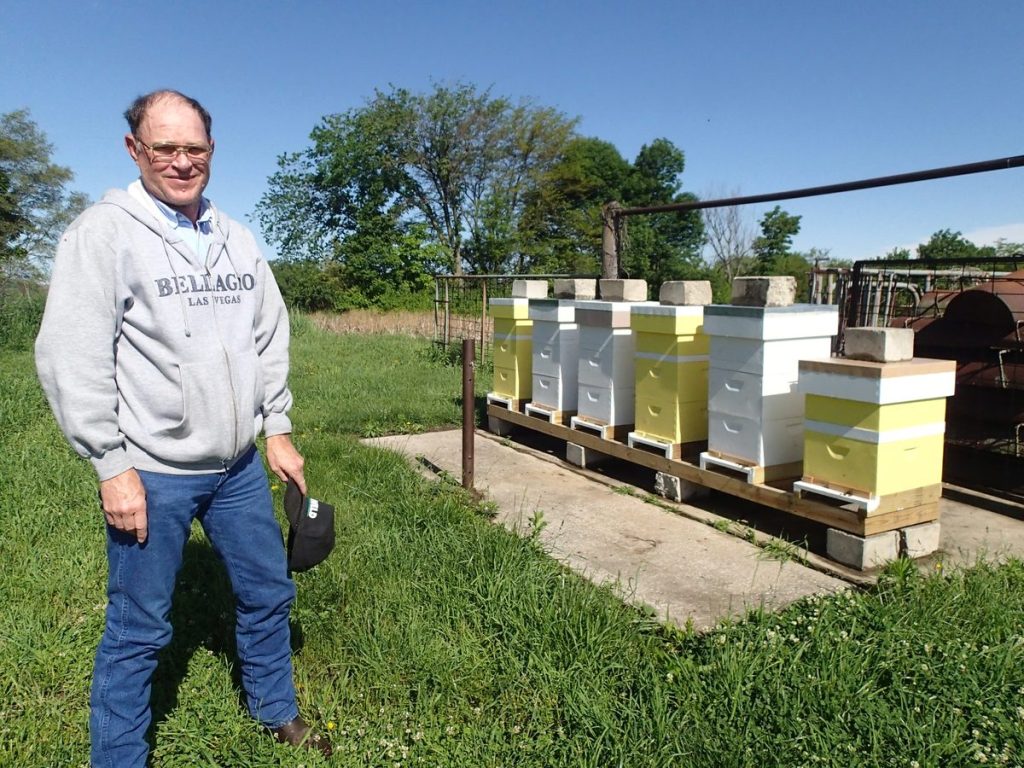
Ed Wohlford stands beside a few of the approximately 25 beehives he maintains on his 180-acre farm south of Maryville. Wohlford said modern agricultural practices, such as the application of super-efficient herbicides and pesticides, pose challenges for beekeepers by weakening bee health and eliminating pollinizing plants such as wild clover and forbs.
Just ask any farmer. Highly efficient herbicides and pesticides have revolutionized row crop agriculture in recent decades, making producers far more efficient and driving yields and profits to new highs.
However, it seems progress always comes with a price, and in this case part of that price has been a significant reduction in the number of pollinators — insects like honey bees and butterflies — that move pollen from flower to flower, allowing plants, including many food crops, to bloom and reproduce.
According to a report released earlier this month by a joint task force consisting of experts from the U.S. departments of Agriculture and Natural Resources, beekeepers nationwide last year reported losing as many as 40 percent of their honey bee colonies.
In addition, a steep decline in viable habitat has placed the monarch butterfly in jeopardy, with overwintering populations in Mexico declining as much as 90 percent over the past two decades, a trend that has placed the North American monarch migration at risk.
In response to what many agriculture analysts and environmentalists see as a deepening pollinator crisis, President Barack Obama last summer ordered the task force to compile the “Strategy to Promote the Health of Honey Bees and Other Pollinators.”
The 92-page report sets forth actions experts hope will reduce honey bee colony losses to “economically sustainable levels” of 15 percent or less; increase monarch butterfly numbers; and, perhaps most significantly, “restore or enhance millions of acres of land for pollinators through combined public and private action.”
According to the report, honey bee pollination alone adds more than $15 billion in value to agricultural crops each year.
Local beekeepers say farmers, landowners and state and local governments can all play a role in increasing the amount of pollinator habitat available through such steps as planting clover, wildflowers and other native plants along highway medians and creating pollinator strips and gardens in yards and along the borders of fields and pastures.
Jerry Auffert, who keeps around 20 beehives near Conception Junction, said town-dwellers can aid the pollinator cause by simply backing off on the herbicide and putting up with yards containing a little more white clover and a few more dandelions.
Another bee-friendly practice is to decorate yards and gardens with coneflowers — the official flower of the city of Maryville — and other native species instead of exotic ornamentals.
During the winter, Auffert’s hives contain between 20,000 and 30,000 bees each, a number that swells to as many as 80,000 insects in midsummer. But the return of cold weather often takes a heavy toll.
Last winter, Auffert said he lost five of 19 hives, with thousands of bees either dying in the hive or simply flying away never to return.
Another local beekeeper, Ed Wohlford, maintains about 25 hives on his small farm a few miles south of Maryville.
Wohlford, who got into beekeeping as a hobby three years ago, is the recently elected president of the Northwest Missouri Bee Busters, a group of area enthusiasts who work to promote bee culture.
Though the decline of bee populations nationwide is blamed on a number of factors — habitat loss, chemicals, parasitic mites, disease and a largely unexplained phenomenon known as colony collapse disorder, or CCD — Wohlford said he believes modern farming practices have had a definite impact on pollinators in northwest Missouri.
He said improved herbicides have basically eliminated milkweed — the monarch caterpillar’s only food source — as well as many nectar-producing plants from which bees manufacturer the honey needed to sustain their hives.
“Fields these days are relatively weed free,” said Wohlford, who added that while he understands the value of modern agricultural practices he believes more could be done to maintain and expand pollinator habitat.
Pollinator-friendly field borders and buffer strips on land unsuitable for row crops could be planted with forbs (herbaceous flowering plants), alfalfa, trefoils (clover) and legumes, he said, in order to provide a boost to bee populations and health.
Beekeepers can also work with farmers to make sure they know bees are nearby. Improved communication allows beekeepers to take precautionary measures, such as covering hives, when their neighbors are applying pesticides and engaging in other practices that could damage colony health.
Wohlford said he would also like to see bee-friendly flora planted along highway right-of-ways and on Conservation Reserve Program acreage, a step that is already frequently a requirement under USDA Farm Service Agency guidelines.
“The thing I see that is beneficial is to get people to understand that they need to provide an ecosystem that is pollinator friendly,” he said.
TONY BROWN/DAILY FORUM
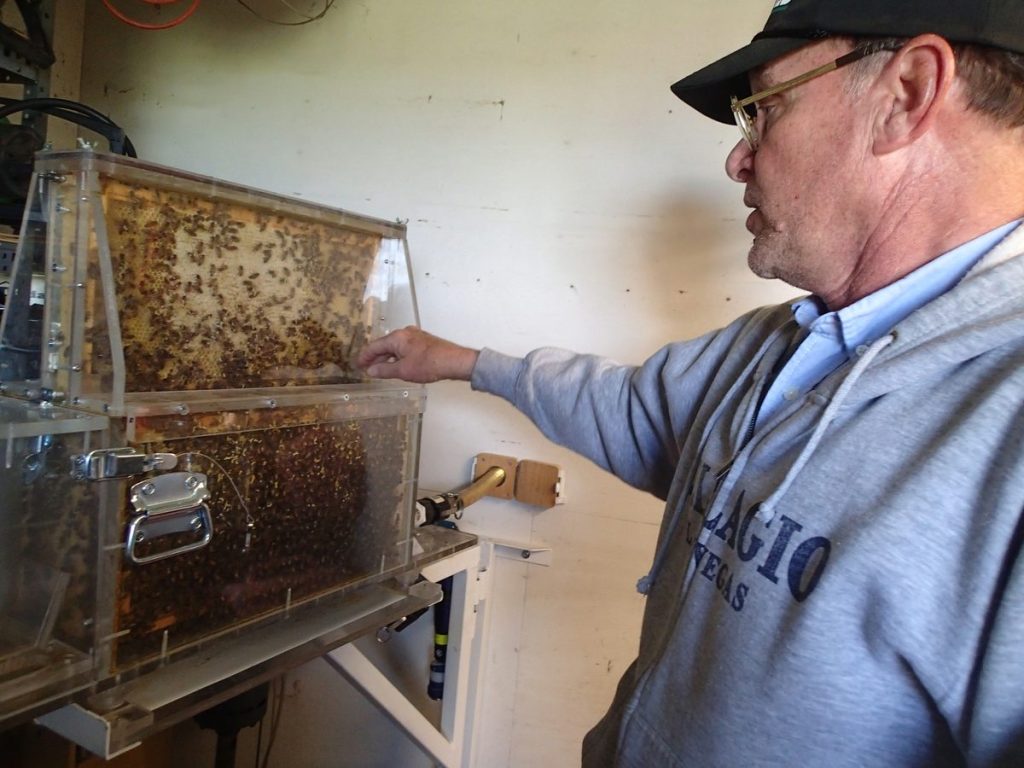
Beekeeper Ed Wohlford gestures toward a transparent hive used to demonstrate how bees organize themselves to feed larvae and produce honey. Wohlford, has been keeping bees for the past three years and was recently elected president of the Northwest Missouri Bee Busters organization.