
Lawmakers review 2015 session
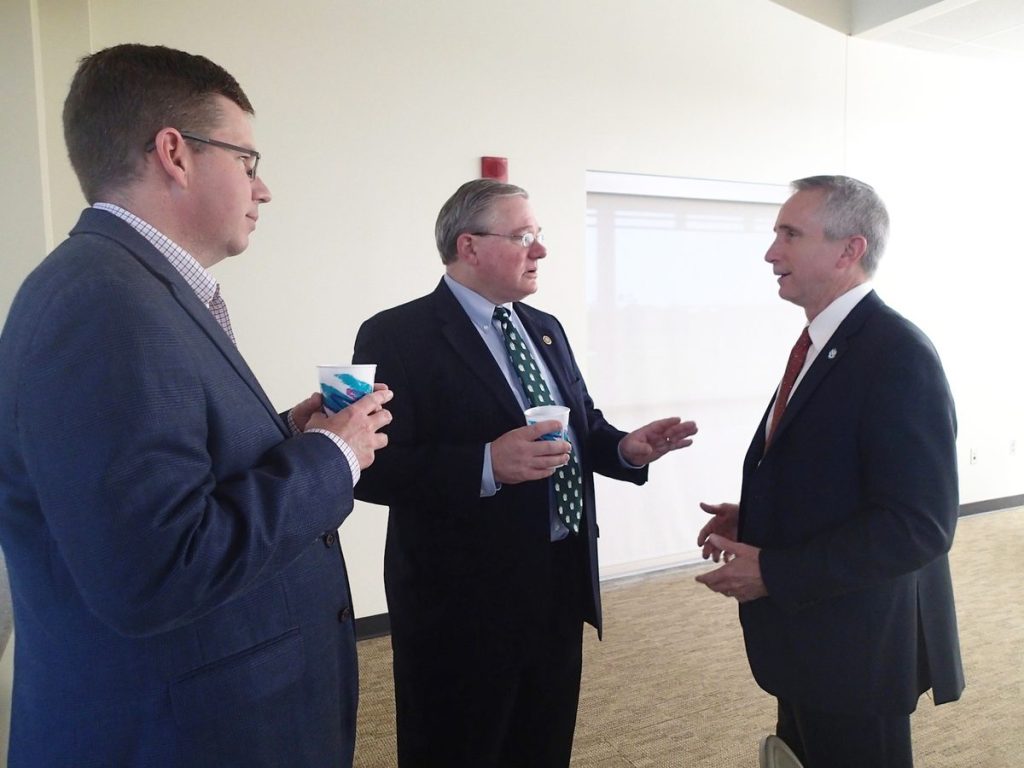
TONY BROWN/DAILY FORUM
As Matt Baker, left, vice president of student affairs at Northwest Missouri State University, looks on, Northwest President John Jasinski, right, talks with state Sen. Dan Hegeman during Wednesday’s legislative coffee hosted by the Greater Maryville Chamber of Commerce.
Missouri State Sen. Dan Hegeman and State Rep. Allen Andrews spoke Wednesday morning during a post-General Assembly session legislative coffee hosted by the Greater Maryville Chamber of Commerce at the Dean L. Hubbard Center for Innovation and Entrepreneurship.
The districts represented by the two Republican freshmen both include Nodaway County. Following last year’s general election, Hegeman succeeded Brad Lager as senator for the 12th District, and Andrews succeeded Mike Thomson in the 1st District as a member of the House of Representatives.
Topics addressed by the lawmakers this week included the Legislature’s passage of a controversial right-to-work bill, which sparked an unsuccessful filibuster by Senate Democrats a couple of days before the session came to a tumultuous end on May 15.
Republican senators choked off debate using a rare procedural move, causing Democrats to retaliate by blocking a number of important votes as the session ground to a close.
On Wednesday, Andrews described the right-to-work measure, which would eliminate union membership as a condition of employment, as “monumental.” He also discounted arguments by critics who see the bill as an attack on organized labor.
“This is not anti-union,” Andrews said. “This simply gives workers the freedom to choose whether they want to pay union dues and be a part of the union or not.”
Likewise, Hegeman characterized the bill as a “freedom to work” measure, adding that “from an individual freedom standpoint” requiring workers to join a union “just strikes me as wrong.”
Aside from the issue of employee choice, Hegeman said turning Missouri into a right-to-work state would encourage economic growth, especially in outstate communities.
Large corporations with a long history of union activity, like automakers, rarely locate facilities outside large cities, Hegeman said. But smaller enterprises, he believes, will be more likely to invest in rural Missouri if they know they will be able to operate in a right-to-work climate.
“From a job growth standpoint, we need to open Missouri up,” Hegeman said.
The chances of the current right-to-work bill becoming law are still up in the air, Hegeman said, since both the House and Senate passed the measure with GOP defections resulting in less than veto-proof majorities. Gov. Jay Nixon has severely criticized the legislation and appears unlikely to sign it.
Turning to education, Andrews and Hegeman said they both bucked the party line on House Bill 42, a student transfer bill that would allow more charter schools in Jackson and St. Louis counties and expand transfer options for students in unaccredited districts.
Andrews said he was uneasy about some of the measure’s provisions with regard to online learning, and Hegeman said aspects of the legislation could prove harmful to small-town school districts generally.
In fiscal terms, Hegeman noted that the $26-billion state budget contains $84 million in new money for public schools but fails to fully fund Missouri’s K-12 foundation formula by around $442 million.
“I don’t know if we’ll ever go back to fully funding the formula,” said Hegeman, a former House member who has seen several education funding schemes come and go over the years. “It seems that every 12 to 15 years, the formula gets out of whack and has to be looked at again,” he said.
As for higher education, both lawmakers said they were pleased about the $6.9 million earmarked for deferred maintenance at Northwest Missouri State University, as well as a $250,000 matching grant that will be used to help establish a new agriculture center at the R.T. Wright University Farm north of Maryville.
With regard to Medicaid expansion, an issue that has found little traction in the General Assembly, Andrews said providing adequate medical coverage in rural areas is nevertheless a “big concern” and one that he believes will result in an “ongoing discussion.”
Hegeman said his Senate district includes 11 hospitals, and that a number of them are “having a difficult time” as Missouri continues to reject Medicaid reforms proposed under the federal Affordable Care Act.
However, Hegeman added he has yet to see “any interest” with regard to expanding Medicaid in either the House or Senate.
On another social welfare issue, Andrews said a bill that would reduce time limits with regard to unemployment benefits will put more Missourians back to work.
The measure, vetoed by Nixon, proposes a reduction in the duration of unemployment compensation from 20 weeks to as few as 13 weeks by linking benefit eligibility to the state’s unemployment rate.
Andrews cited studies that he claimed show shorter periods of benefit eligibility result in more people finding work.
“That may sound harsh,” he said, “and it may sound like you’re not looking after the unemployed, but it’s just a cold, hard fact.”
Asked about transportation issues, and especially the Missouri Department of Transportation’s construction budget, which has fallen from $1.3 billion in 2009 to a current level of around $500 million, both lawmakers said they see highway funding as an issue that needs to be addressed.
Much of the revenue decline has been caused by reduced fuel consumption as motorists switch to more efficient vehicles.
Hegeman said a couple of solutions have been discussed, including toll roads, but that the best answer is probably a gasoline tax increase, which would have to be approved by voters.
“I don’t have a problem with putting a reasonable proposal to the people,” said Hegeman. “I trust the people.”
Andrews said he would likely support an increased sales tax on fuel as well, but added that he believes MoDOT, which has a total budget of about $2 billion, could operate more efficiently by cutting administrative costs at the state level.
“I think they’re spending a lot of money at (state) headquarters that we shouldn’t be,” he said, adding that in discussions with MoDOT officials, he has been unable to “drill down” through the budget in order to determine precisely how money is being spent.
Increasing the motor fuels tax is probably the best ultimate solution, Andrews said, “But we need more accountability if we’re going to do that.”




