Council ponders solid waste solutions
TONY BROWN/DAILY FORUM
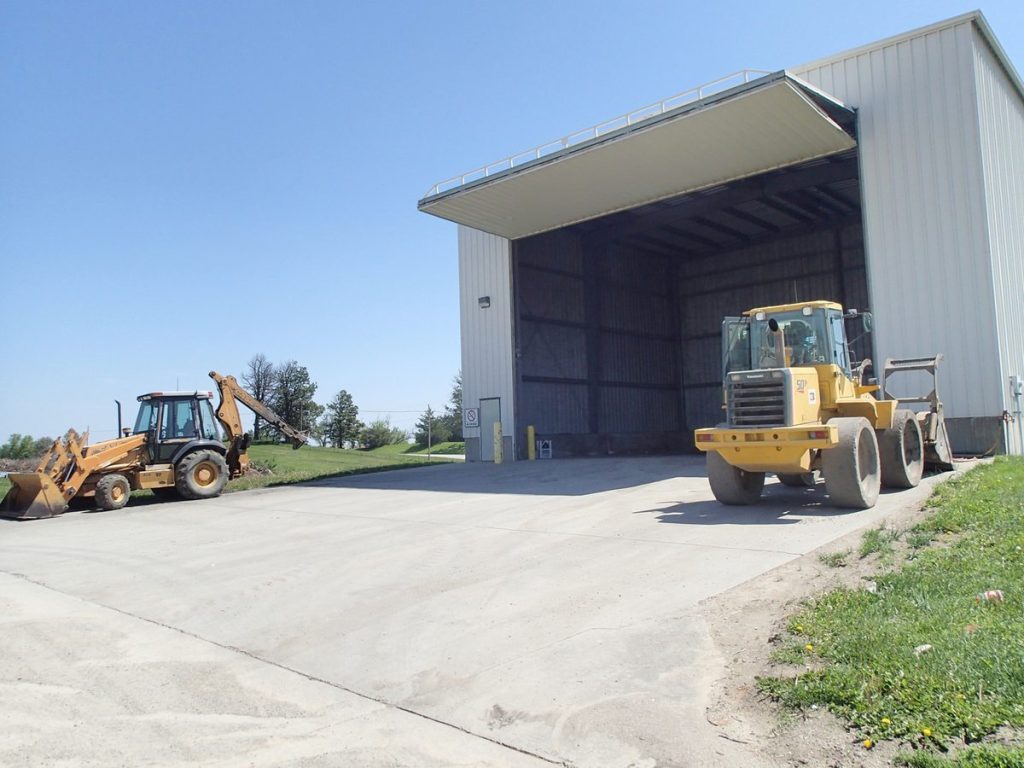
Maryville’s solid waste transfer station, pictured here, has been operating at a deficit for the past several years, largely due to the impact of competition from the private sector. During a lengthy discussion session this week, the City Council reviewed several options with regard to the station, including taking over trash collection service inside the city limits, an operation currently carried out by a half-dozen commercial haulers.
After two years of taking a wait-and-see approach, the City Council this week returned to the long-simmering issue of how best to handle the disposal of Maryville’s trash, debris and garbage.
During a 90-minute study session prior to Monday’s regular meeting, the five-member council listened a lot and talked just a little as City Manager Greg McDanel presented options for pulling the city’s solid waste transfer station north of town out of a continuing fiscal hole.
In theory, the transfer station, where solid waste is loaded onto trucks that haul it to an out-of-town landfill, is supposed to operate on revenues generated by user fees — referred to as tipping fees — charged per ton of waste.
Cities commonly adopt such “enterprise fund” schemes to pay for services like garbage disposal and water/sewage treatment because they force individuals and businesses who use those services the most to bear most of the cost.
The problem with the transfer station is that competition from the private sector has forced the city to reduce tipping fees while facing a steady decline in tonnage. In fiscal 2015, McDanel told the council, the transfer station, which costs around $370,000 a year to operate, required a $109,000 subsidy from the General Fund, money that could otherwise be used for everything from paving streets to economic development.
Though anyone can deposit refuse at the station, the lion’s share of tipping fee revenue is generated by a half-dozen commercial trash haulers who provide garbage pickup service for Maryville residents. In addition, the station accepts demolition debris from contactors along with trash and garbage generated by Northwest Missouri State University.
The transfer station, located at 1860 N. Main St., adjoins the former city landfill, which closed in 2001 under orders from the state Department of Natural Resources. Efforts in 2000 and 2001 to first privatize and then municipalize solid waste service went nowhere and resulted in legal action against the city.
For a decade after the closure, McDanel said, the transfer station generated a positive cash flow, a state of affairs that came to an end when Porter Trash Service opened the privately operated Highway 136 Transfer Station.
In response, the city first attempted to sell its transfer station to Pluvius, a St. Louis company that intended to transform waste into marketable biomass fuel. However, Pluvius soon decided the station handled an insufficient volume of waste to make the operation pay and used the due diligence clause in its contract with the city to back out of the deal.
When Porter’s transfer station opened in late 2012, waste volume at the city facility plummeted. McDanel noted that in April of that year, the municipal station handled 1,485 tons of waste. A year later, in April 2013, tonnage fell to 444.
Currently, he said, the transfer station handles about 20 tons of refuse a day five days a week, or around 400 tons a month.
During Monday’s discussion session, at which no action was taken, McDanel warned the council that finding a solution to the transfer station dilemma was likely to be both time consuming and controversial.
“There is no silver bullet,” he said, adding that any course of action the council ultimately decides on will likely offer both positives and negatives.
McDanel mapped out seven possible strategies for the council, including a solid waste flow control ordinance that would require all local commercial haulers to bring their waste to the city-owned station.
While such an ordinance, unlike municipalization, would allow for continued multiple private haulers, no other city in Missouri has such a rule on the books, and attempts elsewhere to implement flow control have resulted in legal action.
Other proposals outlined by McDanel included “put or pay” agreements that would require haulers to meet minimum tonnage obligations and pay for any shortfalls.
McDanel said such agreements have been used in cities with competing transfer stations, but that haulers have little incentive to sign them. And even if a deal could be reached, he said, the arrangement would likely lead to higher pick-up rates.
A third option would be to add a solid waste user fee on residents’ water bills, or, conversely, tack a surcharge onto the license fee paid by haulers.
A user fee, McDanel said, would make it difficult to adjust revenues in accordance with falling or rising solid waste volume and might also fall afoul of Missouri’s tax-limiting Hancock Amendment; the surcharge option, he said, would almost certainly lead to higher rates for customers.
The elephant in the room with regard to getting the transfer station out of the red is municipalization, in which the city would either carry out trash collection itself, excluding private haulers, or, more likely, contract with a single private hauler following the submission of competitive bids.
By statute, municipalizing solid waste disposal requires the city to issue a two-year notice.
Downsides of this approach, McDanel said, include elimination of a private market open to multiple commercial haulers, a situation he admitted that could well lead to lawsuits.
On the other hand, municipalization would provide citizens with a uniform rate and carrier, direct all local waste to the transfer station, and reduce the number of days a week on which collection occurs.
This last result means residents would set out their garbage only one or two days a week, instead of the multiple days scheduled by various haulers. An added benefit would be fewer heavy trucks rolling over city streets, thus prolonging pavement life.
According to the equivalent single axle load (ESAL) formula used by governments to compute pavement wear, McDanel said, a single garbage truck has a cumulative impact equal to about 1,000 cars.
A final option open to the city is simply closing the transfer station and getting out of the solid waste business altogether. Such a move would eliminate the expense of operating the transfer station, but leave City Hall with an existing $30,000 a year fee charged by DNR for monitoring the old landfill for gas and groundwater leakage.
Following McDanel’s presentation, Mayor Renee Riedel said she was “drawn to the curb appeal and beautification” aspects of municipalization, but wondered, along with Councilman Tim Shipley, if collection under a city-run system could be carried out by a cooperative made up of existing haulers.
Councilman Jerry Riggs said that regardless of the council’s eventual choice, “It’s always going to be bad for somebody.” He added that the council’s responsibility is to choose the option providing the most benefit for the most citizens, regardless of the impact on a particular group.
At the close of Monday’s discussion, the council directed McDanel to set up a second discussion session with local trash hauling companies in an effort to explore solid waste alternatives in more detail.