
Library tax would triple book budget
TONY BROWN/DAILY FORUM
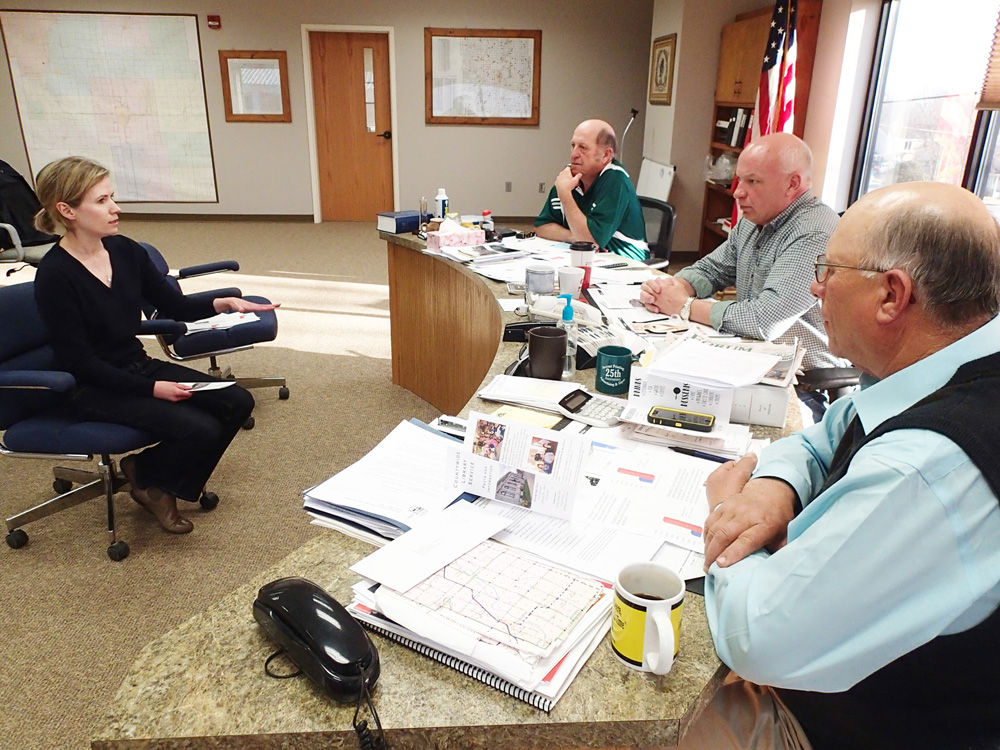
Maryville Public Library Director Stephanie Patterson, left, addresses members of the Nodaway County Commission during an update on how the library plans to spend additional revenue that would be produced should voters approve the creation of a countywide library property tax in the April 7 municipal election.
Maryville Public Library Director Stephanie Patterson met with Nodaway County Commission last week to deliver an update on plans to develop a countywide library system should Nodaway voters living outside Maryville approve a 15-cent per $100 of assessed valuation property tax levy in the April 7 municipal election.
If the measure passes it would produce an estimated additional $250,000 annually for library operations, nearly doubling the institution’s budget.
Maryville residents already pay a similar property tax in support of the library, which is the institution’s sole source of revenue except for grants and private donations. Patterson told the commissioners it was a misconception that the library receives a portion of city sales tax funds.
Because the library is solvent and self-sustaining, Patterson said voter approval of a countywide system would mean that virtually all of the additional revenue would be invested in print books, electronic books, audio-visual materials, youth and adult patron programming, and outreach to Nodaway County school districts and communities.
She offered the commission a breakdown of proposed spending tied to the new revenue, 20 percent of which would be dedicated to acquiring new books, e-books, audio books and electronic resources.
The increase would effectively triple the library’s current book budget, Patterson said. In addition, available funds for programming and outreach would more than quadruple, making possible such services as regular bookmobile visits to rural school districts and increased kindergarten-through-fifth grade programming across the expanded service area.
Additional proposed spending of new revenues would include:
• Twenty-one percent for recurring expenses related to added programming, an enlarged collection and a bigger patron population. This category would include, but not be limited to, hiring additional staff to assist with cataloging and front-desk operations, the upgrading of computer-automated systems and covering increased tax collection costs.
• Twenty-two percent for one-time expenses such as the acquisition of a bookmobile van, a mobile checkout station and remote-site book drop boxes. This category could also include capital investment in book vending machines and Wi-Fi hotspots to be installed in communities across the county.
• Twenty-two percent for recurring expenses tied to increased programming and outreach, including bookmobile fuel and maintenance and special events with an emphasis on activities for children and young people.
• 15-percent dedicated to fund reserves to cover the cost of hardware replacement and capital improvements. One issue here is that the library, for the first time in years, would be collecting funds at the limit of its state-allowed tax ceiling. That means that decreases in the county’s assessed valuation could result in an automatic levy reduction, which might have to be made up with reserve funds.
Should the countywide library proposal pass, the measure would also eliminate the $25 per household per year card charge currently imposed on residents living outside Maryville.
Patterson said the library plans to issue special cards free of charge to every child in the county at the time he or she registers for school. Families, she said, will not have to make a special trip into Maryville to acquire a card.
The cards will differ from regular library cards in that they will allow children to check out only three or four books at a time, as opposed to the 35 items permitted with an adult card. However, materials checked out using a student card will not be subject to late fines.
If a countywide library comes to be, the current seven-member library board would be dissolved and replaced with a nine-member board appointed by the County Commission and the Maryville City Council. Five members of the board would be residents of the political entity with the greatest population.
Patterson said her original understanding was that the board majority would consist of county residents. However, after consulting with the library’s attorney, she believes this may not be the case, and that five board members would come from Maryville based on the results of the 2010 census.




