
State budget rule stalls county disaster funds
NODAWAY COUNTY PHOTO
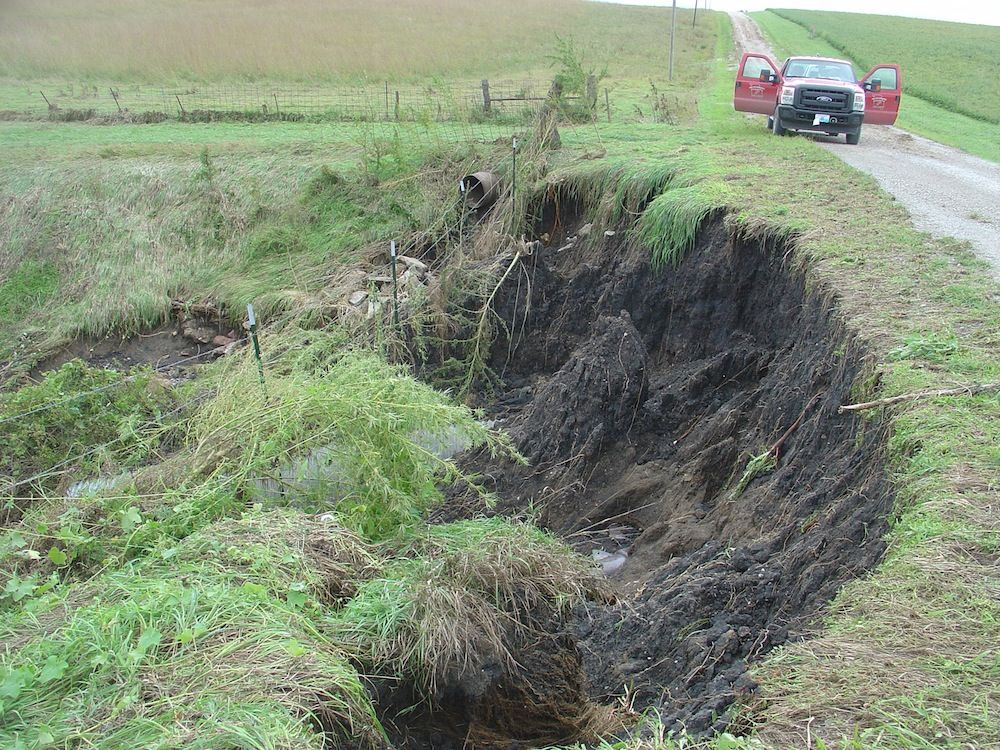
Funding to repair flood-damaged water crossings in Nodaway County like this one have been delayed due to new budget regulations governing Federal Emergency Management Agency disaster aid passed last year by the Missouri Legislature.
The Federal Emergency Management Agency has allocated about $750,000 to help Nodaway County pay for repairs to rural bridges and tube crossing damaged or destroyed during last year’s severe late-summer flooding.
But before that money arrives here it has to get through the Missouri Legislature first, and that is starting to become a problem.
Each year, of course, the Legislature passes a budget, which goes into effect at the beginning of Missouri’s fiscal year on July 1. That budget contains spending limits that apply both to state dollars and money funneled into the state from Washington, D.C.
With regard to Nodaway’s FEMA funds, the difficulty is that, under the state budget, the entire appropriation allowed by Jefferson City lawmakers has been spent.
Freeing up the funds before the current fiscal year ends on June 30 will require the Republican-controlled Missouri House and Senate to pass a supplemental spending package proposed by Democratic Gov. Jay Nixon, something that so far has not happened.
Nodaway County South District Commissioner Robert Stiens said Wednesday the delay means the county is still on the hook for about $350,000 it has already spent fixing bridges hit by last year’s storms, which caused more than $1 million worth of damage to transportation infrastructure countywide.
FEMA has agreed to cover 75 percent of the total, but until an additional appropriation is approved at the state level the county is being forced to proceed on its own.
Local spending for bridge and tube repairs busted last year’s county Road and Bridge Fund budget and forced the County Commission to dip into its General Revenue Fund, something that Stiens said the governing board has the legal right to do, but which has not endeared the commission to its auditor.
“We’re going to get written up for that,” Stiens said.
According to a letter sent to the commission by State Emergency Management Director Ron Walker, prior to fiscal 2014 Missouri had “budgetary flexibility” with regard to federal disaster funds through a process known as an estimated designation, or “E designation.”
But beginning last July, the Legislature eliminated the E designation and capped the amount of federal disaster funds that can be paid out under any single budget.
Walker said that Nixon’s supplementary budget, now pending in the General Assembly, would restore the E designation and “allow SEMA to distribute federal disaster funds as needed to reimburse approved projects.”
Stiens said the commission has been in touch with SEMA officials who have indicated they believe the measure will pass in the Missouri House. He said the three-member board has also spoken with state Sen. Dan Hegeman with regard to the status of the legislation in that chamber.
Last fall Nixon included Nodaway in a group of 20 northwest Missouri Counties eligible for federal disaster assistance following a series of severe storms that moved through the region Sept 9-10. Much of the damage locally occurred in southern Nodaway County in and around Graham.
In the absence of federal disaster funds, the commission balanced the books for 2014 by shifting $185,000 in use tax revenue to the Road and Bridge Fund.
Mostly paid by businesses and factories, the county’s use tax is a 1 cent-on-the-dollar levy that replaces sales tax on items bought from out-of-state vendors.
The use tax was approved by voters in 2006, and the revenue it produced for Nodaway County was at first credited to the General Fund. However, even discounting severe weather, the county has been struggling to keep the Road and Bridge Fund solvent in recent years due to declining gasoline tax revenues as consumers switch to more efficient vehicles.
Use tax money was first used to augment Road and Bridge spending in 2013, and the same thing happened last year. Revenue from the tax is unencumbered, meaning that the commission can spend those dollars for any legitimate purpose.




