Nixon library cuts would have local impact
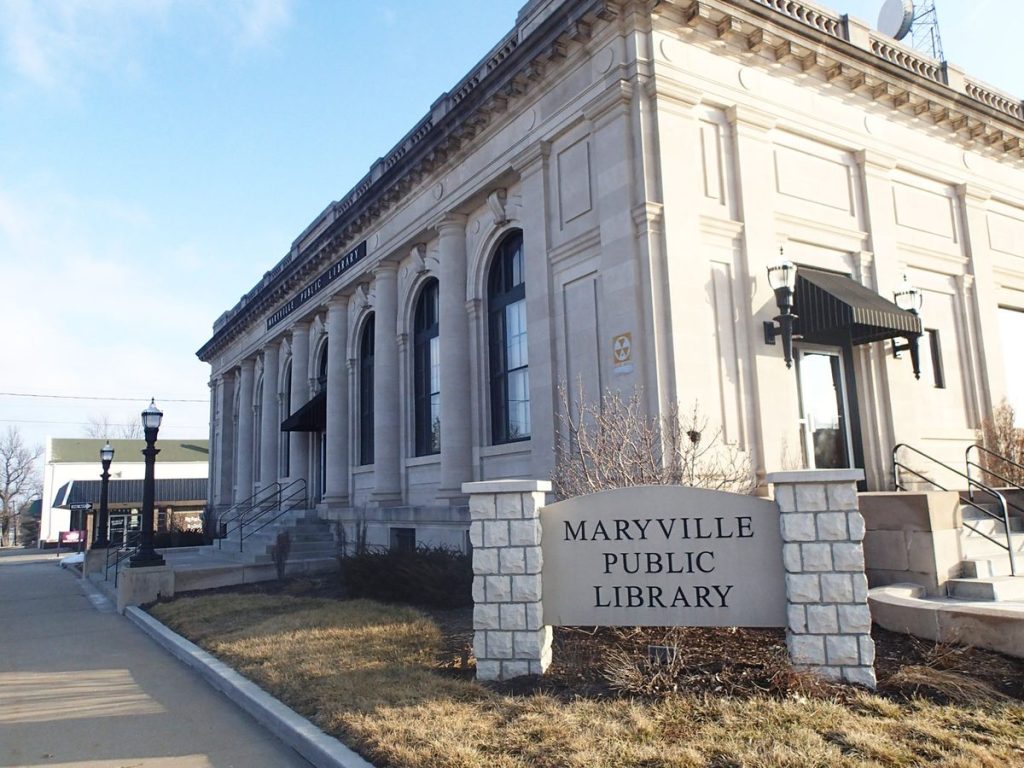
TONY BROWN/DAILY FORUM
Like other libraries across the state, the Maryville Public Library is facing potential reductions of both state and federal aid should budget cuts proposed by Gov. Jay Nixon pass legislative muster.
Maryville Public Library Director Stephanie Patterson this week said spending cuts proposed by Gov. Jay Nixon in his fiscal 2016 budget recommendations could adversely affect local library revenues.
According to Missouri Library Association President Christina Prucha, Nixon’s plan, which must still be approved by the state Legislature, would reduce state funding for libraries next year from $11.5 million to a little over $5.6 million.
“He has recommended a 79-percent cut in the three programs that directly fund essential public services in libraries across the state,” Prucha said.
Patterson said the proposal likely to have the biggest impact on Maryville would be State Aid, a program that Nixon wants to reduce from $3.5 million to $723,776.
She said the local library currently receives a little less than $6,000 a year in State Aid, or about 2 percent of the institution’s $270,000 operating budget.
That may not sound like a lot, Patterson said, but the reduction would hit that portion of the library’s budget that provides direct services and programs to patrons — everything from new books to children’s reading events to special presentations and lectures.
“It seems like every time there is a cut, it always affects programming,” Patterson said.
Also included under State Aid are so-called Equalization Grants, which are intended to supplement local tax revenues collected by libraries operating in economically depressed areas.
Since only county or regional library systems are eligible for Equalization funds, Maryville doesn’t receive any of this money. However, Patterson said, at current funding levels, the local library would likely receive about $15,000 in Equalization Grants if Nodaway County voters approve proposed formation of a countywide library district in the April 7 municipal elections.
Passage of Nixon’s recommendations means any additional state funding for which a new countywide system might be eligible would likely disappear, Patterson said.
On another front, the Maryville Public Library has dodged the bullet with regard to proposed state library reductions that would eliminate all $3.1 million currently allocated for the Remote Electronic Access for Libraries Program, or REAL.
Patterson said REAL helps pay for high-speed Internet connections through the Missouri Research and Education Network, which also serves many of the state’s public schools. However the Maryville library last year opted out of the system in favor of private high-speed access offered by United Fiber, a subsidiary of the United Electric rural energy cooperative.
Under REAL and MORENet, the library was paying about $2,000 a year of high-speed Internet, a cost that could have ballooned to $8,000 next year, Patterson said. As it stands, the library currently pays United Fiber less than $100 a month.
Another local impact should Nixon’s proposed cuts be signed into law has to do with the federal Library Services and Technology Act, which provides $4.1 million to Missouri libraries each year for computers and related technology, such as check-out desk bar code machines. LSAT grants also help libraries pay for outreach programming and supplies.
Prucha said staying eligible for LSTA block grants requires Missouri to maintain a set level of state spending, referred to as Maintenance of Effort (MOE), and that Missouri’s REAL program is one of several appropriations used to calculate MOE.
“If the REAL Program is not funded,” Prucha said, “and with the other reductions proposed, there is a real risk that Missouri’s LSTA block grant will be proportionately reduced in future years, which is a grave concern for the Missouri Library Association.”
Patterson said a failure on Missouri’s part to maintain the MOE benchmark could result in the loss of local grant revenues that have historically ranged between $5,000 and $15,000 a year.
OLYMPUS DIGITAL CAMERA