Winter’s chill drives down blood donations
TONY BROWN/DAILY FORUM
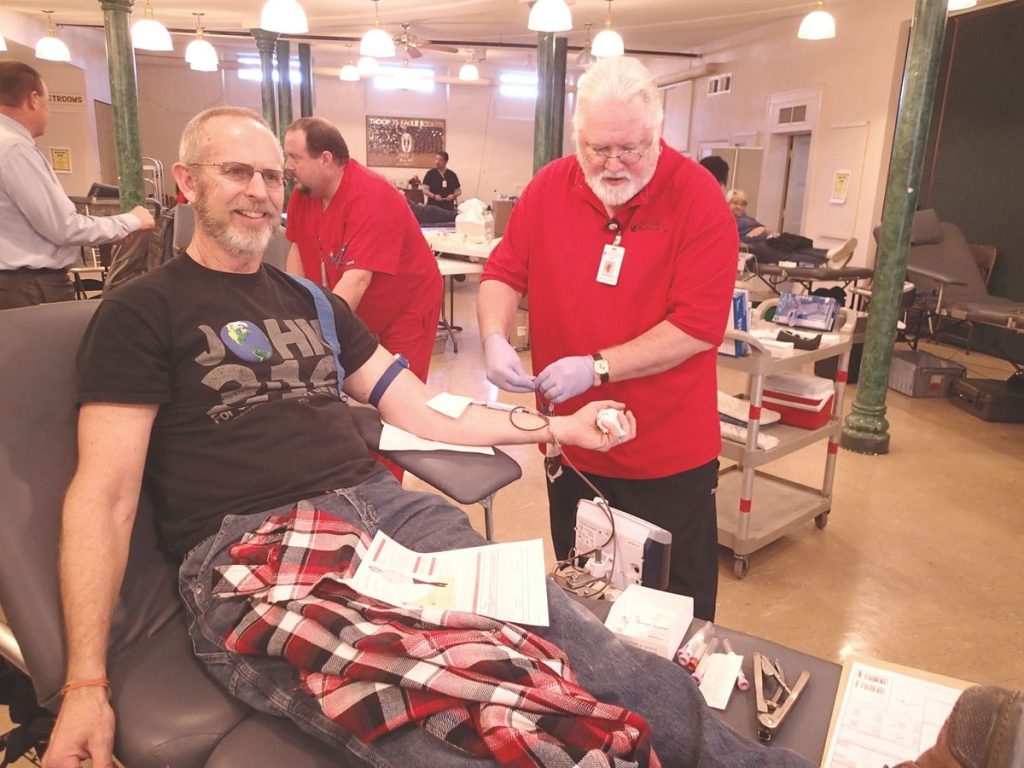
Steve Miller, left, donates blood Tuesday at the First United Church of Maryville under the experienced eye of Community Blood Center Collection Supervisor Mike Capps.
Even when the temperature drops to around zero, the blood needs to keep flowing.
That’s the message this winter — and for the past several winters — delivered by Betty Tinker, an account manager with Community Blood Center whose territory includes Nodaway County.
As she does every eight weeks, Tinker spent most of Tuesday at the First United Church of Maryville, where CBC technicians hoped to collect at least 117 pints of blood from local donors.
Maryville donors, along with the town itself, have received several awards for the amount of blood given, and Tinker said the UMC stop is consistently one of her most productive.
Still, she said, with the onset of severe cold over the past few weeks, blood supplies are critically low — low enough that physicians have been forced to cancel elective surgeries while couriers shuffle blood products from hospital to hospital as need arises.
School cancellations have led to collection postponements in several communities, Tinker said, even as demand for blood increases during a season that always sees donations decline.
“People just don’t want to get out in the cold,” she said, adding that winter weather often worsens the natural anxiety many people have about getting poked with a needle.
“I think mostly it’s fear,” Tinker said when asked to explain why only 7 percent of those eligible to donate blood actually do so.
“Others don’t come in simply because they’ve never been asked,” she said. “A lot of people start donating after (the need for blood) has affected their families.”
One such donor is Maryville resident Steve Miller, 61, a retired teacher who spent 36 years in local middle school classrooms.
Miller donated his 43rd pint of blood over the lunch hour Tuesday for a total of five and a half gallons. Still, he didn’t start giving blood regularly until his was in his 30s, when his father became ill and required surgery.
Tinker said CBC needs more donors as dedicated as Miller, and that people need to realize that the need for blood is constant even if the desire to give it is not.
“After 9/11 we were packed,” she said. “I just wish we could get everyone to try it one time. If everyone who could donate blood did, we would never be short.”
During collection events at UMC, Tinker said Community Blood Center usually aims to collect about 120 units, and almost always comes at least close.
“Very seldom have we not met our goal here,” she said, “But we would like to increase that from 120 units to two or three hundred.”
As the sole-source donor for more than 70 hospitals in Missouri and Kansas, Tinker said CBC needs to collect at least 580 units a day. However, current levels have been “down a lot,” typically running in the neighborhood of 350 units.
In especially high demand are donors with O-negative blood, a universal type essential for emergency rooms.
“When you go to the emergency room, they’re not going to type your blood. They’re going to give you O-negative the minute you come through that door,” Tinker said.
Area residents wishing to donate during the next CBC visit to Maryville can pre-register by going to savealifenow.org.