Northwest still leading in technology innovations
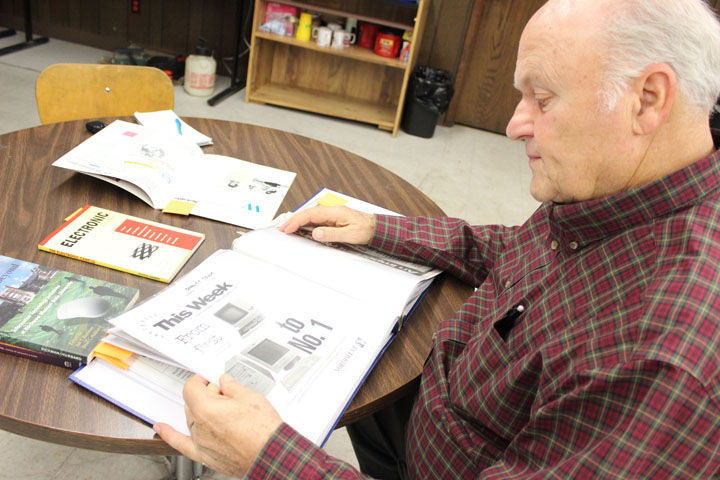
ELIZABETH GOLDEN/DAILY FORUM
Jon Rickman, former vice president of information systems and father of the electronic campus at Northwest Missouri State University, flips through a scrapbook of newspaper articles recounting the foundation of the electronic campus. Rickman created the first campus-wide academic comprehensive computing network and residence hall network in the nation.
Jon Rickman said he didn’t realize the significance until he began writing the books. In fact, he was so busy keeping the system running that he didn’t even think about making an impact — or changing the face of technology on college campuses.
In 1987, Rickman, former vice president of information systems at Northwest Missouri State University, created the first campus-wide academic comprehensive-computing network and residence hall network in the nation, later to be called the electronic campus.
The transition to a fully electronic campus began in 1978 when the computing facilities transitioned from a batch mainframe environment to a time-sharing interactive computing environment. This allowed for greater storage and a universal word processing application, Rickman said.
“That was significant at the time,” Rickman said. “We were the only school in Missouri to do that. Word processing was one of the most important applications because, at that time, there was very little word processing on any type of machine. When we made that change, we caught national attention.”
By the 1980s, Northwest had a network of clustered timesharing computers, which provided computing power at a low cost, Rickman said.
“It permitted us to get a long ways in front of other schools when it came to technology,” he said.
The university went from 300 computing stations to 500 terminals and personal computers connected to the network.
With the foundation of a timesharing computer network, Rickman said the university was in a “unique” position to create the electronic campus.
“A lot of schools hadn’t even gotten to timesharing computing yet,” he said. “We realized it was becoming a problem for students to use computing when there were inequalities in available software. That incompatibility between hardware and software made it really hard to use computing in an academic environment. This was a logical step to take it to the electronic campus level.”
In the late 1980s, the network grew 10-fold, Rickman said, increasing to more than 3000 nodes on the computing network.
“We found big improvements in the amount of writing students did,” Rickman said. “There was a huge increase in the number of emails. We were one of the first institutions in the world to have massive email activity.”
Rickman said more than 250,000 messages were exchanged in 1987. The electronic campus was recognized by various news sources, such as the Washington Post and the Associated Press. This was the official start to the electronic campus.
In the 1990s, Rickman said most of the terminals were replaced with personal computers connected to the network, and the network shifted from a telephone-like switch to an Internet-type connection, which used fiber optics.
By the early 2000s, personal computers were in every residence hall and office. In 2008, Northwest implemented its program to provide laptops to every student, making the university the first in the nation to provide both a laptop and textbooks to its students as part of their tuition. However, each in-state student pays a technology fee of $16.70 per credit hour.
From the very beginning, the demand was high and the network was swamped.
“We were so busy keeping it running that we didn’t think about being first when it came to the creation of an electronic campus,” Rickman said. “We found out we had stretched the technology capabilities to the limits.”
In order to assist with demands, the state of Missouri provided the university with a $2 million grant to purchase digital equipment to power the computer servers.
Even today, the university is struggling with demand. In December, the university voted to increase bandwidth.
“Student use of mobile devices is exploding,” said Roger Von Holzen, current vice president of information technology. “Our Internet traffic is just phenomenal. We’re maxed out almost every day because of how much students use it.”
The bandwidth was increased from 500 to 750 megabytes.
In addition to the overall system, the electronic campus houses the Center for Information Technology in Education, which is celebrating its 15th year. This led the way to Northwest offering online coursework in addition to various other technological innovations.
“Over the past 15 years, we’ve seen more integrations of interactive technology,” said Darla Runyon, director of the CITE. “I’m seeing more collaborative types of software that allow students to work in groups online. Students are also constantly on their computers doing research.”
In the future, Runyon said the electronic campus will continue to grow in size in addition to possibly changing the form of technology given to students.
“We had a pilot study where we tried a tablet type of device, but we haven’t found one that has the productivity capabilities along with the tablet capabilities at a price we can easily fund for our students.”
In addition, Runyon said the university will begin integrating technology in order to greater prepare students.
“Technology is everything,” she said. “Eventually it will become just like electricity. It’s something we have to prepare our students for because they’ll be using it in their jobs. It’s exciting to think about what will happen next.”
To date, Rickman has written several books on the electronic campus.
“The electronic campus put the university in a progressive position with the state,” he said. “It permitted us to be looked at as a forward-thinking university. It took a hard-working team to get it done, and Northwest was very fortunate to have a great team and forward-looking administration.”