
NW says nonprofit’s ranking method is flawed
ELIZABETH GOLDEN/DAILY FORUM
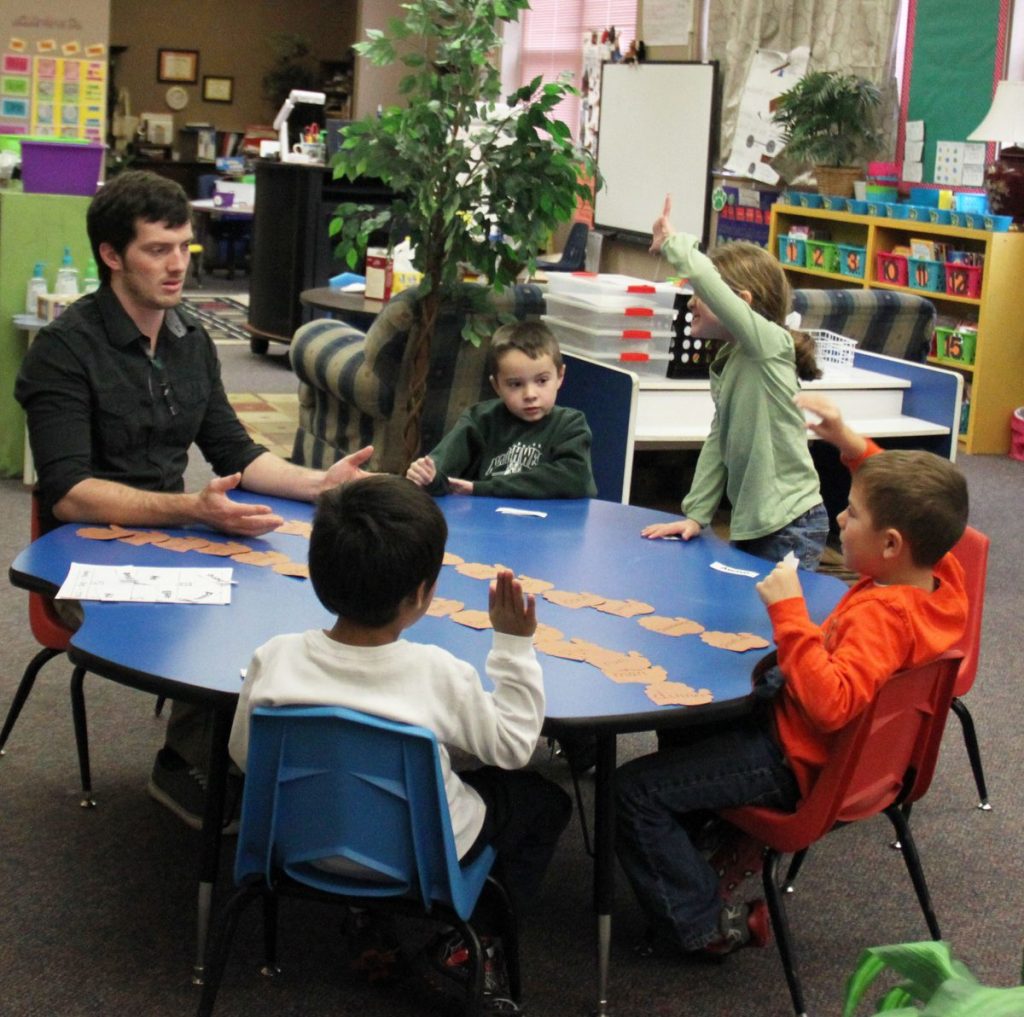
Northwest Missouri State University education major Dan Hedrick helps Horace Mann Laboratory School fourth-grade students with a reading assignment as part of a teacher education practicum requirement.
EDITOR’S NOTE: This is the second part in a three-part series on the nature of college teacher preparation programs and, specifically, Northwest Missouri State University’s recent ranking in the National Council on Teacher Quality. Northwest faired poorly, but school officials disagree with both the study and its methodology.
Part 1: Northwest questions poor survey ranking
Part 3: Northwest disputes study’s focus on GPA
The National Council on Teacher Quality released a survey earlier this month claiming that teacher preparation courses on many college campuses are an easy option compared to other academic majors.
The survey listed Northwest Missouri State University as one of the universities that has a relatively low standard for rigor when it comes to professional education programs.
NCTQ is a nonprofit, nonpartisan research and policy organization that has the stated goal of restructuring the way teachers are trained and educated.
The report, “Easy A’s and What’s Behind Them,” states that 44 percent of education majors graduate with honors based on cumulative grade-point average. The study claims the ratio for all undergraduates is 30 percent.
In order to collect data for the report, NCTQ looked at graduation data from more than 500 institutions. The organization collected data from spring commencement brochures.
Northwest officials disagree with the results, saying the organization’s methodology is disappointing.
NCTQ analyzed the types of course assignments for 1,161 courses, both education and non-education.
“We don’t just have a school of education,” said Joyce Piveral, dean of the College of Education and Human Services at Northwest. “Our math teachers are in with all the other math majors, so they are taking the same courses.
“If you master learning, you’re going to have high GPAs; you’re going to have high scores because we don’t accept failure. We don’t let a student off the hook with a grade we don’t accept, so we make them redo. If you do that long enough, you’re going to have a higher GPA and higher grades.”
William Gordon, chair of the Department of Professional Education, said the university has a liberal supersede policy, meaning students are allowed to retake classes if they obtain a grade of C or lower.
“If a student gets a C, they will just take it again and get an A,” Gordon said. “Those students will end up with honors and we’re OK with that. Students are expected to get good grades in all their classes. The bar is being raised. It’s harder than ever to be a teacher in Missouri.”
Prior to a change in policy at the university, students could only supersede if they failed a course.
“It still takes a dedicated student to supersede,” Gordon said. “They are paying for a class again, but it raises the bar and raises standards. It benefits all students who want to master the coursework.”
Piveral said students are more motivated to do well than before the policy change.
“You know you have to work hard, so the bar is already raised,” Piveral said. “At first we might see some superseding, but after time, we will see students take classes more seriously, especially with teacher candidates.”
In order to assess courses taken by education majors, NCTQ asked institutions to submit syllabi. Several schools, including the University of Missouri, refused.
“They’ve (NCTQ) had litigation with MU because they have not turned over their syllabi,” Piveral said. “They’re basing most of their information on incomplete data. We are in the process of changing our curriculum to match with the new state requirements, so we requested extra time in submitting syllabi. They were going to go ahead and rank us before we sent it even though they had incomplete data.”
Gordon said MU has a highly selective teacher education program.
“So all their graduates are probably going to be honors kids,” he said. “MU has a running conflict with NCTQ. They have been at the forefront of being unhappy with the methodology.”
Although MU did not turn in syllabi, the university was still ranked.
“I’m guessing they didn’t meet standards because they didn’t release their syllabi, but they’re ranked anyway,” Piveral said. “That’s the case with a lot of schools. We’ve all been reluctant to release syllabi. They aren’t asking for accreditation reports; they’re asking for something to further their agenda, and I’m not sure that promotes good teachers.”
Although Piveral believes the methodology is flawed, Mark Hargens, chairman of the Northwest Board of Regents, said the board carefully reviews any organization that evaluates a Northwest program to see if its findings are valid.
“The response of the board will always be to review any finding of any organization that is evaluating the programs we have,” Hargens said. “At this point, it’s difficult with this group because of the way they collected information. It might not be as accurate as some other organizations. We never dismiss anyone, but we also take a look at how they gather their information.”
In addition, NCTQ claims its research shows that a majority of education courses are “criterion-deficient,” meaning assignments are broad in nature and do not require a mastery of a particular skill.
Hargens, himself a retired public school administrator, said it is true that coursework for education majors is somewhat different than for college students in other fields.
“Teachers take the same courses as everyone else for their first couple years,” Hargens said. “As they get into their major, they have more field experiences that are graded a little differently. The difference between them and other majors is the grades they get in field experiences. I believe oftentimes those are slightly higher than strictly academic fields.”




