Northwest questions poor survey ranking
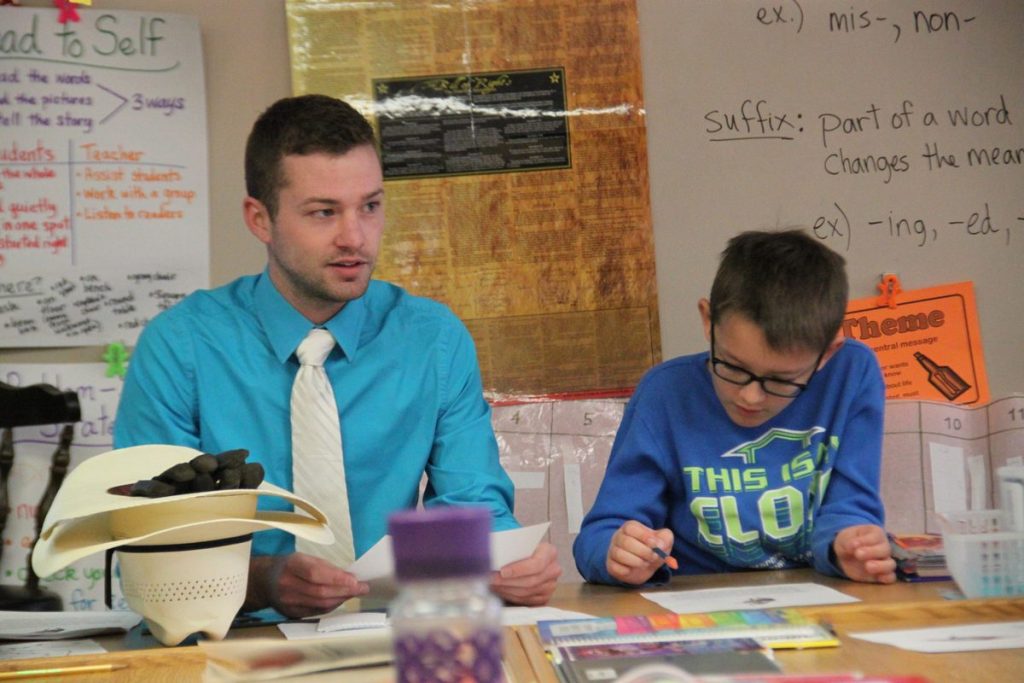
ELIZABETH GOLDEN/DAILY FORUM
Northwest Missouri State University junior education major Alden Adams helps Eugene Field Elementary School fourth-grader Blake Morrison with a reading assignment as part of a teacher education practicum requirement. Adams credits Northwest for his success in the program, saying he knows he is meant to be a teacher now more than ever.
EDITOR’S NOTE: This is the first part in a three-part series on the nature of college teacher preparation programs and, specifically, Northwest Missouri State University’s recent ranking in the National Council on Teacher Quality. Northwest faired poorly, but school officials disagree with both the study and its methodology.
Part 2: NW says nonprofit’s ranking method is flawed
Part 3: Northwest disputes study’s focus on GPA
The National Council on Teacher Quality released a survey earlier this month claiming that teacher preparation courses on many college campuses are an easy option compared to other academic majors.
The survey listed Northwest Missouri State University as one of the universities that has a relatively low standard for rigor when it comes to professional education programs.
NCTQ is a nonprofit, nonpartisan research and policy organization that has the stated goal of restructuring the way teachers are trained and educated.
The report, “Easy A’s and What’s Behind Them,” states that 44 percent of education majors graduate with honors based on cumulative grade-point average (GPA). The study claims the ratio for all undergraduates is 30 percent.
In order to collect data for the report, NCTQ looked at graduation data from more than 500 institutions. The organization collected data from spring commencement brochures.
“We have been quite disappointed with (NCTQ’s) methodology,” said Joyce Piveral, dean of the College of Education and Human Services at Northwest.
“Their most recent results were published by looking at a commencement program and counting the number of education students that received honors then looking proportionally at the rest of the population. They only pulled from the spring commencement. We have three graduations per year and it fluctuates.”
Piveral said NCTQ advocates accepting only the best and brightest into teacher education programs — those in the top third of the total student population.
The state of Missouri is in the process of revising GPA requirements for undergraduate education majors. Graduates must currently have a 2.5 GPA overall, 3.0 in content area and 3.0 in education courses. Northwest has been pushing this grading system since 2013.
“Honors graduates are selected by having a higher GPA, so it is counter to their argument that we need the top third in education,” Piveral said. “We knew what the state was doing, so we’ve been going into all classes and telling students they can no longer accept a C. If you want to be a teacher, you have to start earning those B’s or above.”
The NCTQ ranked the universities as “meets standard,” “partially meets standard” and “does not meet standard.”
Northwest received a “partially meets standard” rating.
Mark Hargens, chairman of the Northwest Board of Regents and a retired public school administrator, said the board’s initial reaction to the NCTQ survey was shock.
“At first, you look at it and think it’s terrible,” he said. “Then we looked at how they gathered information and then tried to get perspective on the report. As a board, you have to look at the whole thing and realize what they’re doing. Their biggest flaw is how they collected their information.”
According to the report, 43 percent of those graduating with a professional education degree from Northwest received honors while 26 percent of all majors graduated with the same distinction.
“(Those that partially met standards) are not as bad as the worst offenders, but they’re not good,” said Kate Walsh, president of NCTQ. “They’re still giving out too many honors. There’s no reason why teacher candidates should have a higher percentage. It’s a really tough job, so it doesn’t make sense why there should be such a lack of standards in coursework.”
Universities that had more than a 20 percent differential between teaching candidates and other majors did not meet standards, according to NCTQ.
“This means you’re graduating new teachers who are told they got it down cold,” Walsh said. “They made all A’s, think they’re prepared, then get into a classroom and hit a brick wall.
“We know new teachers are not prepared. Principals will tell you they’re not prepared. When we look at how students do, it’s clearly evident of a learning loss in new teacher classrooms. Everything speaks to the disconnect between what they’re told in teacher preparation programs and what they actually experience in the classroom.”