Arkoe celebrates 140th year
TONY BROWN/DAILY FORUM
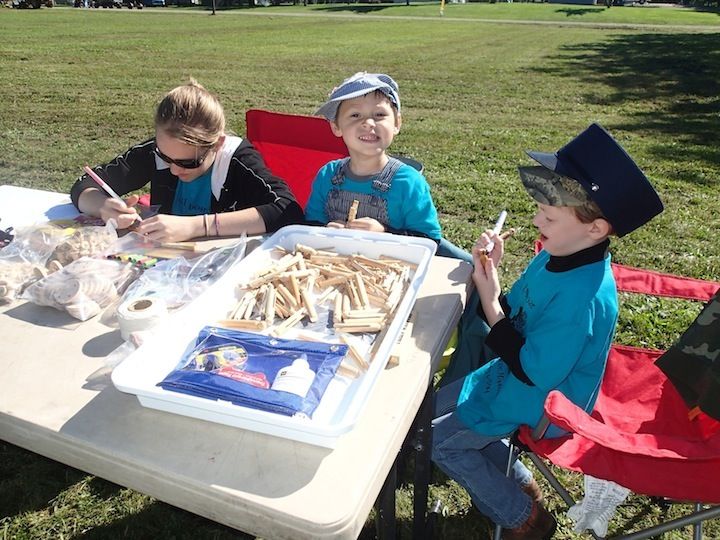
Josie Partridge, left, Owen Cronk, center, and Jaron Partridge, wearing an old-fashioned train conductor’s hat, make clothespin “peg people” and small wheeled wooden toys Saturday during the 140th anniversary celebration of the village of Arkoe, a town of less than 70 people located south of Maryville.
Tiny Arkoe, a village of less than 70 people living along a few winding gravel streets on the north side of Route U about 10 miles south of Maryville, celebrated their town’s 140th birthday on Saturday.
The town council borrowed the grounds of the Church of Jesus Christ Restored for the occasion, and a few volunteers arrived shortly before 10 a.m. to set up tables filled with souvenirs, snacks, reproductions of old photographs, T-shirts, and simple wooden toys and games of the sort popular with children more than a century ago.
It was a stunningly beautiful September day filled with the smell of new-mown grass and sizzling hot dogs and hamburgers.
Little boys, one of them wearing an old-fashioned train conductor’s hat and the other a pair of hickory-stripe overalls, played horseshoes on the wide lawn behind the church, while a pair of slightly older girls tried their hand at hoop-and-stick, a pastime calling for speed and agility and now mostly preserved in “Little House the Prairie” reruns.
And so for a few hours for a few families, life in a farm town in the Midwest was as it used to be — life before television and computers, life before the collapse of the farm economy in the 1970s and the flight of young people to big cities, life before four-lane highways and commutes into town, life in a time when most Americans lived off the crops they raised and the animals they bred on land they owned.
Those were the years in Arkoe, and hundreds of places like it, when stores and shops lined streets with wooden sidewalks, when hundreds of cattle filled the stockyards, and when the blue Missouri sky reeked of coal smoke as churning locomotives carried harvested grain and beef on the hoof to the giant slaughterhouses and elevators in Kansas City and St. Louis and Chicago.
Saturday’s anniversary party in this little town — one of the busiest freight yards in Nodaway County during the boom decades before the Great Depression — was largely the work of Susan Cronk, a self-published novelist and historian who has made her home in the village, where she runs a home-based transcription service catering to museums, researchers and college professors.
Among other books, Cronk is the author of “Where in the World is Arkoe Missouri,” which traces the history of the settlement from its beginnings along what eventually became the Chicago, Burlington & Quincy Railroad.
The “Burlington Route,” Cronk said, continued passenger and freight service to the town until 1959. Sometime after that, the tracks were taken up and an era ended.
Years before, speculation and development fueled by the coming of the railroad led to the founding of Arkoe by Dr. Perry Talbott, whose two sons were convicted and hanged for their father’s murder following a sensational 1881 trial, and Scott Snively, a merchant and rancher who went on to own the Arkoe Milling Co., for years one of the area’s major enterprises.
In its glory days, which more or less lasted through the 1950s, Arkoe’s economy supported several general stores, blacksmith shops, grocers and the Arkoe State Bank, as well as Oscar Moon’s dance hall.
Once home about 130 people, Cronk said Arkoe almost ceased to exist in the 1970s when the population dwindled to fewer than 30.
In recent years, she said, the town has rebounded as a small residential center for retirees and folks who work in either Maryville or St. Joseph, but who prefer life in the country. The only real enterprises remaining are a machine shop and a small custom saddlery. However, a number of residents, like Cronk, operate home-based businesses.
Once upon a time, Cronk said, community life in the little valley town embraced club meetings, dances, boxing matches, baseball games, school programs and events staged by such civic groups as the Oddfellows, the Buffalo Five and the Woodmen of the World.
Those days are long gone. But for a few hours on a lovely September weekend they returned, standing as tall in the memory as the stalks of surrounding corn.