Habitat adopts pre-fab tech
TONY BROWN/DAILY FORUM
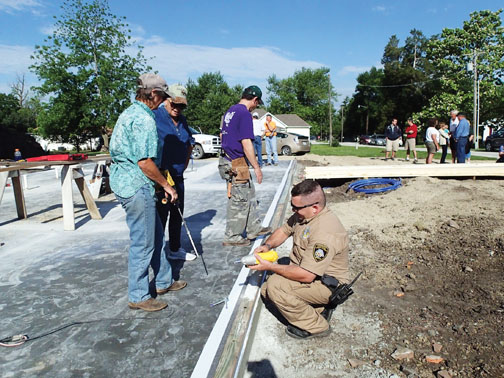
Nodaway County Sheriff’s Deputy Vince Lippencott uses a drill to drive bolts into a footing, while Habitat for Humanity volunteers Nell Cowden, left, Nancy Remmenga, and the Rev. Jonathan Mitchell prepare to perform other construction tasks Saturday morning at the new Habitat for Humanity construction site in Ravenwood.
The groundbreaking ceremony for a new Habitat for Humanity house in Nodaway County is always a special event.
It’s a day filled with satisfaction for the volunteers and with hope and expectation on the part of the client family, who is embarking on the adventure of helping to build a home that will be truly their own.
Habitat board members, volunteers, and this year’s family — Billie Kneale and her three young sons — gathered Saturday morning on aptly named Joy Street in Ravenwood at the organization’s newest homesite for a brief photo op before getting down to the serious business of building a house.
The groundbreaking was almost an afterthought. Prior to taking a five-minute break for the group photo, the Habitat crew hit the ground running with volunteers Nell Cowden and Nancy Remmenga, along with Nodaway County Sheriff’s Deputy Vince Lippincott, picking up heavy-duty drills and bolting lumber onto newly poured concrete footings.
In this county, Habitat has always been less about publicity and more about getting the job done.
All told, the organization has built a total of seven homes in Nodaway County over the past decade with the help of more than 150 volunteers. In addition to the new build in Ravenwood — house number eight — Habitat homes have gone up in Skidmore, Hopkins, Maryville and Burlington Junction.
And in a county like Nodaway, where rural poverty is an endemic, Habitat Board President Jonathan Mitchell said the impact is significant.
“It’s really important,” Mitchell said. “Housing stability is one of the major roadblocks that working low- and moderate-income families face.”
Such families, Mitchell said, are often forced to move from rental home to rental home, which is expensive. In addition, they frequently have no choice but to live in aging, substandard housing where health risks abound and utility costs strain already tight budgets.
Putting lower-income folks in newly constructed homes they can afford, Mitchell said, “positions the family for success” in a number of ways. For example, Habitat volunteers work with families to improve their credit rating so that, in addition to getting a new house, they also receive a clean slate, a ticket to a more-secure financial future.
“It’s a hand up and not a hand out,” said Mitchell, who noted that Habitat clients must contribute 500 hours of “sweat equity,” either in construction labor or community service, in addition to making payments on a no-interest home loan. That money, in turn, is used to finance additional Habitat projects.
Asked why Habitat has such a solid track record in Nodaway County, Mitchell said citizens have simply seen the need and stepped up to the plate.
“It’s a tight-knit community,” he said. “People want to help each other. You don’t have to do much explaining about why it’s a worthwhile endeavor.”
Aside from the personal aspects of the newest Nodaway Habitat project — Kneale is a respected member of the Ravenwood community who works as a custodian for the Northeast Nodaway School District and operates her own housecleaning and janitorial service — the build is unique in other respects.
This is the first local Habitat house to be constructed using pre-fabricated wall panels manufactured by Energy Panel Structures of Graettinger, Iowa, a building system that replaces traditional wood framing with large rectangles of foam sandwiched between sheets of plywood.
Habitat construction manager Eric Couts of Premier Homes said the technology is slightly more expensive than traditional wood-frame construction, but that energy savings more than make up the difference.
Couts said he has built commercially constructed foam-block homes in Maryville that cut energy bills to below $40 a month.
“It may raise your mortgage payment $10 a month, but your energy savings is $70 a month, so there is more cash in your pocket,” Couts said.
In addition, because the houses are so tight, smaller heat pumps are required, which Couts said helps balance out the higher construction cost.
As far as Habitat is concerned, another big advantage is that relatively unskilled volunteers have simply to bolt and nail the panels together rather than assemble complex framed walls.
Couts said professional builders can put a pre-fab house together in less than a day, minus siding and interior finishing. A Habitat crew, made up of amateurs possessing a mixed bag of carpentry skills, might take two of three days.
“From what I understand, by Wednesday we’ll be able to put the roof on,” Mitchell said.