State archivist continues Nodaway County record-saving effort
SKYE POURNAZARI/THE FORUM
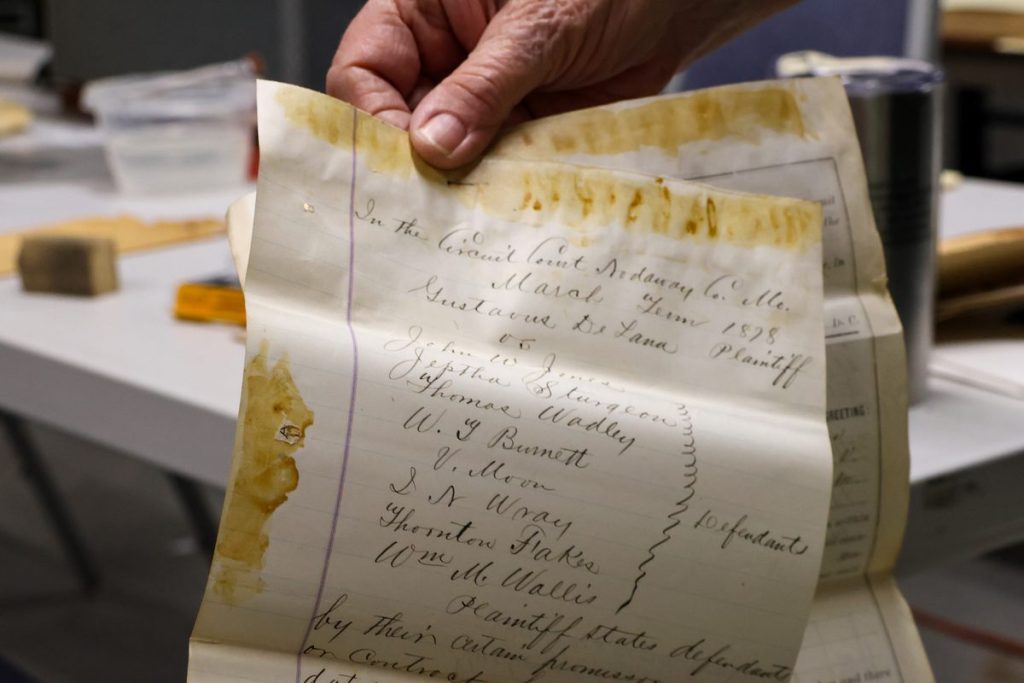
Old records are cleared of glue and if necessary, put into a humidification chamber before they’re labeled and boxed.
MARYVILLE, Mo. — One state archivist and two volunteers are slowly and methodically making their way through thousands of the earliest recorded histories of Nodaway County.
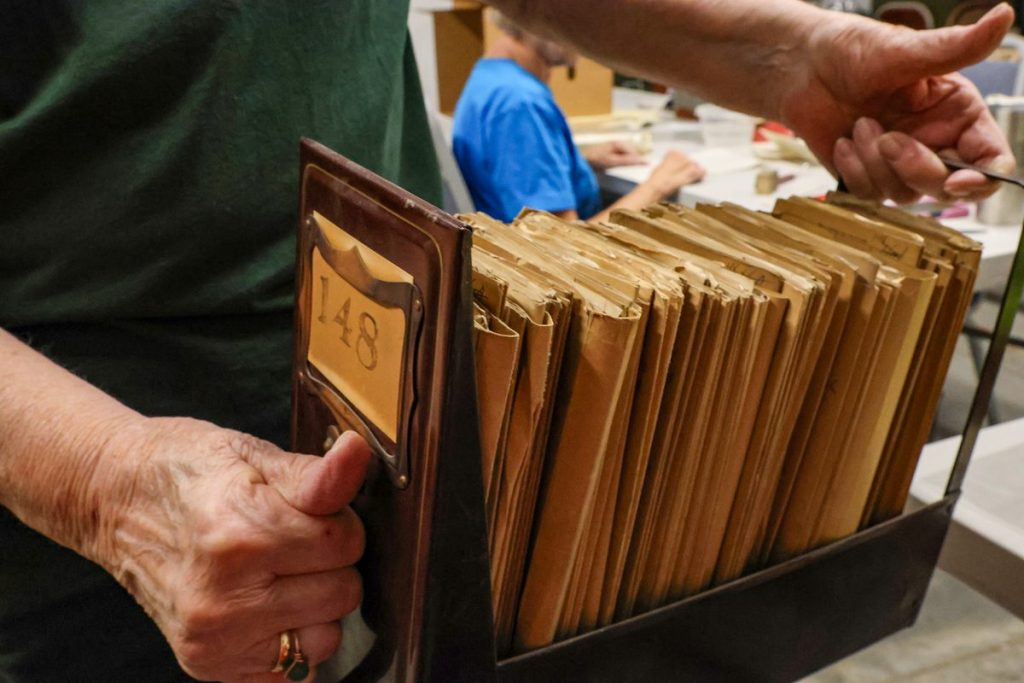
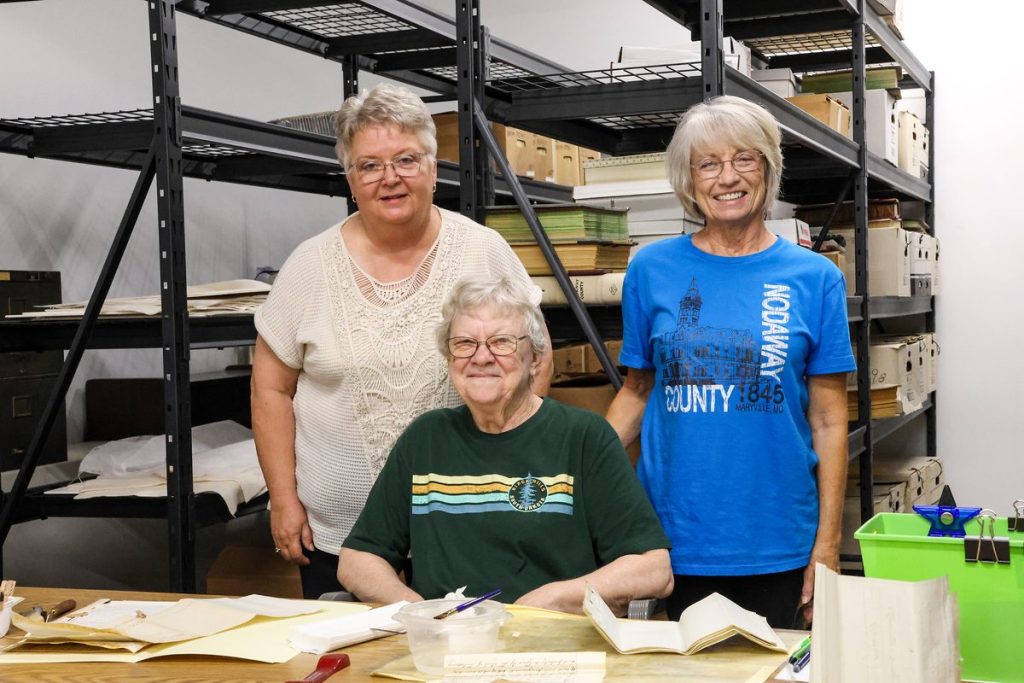
Becky Carlson, a field archivist from the Missouri State Archives, spends much of her time in the basement of the Nodaway County Administration Center. Studying handwritten court documents recorded between 1845 and 1899, Carlson’s job is a big one, not only in its importance for maintaining an accessible record of the county’s history, but also because of the towering shelving unit on which sit drawers upon drawers filled with folded, bradded, glued, nailed and sewn records all requiring careful handling in order to read.
She has the help of two local volunteers to make this endeavor, which began in 2019, a little less overwhelming. Maryville residents Janet Hawley and Lorraine O’Donnell spend a good portion of their days tucked away in the basement unfolding court records, reading the contents and headers, removing brads or tacks, and cleaning off any residual glue or soot.
“They were by a chimney so they’re very dirty,” Hawley said, noting that vulcanized rubber, also good for removing pet hair, is a special tool — one of many created and used to clean and restore the documents — she uses to clean off the dark soot on the old, faded pages.
Carlson explained that the original Nodaway County Courthouse was heated with coal and that dust is very fine and settles everywhere.
Believe it or not, Carlson said, the best tool they use for glue removal is actually glue — methyl cellulose.
“Their glue back then must have been horse glue because it’s the hardest stuff to get (off),” O’Donnell said. “It lasts forever.”
For particularly stiffly folded pages, a humidification chamber is used. Once the pages are clear of glue, and the hard creases have been pressed down with a ruler, the pages are placed between plastic sheets and felt to help the pages relax. Once the pages are flat and labeled with the pertinent information — such as plaintiff, defendant and what the action was — they are boxed. The information is uploaded into a database and once a box is full, it’s shipped to the state archives where the documents are simultaneously imaged and microfilmed. Then they are uploaded to the state archives’ website.
Carlson said that since the start of the local program, about nine boxes of the earliest court records have been submitted and are currently available online at s1.sos.mo.gov. She said the site receives thousands of visits per day with people seeking information for various areas of study.
Searchable not only by county, but also name, type of action or amount of dollars, the online database can be used easily, she said.
“There’s information on agriculture in the 19th century,” Carlson said. “… It gives you an idea of what items were purchased, how much they cost, what supplies the early settlers had to have. It just provides a wealth of socioeconomic and historical information that really can’t be found as a primary source anywhere else.”
The effort is funded by a $1 fee that is paid when documents are recorded at local recorders’ offices throughout the state.
“We work to help local tax-based entities like the 4th Circuit Court identify, organize and preserve their permanent and historic records and manage the records that are not permanent,” Carlson said.
She said part of the program helps tax-based entities know what type of records they create and how long they’re required to keep them in order to satisfy state statute. Then the state division helps them to implement record management procedures.
On the front lines
As of Sept. 1, Carlson will have been working to help with record retention for 33 years. A nontraditional student, she took a record analyst internship at Missouri Western State University years ago after a brief flirtation with teaching. Then she trained at the National Archives in Washington, D.C., before becoming a certified archivist. As a field archivist, she’s on the front lines in ways her counterparts back in Jefferson City aren’t.
“Attics, basements, we’ve cleaned out dead pigeons, live pigeons, bats, rats, mice,” she said. “We did floods.”
Even live grenades at one northwest Missouri courthouse.
A story she tells often, many years ago Carlson was sorting through documents in the vault of the DeKalb County Courthouse. Next to her was a large black box that turned out to contain six grenades and a launcher dating from around World War II. That wasn’t going to stop her from continuing her work, though, and she kept right on going while the bomb squad from Jefferson City made its way north.
“I think it didn’t explode in the last 50 years, surely not in the next hour or two is it gonna (explode),” she recounted.
When the bomb squad arrived, Carlson, of course, was interested in seeing their safe detonation as much as anyone and accompanied them to a safe area in a field.
“You’ve seen that mushroom cloud from Hiroshima? Yeah, the exact same thing,” she said.
In the same vault, she came across a textbook, which isn’t typically something that a courthouse would retain as a record, she said. This one turned out to be even more unusual: held within were two slips of paper and an envelope. Inside the envelope was a bullet casing, and a slip of paper read, “You’ll find my body in the vault,” signed “Lowry.”
She said that Mr. Lowry had been a shop owner on the south side of the square and that his wife had died of cancer. After sending his shop girl home after lunch one day, he had committed suicide.
“That was all in one flippin’ day,” Carlson said.
It’s not all about excitement though; sometimes what she finds leads to correcting what had been known up to that time as a historical fact.
“A lot of the stuff we find rewrites what’s been given as history,” Carlson said. “We find documentation to prove otherwise.”
Here in Nodaway County, she said some of the facts that have changed include proof of a brothel located within earshot of the convent that housed St. Francis nuns. She said they have court records involving women who were arrested for doing their work.
“Nobody ever mentioned that before,” Carlson said. “It’s not in the 1881 history book at all. But it’s interesting, because there’s nothing new under the sun. There truly isn’t. The same stuff that’s going on today was going on then.”
She said the records also show that slaves were kept in northern Missouri, though history books would disagree.
“We have slave-hire contracts in the case files,” Carlson said. “We have emancipations.”
She said another historical tidbit corrected by this historic record salvage concerns George S.E. Vaughn, a convicted Confederate spy who falsely claimed to have been pardoned by President Abraham Lincoln in the hour before his death as his last official act.
“He gave interviews with the local newspaper and The New York Times saying he had been tried three times and convicted to death by firing squad, which was a lie,” Carlson said. “I found the documents of the provost marshal, that yes he was arrested and accused of recruiting for Price’s army over in Hannibal, but he was never sentenced to death.
“He abandoned his wife and his five children. … He ended up living the rest of his life right here outside of Maryville.”
Future-proofing history
Carlson, Hawley and O’Donnell are working with 4th Circuit Clerk Elaine Wilson to complete the project. How long that might take, Carlson wasn’t sure. The work is detailed and careful, which also means slow and steady.
“I wish I could tell you that in 33 years I’ve gotten every county done in northwest Missouri, but I haven’t,” she said, further noting that some county records have been destroyed, like the earliest records from Buchanan County.
This work frees up space for record storage and makes information more readily available to the public and to historians. Carlson said she’s concerned that without saving these primary sources, people could be learning false history.
“What are we gonna use for primary sources since newspapers are kind of …” she said, trailing off with the understanding that she was talking to a newspaper reporter, but confident anyone could fill in the blanks.
While she’s a self-described lover of all things paper, Carlson said the Missouri State Archives doesn’t care about the form of the record and the office preserves all records alike.
“A record is still a record and it has the same retention, regardless of the format,” she said.
SKYE POURNAZARI/THE FORUM
Janet Hawley holds a drawer filled with some of the earliest court records of Nodaway County.
SKYE POURNAZARI/THE FORUM
Missouri State Archives field archivist Becky Carlson, left, and volunteers Janet Hawley, seated, and Lorraine O’Donnell are shown in the basement of the Nodaway County Administration Center. The trio has been working to record Nodaway County’s earliest court records, Carlson since 2019.