Check websites, people before purchasing items, equipment
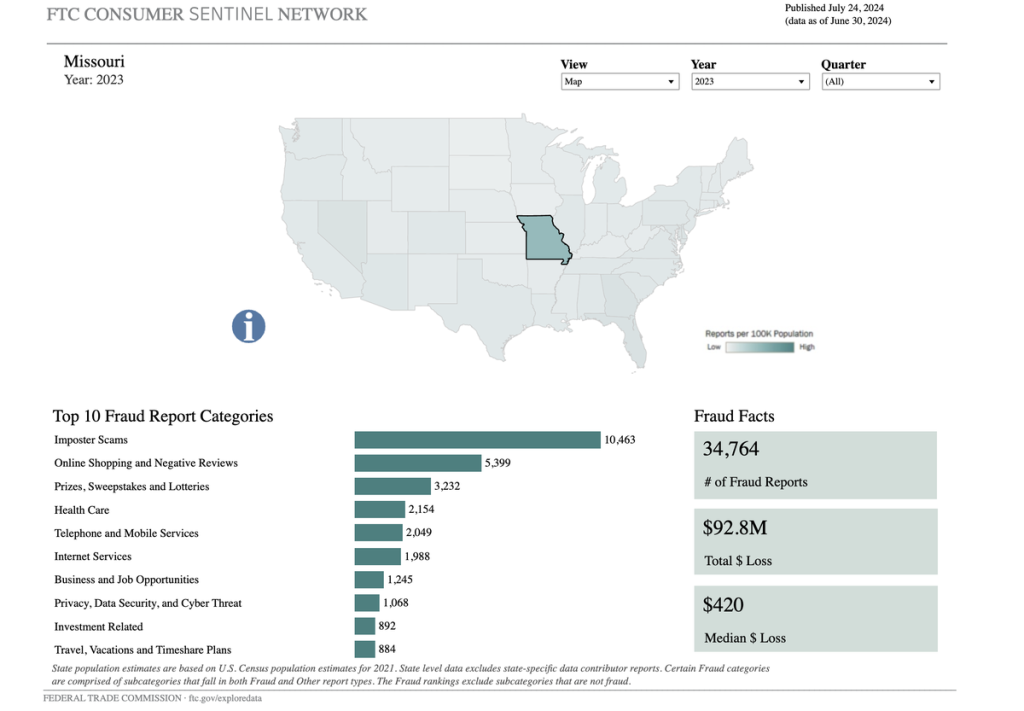
Scam Sites fraud reports map
MARYVILLE, Mo. — Oh what luck! While shopping for a rifle, you find a website offering 20 percent off the purchase price should you decide to buy with Bitcoin. Excitedly, you prepare to make your purchase, finding a local Bitcoin ATM and pushing your cash into it, expecting to see it appear in a digital wallet you can use to make the purchase. However, the website was a scam; you don’t receive the digital wallet information; and your hard-earned money has digitally disappeared.
This scenario has played out similarly in Maryville, according to detectives with the Maryville Police Department, and as the holiday season approaches, they’re drawing attention to the fact that people in Nodaway County and throughout the world are still falling victim to the various and new ways in which scammers are stealing money out of the pockets of people looking to purchase something.
Whether buying through Facebook Marketplace, Craigslist, eBay or any other number of websites listing items for sale, scammers are on the lookout for every way possible to separate a buyer from their funds and offering incredible deals on absolutely nothing.
“If it looks too good to be true, it probably is,” Detective Sgt. Ryan Glidden said. “… This is something, I think, that people need to watch for.”
Just this month, he received a report about the continued proliferation of scam websites from the Missouri Information Analysis Center, recognized by the U.S. Department of Homeland Security as the primary fusion center for the state of Missouri, a state-owned and operated center that serves as a focal point for the receipt, analysis, gathering and sharing of threat-related information that crosses legal jurisdictions to help law enforcement track crime.
“Based on investigators in multiple jurisdictions, there’s been an uptick in fraudulent website advertising of the sale of heavy machinery and farm equipment as of July 2024,” Glidden said. “The websites and the criminals operating them go to great lengths to appear legitimate, and their tactics are becoming increasingly sophisticated and difficult to detect.”
He said scammers use fake websites, sometimes even sites cloned from real businesses, to lure in prospective buyers. Scammers exploit legitimate sites with little to no internet presence to use authentic information, thus appearing more legitimate.
For example, he said a scammer could access the VIN and photographs of vehicles from automotive websites and then create an entirely separate website with just a slight change in the web address to catch anyone who happens to enter a close typo instead of the site they’re trying to get to. “Look at the details of (the site),” Detective Sgt. Adam James said.
“Look at the pictures. … You look for spelling errors.” He noted that sometimes someone who is trying to create a site that looks legitimate will use a No. “1” for a letter “l” because it is difficult to see the difference.
SERIES INFORMATION
This is Part 10 of The Forum’s yearlong series about scams. With the ever-evolving nature of scams, new AI tech and faster communication, people of Nodaway County and northwest Missouri are falling victim, losing more than a million dollars to scams over the past five years.
The Forum is diving into the specifics of some of the most prevalent scam types being used in Nodaway County today, red flags to look out for and what local law enforcement, businesses and financial institutions are doing to stop the scams before they happen.
Find the previous stories at maryvilleforum.com/news/scams.
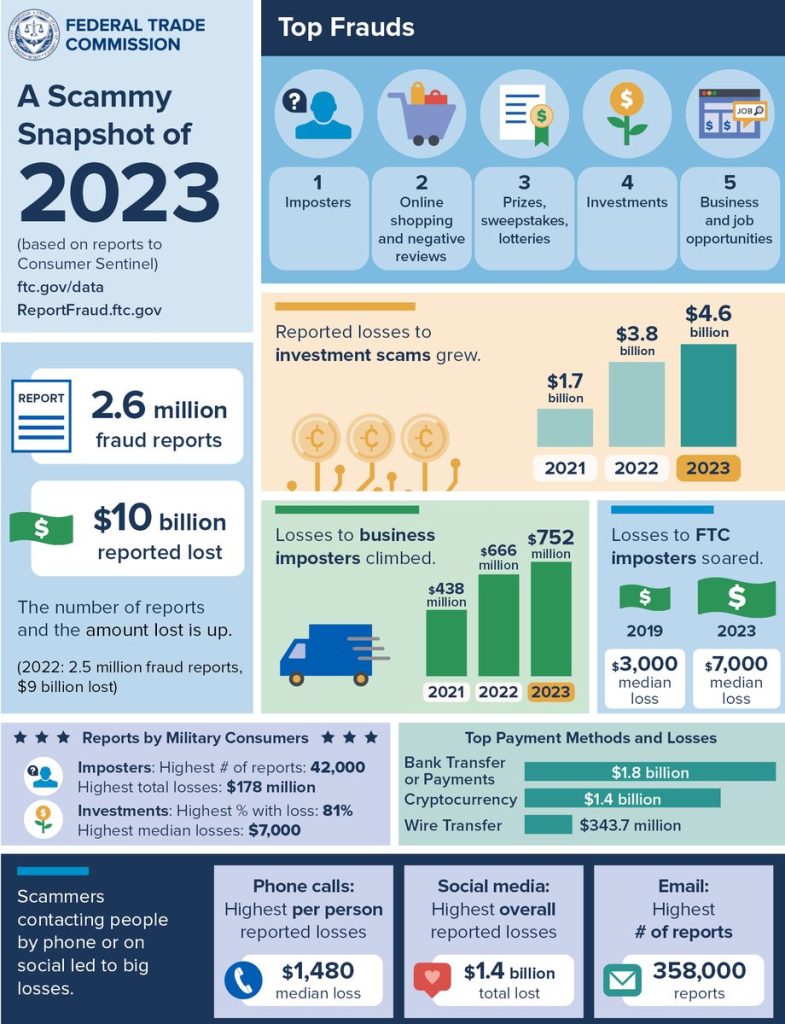
In 2023, the Federal Trade Commission reported that consumers lost more than $10 billion to scams of varying types, and that the No. 2 fraud happening throughout the U.S. is online shopping and negative review scams. In Missouri, the FTC reports it received 34,764 reports of fraud in 2023, with 5,399 of them being online shopping related.
Not all scammers will use Bitcoin as part of a scam, but because of the type of currency it is, it is alluring to them. Bitcoin is a digital currency in which a record of transactions is maintained and new units of currency are generated by the computational solution of mathematical problems. Its use in scams is fairly new to the region, Glidden and James said, noting there were two Bitcoin ATMs in local businesses in town at one point; however, at least one is no longer in use.
“Once that money goes into the Bitcoin world, no large task force — which they are starting to develop a task force to combat that — is going to be interested in a few hundred dollars or a few thousand dollars,” Glidden said. “You’re just out of luck.”
While it is possible to purchase Bitcoin legitimately, it is also possible to lose all your hard-earned dollars while transferring them entirely to unknown party, with no recourse. Not backed by a centralized bank, Bitcoin is often difficult to track, especially if the transactions aren’t verified and recorded in a publicly distributed ledger called a blockchain.
Glidden and James advise all buyers to be cautious when on websites shopping for items. They suggest, for example, taking a little time to look into the person selling the items.
Glidden said there are numerous ways to check on someone or a website. Sometimes it just takes a quick Google search, he said. He also uses an app called onX Hunt, which helps narrow down landowners for hunting, but the app can also quickly show the landowner of an alleged business or seller of an item.
“Sometimes you just call and run it by somebody,” Glidden said.
James said he’s had neighbors come by and ask about certain situations, including one where a scammer sent a check for more than the purchase price of an item his neighbor was selling and asked him to send it back to help with the shipping process.
“You’re going to be out that, because the check is going to bounce because it’s a no-good account,” he said.
“I don’t think people probably realize how many hours a year we deal with stuff like that,” Glidden said, noting that they’ve talked with numerous people who sent deposit money for an item — such as a pet from a breeder, or equipment allegedly owned by a recently deceased relative — and never received the item or were held off with rescheduling so long that they realized they had been scammed.
Both detectives suggest, if someone looks like they have a great deal on a piece of equipment or item, to run it by someone trusted first. Telltale signs include deeply discounted prices and major sales.
“First of all, it’s a sign that it may be stolen,” James said. “Or secondly, something’s not right. … We do see that. I’d stay away from the deposit. It’s probably better to lose the item if it was legit. … I’d caution putting any money down until you’ve safely met the person, you see the item, you check the numbers, make sure everything is legit and at that point you can make your transaction.”
He suggested meeting at a safe, public location, like the police station, if possible.
There is a difference between purchasing from one person on Marketplace and purchasing from a fake website that has been crafted using social engineering, which exploits human judgment to draw in people. Glidden explained that websites designed for scamming are not always well-organized and a careful eye can reveal it. To avoid being scrutinized, a scam website will use a component of social engineering: emotion. Whether that manipulation is adding a sense of urgency, excitement or fear, it’s crafted that way to add expediency, not attention to detail to the site and the transaction.
“The one thing I think that probably makes this worse, is that as we went through COVID, (and) items became hard to come by,” Glidden said. “So when you came across what you wanted, you got used to the mindset, ‘I’ve got to pull the trigger now and buy right now or it will be gone.’”
He thinks that people have become accustomed to that feeling of needing to pounce on a good deal.
“We don’t hardly get any calls on Craigslist stuff anymore, but we do get some on Facebook Marketplace,” Glidden said. “… And sometimes things turn out to be legit, but any more you just can’t take things at face value.”
Popups
An entirely different scam website issue involves popups on computers spouting scary words like “virus,” and “infected.”
“The Microsoft Scam,” Glidden said. “You’re just sitting there and all of a sudden you get this pop up and your computer’s locked and they want you to call. Then they start getting information from you and they take your computer over and then you’re in a world of hurt.”
Very much like the introduction to the 2024 film “The Beekeeper,” starring Jason Statham, this scam still manages to catch computer owners unaware of its surreptitious attempt to steal banking information and, eventually, funds.
“It doesn’t give you time to think, but really what you should do is hit control + alt + delete and get the heck out of there,” Glidden said. “Unplug it. Unplug your internet until you get somebody there to help you.”
According to the FTC, these tech support scams are trying to trick computer users with a pop-up window that appears on the screen.
“It might look like an error message from your operating system or antivirus software and it might use logos from trusted companies or websites,” noted a 2022 FTC article about spotting scams. “If you get this kind of pop-up window on your computer, don’t call the number. Real security warnings and messages will never ask you to call a phone number.”
Contact police before sending money
“So many people send the money, then they come ask,” James said. “… Just reach out to us. Come talk to us. Come in, walk in the front door.”
Both James and Glidden expressed the hope that people would utilize their ever-expanding knowledge about scams more often.
“It’s a lot easier to stop it than it is to try to fix it,” Glidden said. “Because a lot of times once the money’s gone, it’s gone forever.”
The two detectives have been learning about scams for years and presenting information to local organizations. During those presentations, they both ask people to contact them if they think they are being or have been scammed. James said especially with concerns about Bitcoin, it’s always better to be on the front end of those transactions because the use of digital wallets moves those funds quite quickly and it’s difficult to catch up while requesting subpoenas and search warrants.
“Walk in the front door,” James said. “Ask for me … we can talk it through. If it’s legit, it’s legit. If it’s not, we can put a stop to it.”
For more information or to report a scam, contact Detectives James or Glidden at the Maryville Police Department or by calling 660-562-3209.
Scam Sites infographic
Scam Sites