Forum Flashbacks: Sept. 12-18
MARYVILLE DAILY DEMOCRAT-FORUM, SEPT. 15, 1924
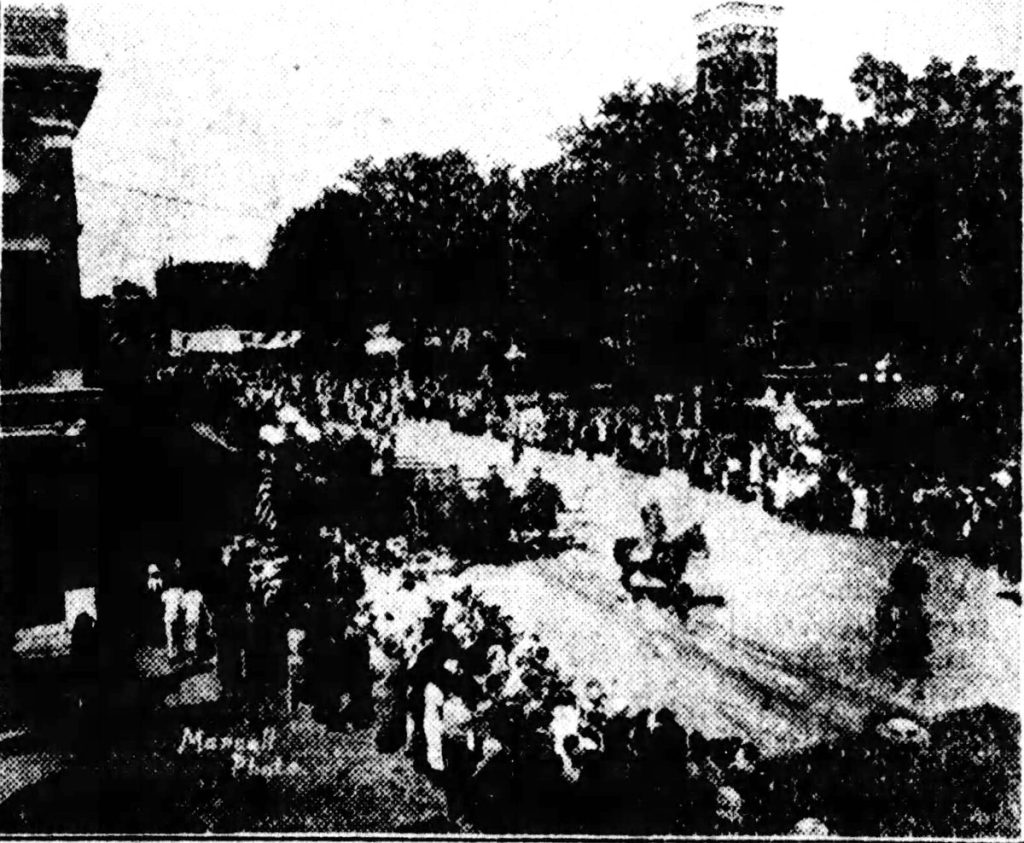
100 YEARS AGO: When Maryville Goes On Parade – Hundreds of persons viewed the Defense Day parade held in Maryville Friday afternoon. This picture shows Battery C “on parade” as a part of the fifteen-block demonstration witnessed in Maryville last Friday when all the business houses (except the newspaper offices) closed from 1 to 4 o’clock and everyone (except newspaper workers) had a half-holiday.
50 years ago
Maryville Daily Forum, Sept. 12, 1974
In the last 10 years Don Corrough has lived on his property in Arkoe, about 250 person have come to his door asking if they could dig up his yard.
Corrough has said yes to just about every one of them.
He lives on a farm which at one time was owned by Dr. P.H. Talbot, one of the founders of the community of Arkoe which will be celebrating its centennial Sunday.
Dr. Talbot was a rich man and every so often, a national treasure-hunting magazine will stir up the old rumors that Talbot buried his gold on that land. The gold diggers come from all over the nation to search for his fortune.
Gold fever is what brought Talbot to this region in the first place, said Corrough, who is somewhat an expert on Talbot and the history of Arkoe.
“Talbot came from Ohio during the gold rush days,” Corrough said, “and settled in this area in 1853. On Sept. 15, 1874, he and S.K. Snively laid off the site of Arkoe, giving it a name from ‘Twenty Thousand Leagues Under the Sea,’ it is thought.
“Arkoe was located about one mile north of the old town of Bridgewater, which was consequently abandoned.
“In order to have the railroad located near him, he gave the land for the depot and the right-of-way to the railroad with the stipulation that the Chicago, Burlington and Quincy Railroad Co. would maintain the depot and always make a stop at Arkoe,” Currough said. …
According to The History of Nodaway County, “As a husband and father he seemed to lack affection, and his home was the abode of discord. His children grew up neglected, no care being given to their temporal welfare or moral training. His house was an arsenal of small arms and the children were familiar with their use.”
On Sept. 18, 1880, Dr. Talbot was shot through the chest and he died the next day.
“Though there are many speculations as to who really did him in, his two sons — Charles, 17, and Albert, 21 — were found guilty of the crime and were hanged.”
The hanging, the first legal execution in Nodaway County and the only double hanging, took place July 22, 1881.
“The hanging took place about where Beal Park is today,” Corrough said. “A crowd of about 10,000 showed up and brought picnic baskets. A hole was dug a foot deep under Charles because he was so tall.”
The boys were buried on Corrough’s land under one tombstone with Albert’s name on one side and Charles’ on the other. The inscription reads: “We died innocent.” …
In 1902, Corrough’s grandfather purchased the land and since that time the story has been circulated many times over that Talbot buried $25,000 in gold “which he carried in nail kegs in a spring wagon, in an easterly direction toward the tipped rock.”
Corrough said there is no tipped rock on his land to his knowledge. …
Corrough doubts the existence of any fortune on his land. “The doctor was a professional gambler. I’m not so sure he had $25,000 in gold together long enough to bury it.”
100 years ago
Maryville Daily Democrat-Forum, Sept. 12, 1924
MARYVILLE JOINS IN NATION’S TEST
_______________
Led by a grim old warrior who fought in the war when breaking up of the Union was imminent, Nathaniel Sisson, with a Battery C man carrying the colors and Major Rolf Raynor, commander of a battalion of the 128th F. A. National Guard, all mounted, headed a parade stupendous in proportion and bright in color.
“For the Defense of the Home” was the undoubted thought in mind of those who rode in automobiles and marched in the First National Defense Day parade, starting promptly at 2 o’clock this afternoon from the postoffice on Fifth and Main, and wending its way down to First street, west to Buchanan, south on Buchanan to Thompson street, east to Main street and again on Main north to the courthouse square.
The presence of veterans of the Civil, Spanish and World War, in their different organizations with the Women’s Auxiliaries, each organization floating the Stars and Stripes on high, brought back memories to the present generation of the suffering of the wars — and the civic organizations with the students from the College and the pupils from the public and parochial schools brought to mind the purpose of the National Guard unit, Battery C, bringing up the rear of the parade, as a safeguard to all living under the tri-colored flag of security.
Not until the head of the parade had turned back and marched north on Main street to the square and thence east did the last of the school children pass the intersection of Third and Main streets. Then when the parade, under the able supervision of Harry Snyder, commander of the Spanish American War Veterans and L. M. Eek, president of the Chamber of Commerce, passing the reviewing stand on the courthouse square until the last of the paraders returned to the square, the line of march broke up to take part in the program and hear the speakers of the afternoon.
EDITOR’S NOTE: The 50-year and 100-year flashbacks are courtesy of the Missouri Digital Newspaper Project from the State Historical Society of Missouri, accessible at shsmo.newspapers.com.