Celebrating Archaeology Month
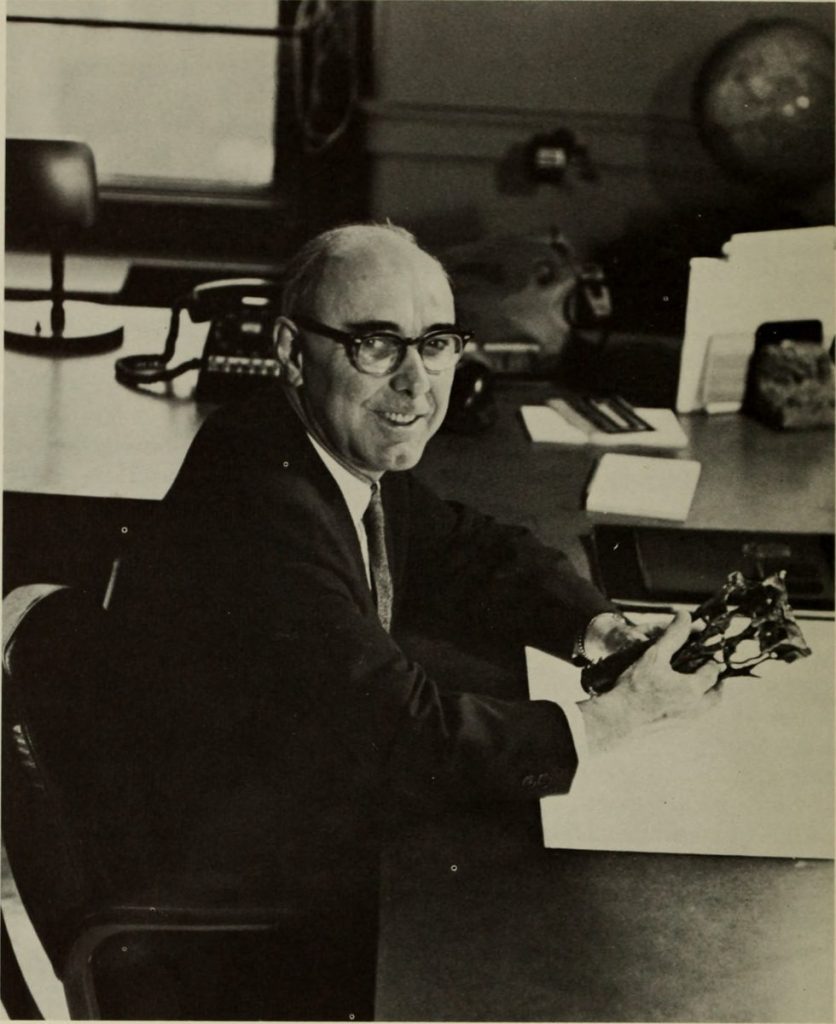
PUBLIC DOMAIN PHOTO
Edwin H. Colbert, who grew up in Maryville, is pictured at work at the American Museum of Natural History during the 1960s.
September is Archaeology Month, and we at the Nodaway County Historical Society Museum would like to highlight some of our important local stories. Not only are we in a region that has been rich in discoveries of objects like mastodon bones (stop by the museum to see our display featuring locally-found items!), but we also have been home to a renowned paleontologist.
Edwin Harris Colbert was born on September 28, 1905, in Clarinda, Iowa, to George Harris Colbert and Mary Adamson Colbert. Edwin’s father had gotten a job teaching in the mathematics department in the newly-founded Fifth District Normal School, so in the summer of 1906, the family moved to Maryville. Colbert grew up and spent his childhood in Maryville, originally living on Third Street, and later in the house his family built on the second block of East Seventh Street.
He attended high school and from 1923 to 1926 studied at the Maryville school, by then known as the State Teacher’s College, before transferring to the University of Nebraska, where he earned his Bachelor of Arts degree in 1928. Colbert then moved to New York City to study at Columbia University, completing his master’s there in 1930 and his Ph.D. in 1935.
While attending Columbia University, Colbert married Margaret Mary Matthews on July 8, 1933. Margaret was a scientific draftsman of fossils and the daughter of famous mammal paleontologist W.D. Matthews, curator of the American Museum of Natural History. Together they had five sons: George, David, Phillip, Daniel and Charles. The family moved to Leonia, New Jersey, in 1937.
Colbert began his tenure at the American Museum of Natural History in 1930, where he would stay for 40 years up until his retirement. There he served as a research assistant, assistant curator, curator, department chairman and dean of the Council of the Scientific Staff. In addition to that work, from 1945 until 1969 Colbert was the professor of vertebrate paleontology at Columbia University.
Colbert traveled extensively across the United States and to England, Mexico, Brazil, Argentina, Israel, South Africa, India, Australia, New Zealand, Germany, Switzerland, Lesotho and Antarctica. On a 1947 trip in the Santa Fe, New Mexico, area, he discovered a “mass grave” of dinosaur skeletons packed together in a layer of 214-million-year-old mudstone — most of the skeletons were nearly perfect.
This became known as Ghost Ranch. During his 1969 Antarctic expedition, Colbert found a 220-million-year-old fossil of a Lystrosaurus. This discovery helped support the acceptance of the continental drift theory.
Over his career, Colbert received many awards and prizes for his contributions to paleontology. For his work in Siwalik Mammals in the American Museum of Natural History, Colbert was awarded the Giraud Elliot Medal from the National Academy of Sciences in 1935. He also wrote more than 20 books and 400 scientific articles during his career. Even after his retirement, when he moved to Flagstaff, Arizona, in 1970, he continued to devote his time to science as a volunteer at the Museum of Northern Arizona. Colbert lived in Flagstaff until his death on Nov. 15, 2001.
Learn more about the scientific history of this region and explore locally-discovered objects by visiting the NCHS Museum at 110 N. Walnut St. The museum is open March to December on Tuesdays to Fridays from 1-4 p.m. and year-round on the second Saturday of each month from 9-11 a.m. We host monthly programs that are free to the public. The next NCHS Museum event is our second Saturday coffee on Saturday, Sept. 14, from 9-11 a.m. Then, join us for a special program at 11 a.m. that day to learn more about the archaeology of this region.
Learn more about the museum’s work on our website, nodawaycountymuseum.com. You can contact us at [email protected] or 660-582-8176.