Classes back in session and so are scammers
FEDERAL TRADE COMMISSION
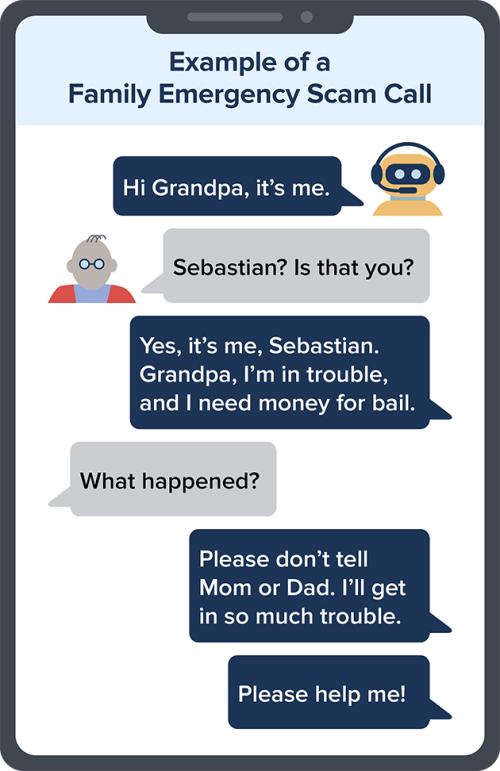
An example of a text family emergency scam call is provided.
MARYVILLE, Mo. — With school back in session this week at Northwest Missouri State University comes an increased potential for scammers seeking to separate grandparents from their money.
SERIES INFORMATION
This is Part 8 of The Forum’s yearlong series about scams. With the ever-evolving nature of scams, new AI tech and faster communication, people of Nodaway County and northwest Missouri are falling victim, losing more than a million dollars to scams over the past five years.
The Forum is diving into the specifics of some of the most prevalent scam types being used in Nodaway County today, red flags to look out for and what local law enforcement, businesses and financial institutions are doing to stop the scams before they happen.
Find the previous stories at maryvilleforum.com/news/scams.
Emergency scams, also known as “grandparent scams,” work because a scammer preys on the willingness of an unsuspecting, worried individual to help friends and family members in a dire situation.
These scams start with scammers mining social media for information and then calling or texting someone impersonating their family member in distress. They may say they’ve been arrested or there was an accident, medical emergency or other difficulty, and they’re in need of money. Sometimes the scammer even sends a photo that appears to look like a mugshot.
Because of the scammer’s earlier information gathering, they have pertinent details, like correct names of family members or the school they’re allegedly attending. Last year the Federal Trade Commission even put out a warning that voice cloning and artificial intelligence is being used in these cases to fake an entire conversation that sounds like a family member.
Another twist in the scam is when the scammer calls a grandparent and claims their grandchild has been arrested and needs bail money sent immediately through a payment app, like Venmo or PayPal. Without the need to pretend to be a specific person, this tactic is even more easily believed by a grandparent.
“It does happen here,” said Detective Ryan Glidden with the Maryville Police Department.
He told The Forum about one particular case a few years ago in which a local grandmother showed up at the police station searching adamantly for a specific law enforcement officer.
One that did not exist.
An officer explained that to her, but she didn’t believe it, Glidden said.
The grandmother told them that this officer called and said her granddaughter had been arrested and if she didn’t want her to go to jail, they needed a bail payment. Rather than send the money, the grandmother quickly made her way to the police station with the funds.
“The scammer had given her a fictitious name,” Glidden said. “I visited with her. She had all these notes.”
Better Business Bureau tips to spot the “grandparents scam”
- Resist the urge to act immediately, no matter how dramatic the story is. Check out the story with other family and friends, but hang up or close the message and call your loved one directly. Don’t call the phone number provided by the caller or caller ID. Ask questions that would be hard for an impostor to answer correctly.
- Know what your family members are sharing online. You may not have control over your family’s social media accounts, but familiarize yourself with what they share online and what photos they may have posted. Make sure they’re aware of this type of scam and advise them to use privacy options to keep other people from seeing and stealing their images.
- Don’t send money if you are unsure about the call. If the caller asks you to send money via a payment app or a gift card, do your homework to ensure that it’s not a scam. If you wire money and later realize it is a fraud, the police must be alerted.
- If you are told that someone will come to your home to pick up the money, do not answer your door and call the police immediately. This action could be part of the scam, and the driver may not be aware they are part of the fraud.
While taking the call, the grandmother took extensive notes about it. He explained that often people take notes during phone calls and that those can be very helpful, however in this case, it wasn’t, because the “officer” whose name she wrote down didn’t exist.
“I was able to track down her granddaughter on campus,” Glidden said.
He asked her to come down to the station. Immediately, the stressed grandmother asked if she was all right.
“Even though (the grandmother) could now see her, she was still convinced she needed help,” Glidden said.
Nothing had happened to her granddaughter, who was also very confused about the entire situation. Not all the local cases — which have all had a similar story — ended so well. Glidden said people in the area have fallen for this scam and lost money doing their level best to help someone they think is a family member.
The FBI warned senior citizens about this scam that most often targets their age group. From January to September last year, the FBI Internet Crime Complaint Center received more than 195 victim complaints regarding grandparent scams, resulting in at least $1.9 million in victim losses.
“Seniors are often targeted because they tend to be trusting and polite,” noted the FBI’s website. “They also usually have financial savings, own a home, and have good credit — all of which make them attractive to scammers.”
The FBI says that with the elderly population growing, elder fraud remains a growing problem, racking up more than $3 billion in losses each year.
The bureau also says that seniors may be less inclined to report fraud because they don’t know how, or they may be too ashamed of having fallen for the scam. They also might be concerned that their relatives will lose confidence in their abilities to manage their own financial affairs. The FBI suggests anyone who has fallen for a scam to report it online at ic3.gov, the FBI’s complaint center.
“We just encourage people to go ahead and contact that child, grandchild or parent to verify,” Glidden said. “Most of the time, it’s not gonna be true.”
Contact the Maryville Police Department at 660-562-3209 if you think you have been the victim of a scam.