April 2 ballot issues explained
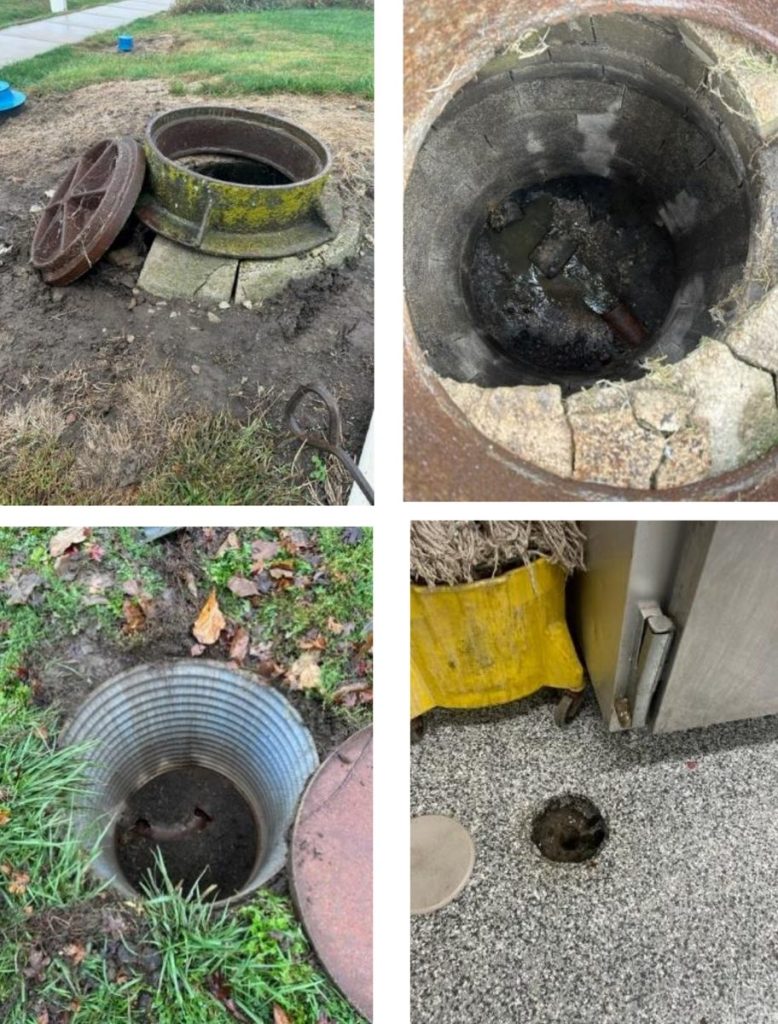
WEST NODAWAY R-I
Proposition K.I.D.S. would allow for repairs to the main sewer line at several points, including replacing a deteriorating manhole, a broken cap at the street, filling in a failed sewer line near the east parking lot and replacing a faulty drain in the kitchen.
Nodaway County voters will go to the polls on April 2 and decide three major ballot questions, in addition to more localized proposals.
The three major ballot questions to be decided are a countywide 911 sales tax of 3/8 of a cent, Proposition JUMP, which is a bond issue for the Maryville R-II School District, and Proposition K.I.D.S., a bond issue for the West Nodaway R-I School District. Below are summaries and analyses of each ballot question.
911 SALES TAX
911 Sales Tax
Shall the County of Nodaway impose a county sales tax at the rate of up to 3/8 of 1% (three-eighths of one percent) for the purpose of providing central dispatching of fire protection, emergency ambulance service, including emergency 9-1-1 telephone services, and other emergency services within Nodaway County, Missouri?
The 3/8-cent countywide 911 sales tax would fully fund the consolidated 911 dispatch operations.
Currently, a landline telephone tax is the only dedicated funding source for 911 dispatch, which has been generating less and less revenue as time has gone on. According to local officials, the landline telephone tax brought in $217,488 last year — far short of the just over $1 million annually that it takes to operate the Northwest Regional Communications Center.
After decades of false starts, the city and county governments combined dispatch operations in 2020, ensuring that all emergency communications went through the city-run NRCC at the new R. Keith Wood Public Safety Facility. The city and county governments have been paying for the bulk of the center’s expenses, just as they did for separate dispatch operations prior to 2020. That money comes from their general revenue funds that would otherwise go toward other projects.
The 3/8-cent sales tax would replace the landline telephone tax and would generate an estimated $1,087,000. The NRCC’s annual operating expenses are about $1,037,094, according to the Joint 911 Oversight Board, which oversees the consolidated dispatch operations. In addition to the revenue from the sales tax, dispatch operations would also be funded by the countywide use tax, which applies sales taxes to online transactions made from within Nodaway County. The use tax is estimated to generate between $200,000 and $400,000, according to city documents, which would give the dispatch center some cushion and room to grow.
One of the first ways the center has prepared to grow is by implementing a text-to-911 system that would allow anyone to text 911 and be routed through dispatch that way instead of having to make a phone call.
By law, the sales tax would also necessitate the creation of an independent oversight board to oversee the funds collected from the tax.
The overall sales tax in Nodaway County would rise from 6.225 percent to 6.6 percent. The overall sales tax in Maryville would rise from 8.725 percent to 9.1 percent.
MARYVILLE BOND – PROPOSITION JUMP
Proposition JUMP
Shall the Board of Education of the Maryville R-II School District, Missouri, without an estimated increase in the current debt service property tax levy, borrow money in the amount of Twenty Three Million Dollars ($23,000,000) for the purpose of providing funds to renovate existing classroom spaces, remodel building entrances to increase safety, and reconfigure car and bus drop-off zones at Eugene Field Elementary; to remove built-in computer lab learning areas and renovate existing areas to increase learning spaces at the Middle School; to renovate hallways, construct a secure entrance with office area, enhance safe entrances and exits in the parking lot, build a new access road, and relocate electric lines at the High School; to install synthetic turf at the Athletic Complex; to the extent funds are available, complete other mechanical repairs, replacements, improvements or energy efficiency upgrades, and possible demolitions of the existing facilities of the District; and issue bonds for the payment thereof?
If this proposition is approved, the adjusted debt service levy of the School District is estimated to remain unchanged at $0.7900 per one hundred dollars of assessed valuation of real and personal property.
The $23 million bond issue, which would not raise taxes, would allow for:
- Extensive renovations to Eugene Field Elementary School and the Maryville Early Childhood Center, including safety enhancements, larger classrooms and improvements to parking and pickup/drop-off zones
- Replacing an outdated heating and cooling system at Maryville Middle School
- Safety improvements to the parking lot and entrances at Maryville High School
- Renovating the main hallway next to the gym and cafeteria at the high school
- Installing artificial turf at the football and baseball/softball fields
Eugene Field, MECC
The elementary school and the Maryville Early Childhood Center would see the most extensive renovations as part of the proposed bond issue. The east end of the building would be razed and a new, two-story addition would replace it, featuring twelve classrooms and a new, secure front office and visitor reception area.
Additionally, the parking area and loading zones would be redesigned to be larger, safer and more accessible.
The new classrooms would be larger and more uniform in size than they are now, and outfitted with new technology, such as ports for charging devices and more electric outlets, according to a district summary.
The Early Childhood Center would be moved to the west side of the building, which could allow for future expansion if needed.
The building would also see safety upgrades at each entrance and would introduce locking doors to preschool classrooms, which currently are open. Under the new plan, the classrooms would be side-by-side and separated by large, swinging, panel doors that can be locked.
What is a ‘no-tax-increase’ bond?
Just like the name suggests, a no-tax-increase bond means that the tax levy won’t go up from where it is now. Commonly what happens is an existing bond is about to be paid off, and so a school district will put a new bond issue on the ballot at a figure that would not require a tax rate hike in order to pay for it. That does mean that if a no-tax-increase bond fails to pass, the district’s tax rate will go down at some point in the near future, though not necessarily immediately since there’s usually a built-in cushion period. Bonds require a 4/7 majority vote to pass, or a little over 57 percent.
Middle school
The outdated heating, ventilation and air conditioning system at the middle school will be replaced as part of this bond issue. Additionally, the center of each grade-level wing would be repurposed with collaborative furniture replacing outdated computer desks to create small-group learning spaces, according to the district.
High school
At the high school, the main entrance will be moved to the west side, adjacent to the cafeteria, where an administrator, a receptionist and the school resource officer will be relocated and control access to the building. The hallway next to the gym and the cafeteria will also be renovated as part of the project.
In the parking lot, an island will be added to help slow traffic and control flow.
And artificial turf will be installed at the football and baseball/softball fields. District officials have said that the artificial turf will cut down significantly on future maintenance costs compared to natural grass, and will allow for more use of the fields. Superintendent Logan Lightfoot has singled out soccer and band practices as specific added uses of the football field that would be possible with artificial turf. With natural grass, he has said, those activities would risk too much damage to the field.
More information about the bond will be available at a public forum set for March 25 at 6 p.m. at The Bridge church in Maryville.
WEST NODAWAY BOND – PROPOSITION K.I.D.S.
Proposition K.I.D.S.
Shall the Board of Education of the West Nodaway County R-I School District, Missouri, without an estimated increase in the current debt service property tax levy, borrow money in the amount of Two Million Dollars ($2,000,000) for the purpose of providing funds to replace roofs and improve insulation; to repair and/ or replace sewer lines; to upgrade the heating, ventilation, and air conditioning (HVAC) system at the High School; to the extent funds are available, complete other repairs and improvements to the existing facilities of the District; and issue general obligation bonds for the payment thereof?
If this proposition is approved, the adjusted debt service levy of the School District is estimated to remain unchanged at $0.6542 per one hundred dollars of assessed valuation of real and personal property.
The $2 million bond issue, which would not raise taxes, would primarily address deteriorating and leaky roofs, failing insulation and several problems with the main sewer line. School officials have said that if passed, work would likely be completed during the 2024-2025 school year.
High school
On the high school side, a third-party evaluation showed “an extensive number of leaks” in the roof that have caused water damage, along with rusting components, pin holing that is allowing moisture into the building and failing panels, joints and flashing.
The bond would pay for replacing the faulty roofing and ceiling tiles in the building that have been affected by the moisture getting into the building.
Additionally, the heating, ventilation and air conditioning system at the high school has reached the end of its useful life, and would be replaced with several mini-heat pumps that Veregy, a construction company focused on energy-saving projects that provided recommendations to the district, said would be more energy-efficient and more cost-efficient, along with being more effective. The HVAC overhaul could also include the addition of a fresh air delivery system, which would introduce air from outside, a feature the current system does not have.
Elementary school
On the elementary side, the roofing is also leaky and deteriorating and would be replaced, along with new insulation solutions. Veregy’s evaluation found open spaces and a lack of insulation between the roof and the ceiling at several points, making it harder to keep the desired temperature.
Sewer repairs
And finally, the bond would pay for critical repairs to a kitchen drain and multiple points of failure along the school’s main sewer line. According to district documents, Veregy, using a camera to inspect the sewer line, found several issues in need of repair:
- Manhole deterioration at street side causing reduced flow
- Broken cap on the cleanout at the street
- Failed sewer line at a 90-degree elbow outside of the school, adjacent to the east parking lot
- “Sewer odor” present in kitchen, floor drain no longer effective
The bond would pay for the installation of a new kitchen drain and repairs to each of the above issues with the sewer line.
According to district documents, all of the above fixes and improvements are estimated to cost between $1.425 million and $1.7 million, and any remaining funds could be used on other necessary repairs.
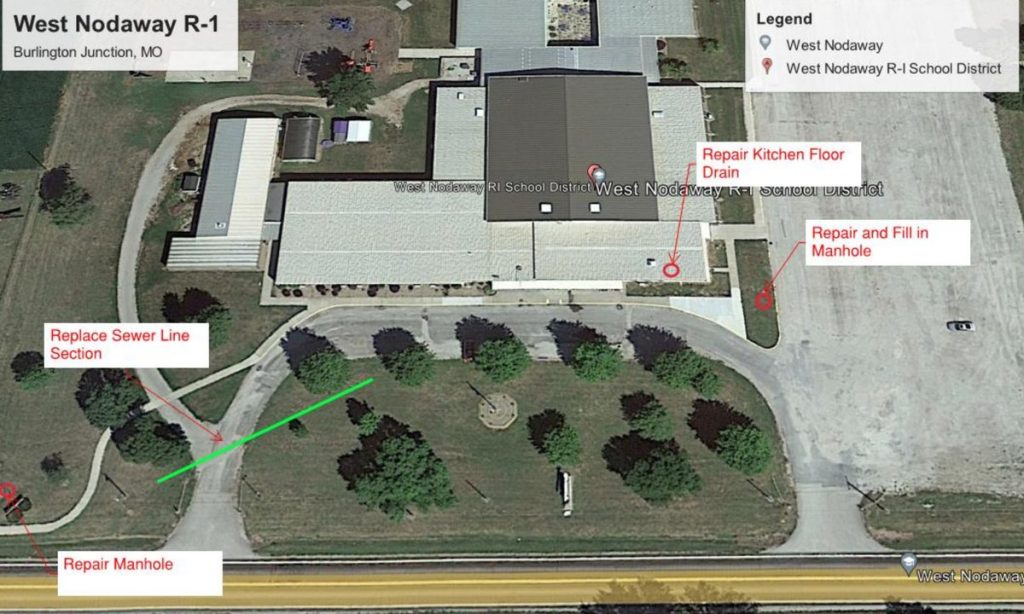
WEST NODAWAY R-I
A map showing where the sewer-related repairs would be performed with funding from Proposition K.I.D.S.
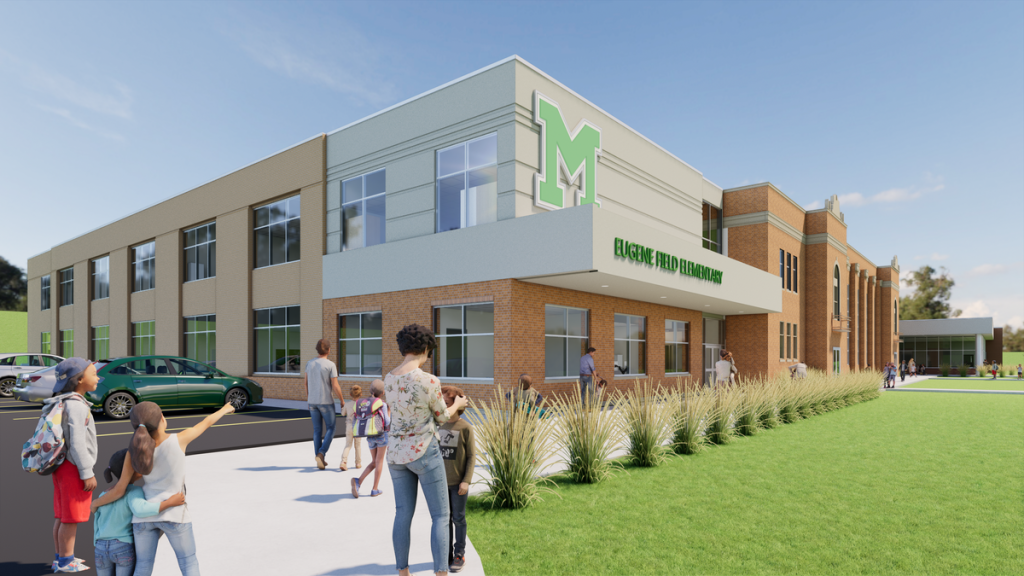
RENDERING SUBMITTED BY MARYVILLE R-II
A rendering of what the exterior of Eugene Field Elementary could look like should the Maryville R-II no-tax-increase bond be approved by voters on April 2.